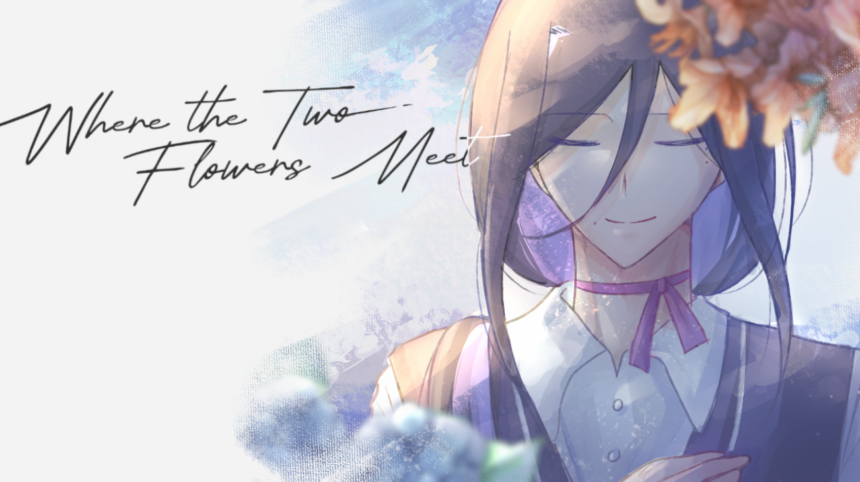
A photograph can preserve a happy moment without preserving any of the reasons it mattered. Where the Two Flowers Meet gave me that same uneasy feeling whenever it returned to Aran and Caleb’s past. Their earlier years can be warm and almost nostalgic, but I already know I’m looking backward from a present where something has gone badly wrong. That contrast is reinforced by the artwork. Sylvan fills the game with more than 38 CGs across ten chapters, and the softer scenes between Aran and Caleb initially make their relationship easy to settle into. I liked how effectively that warmth worked against the psychological-horror elements waiting underneath it. The game doesn’t need every image to look threatening when memories that initially seem comforting can become unsettling simply because I gradually understand more about what surrounds them.
Aran Yun’s present is considerably less comforting. He wakes badly injured in a hospital in 2034 and discovers that eleven years of his life are missing from his memory. His doctor is Caleb Ashton, who makes the situation stranger by claiming that he and Aran are lovers. Aran turns to him for help reconstructing the years he cannot remember, giving the story an immediate problem: nearly everything I learn about their relationship is being filtered through a past Aran himself cannot verify.
That made Caleb particularly interesting to me. I wanted to understand their relationship, but the circumstances made it difficult to accept every affectionate memory at face value. Aran works well as the viewpoint character precisely because his uncertainty becomes mine, while Caleb is given enough presence that he never feels like a mystery object waiting for Aran to uncover him. The story switches between its two main characters and two timelines, allowing their relationship to exist beyond what either one perspective or the damaged present could show me.
The earlier material is where their dynamic landed best for me. Seeing the history between them accumulate gave the darker present something meaningful to threaten, and I became invested in them as people before I understood what the larger mystery was doing. Where the Two Flowers Meet is at its strongest when the psychological horror grows directly out of that attachment. The more I cared about what Aran and Caleb had been to each other, the more uncomfortable it became to question what had happened between then and 2034.
Choices eventually fracture that story considerably. There are ten endings across two main routes, with the major branch arriving in Chapter 5 and dividing the story into Route C and Route S. Earlier decisions can also terminate the story before that split, so reaching another conclusion sometimes means returning further than the central branch and reconsidering choices I initially thought were minor.
I enjoyed that structure because the endings gave me reasons to test different interpretations of what was happening rather than treating one completion as enough. At roughly three to seven hours depending on reading speed, exploring another branch isn’t an enormous commitment either. The game even has an official ending guide, although I preferred seeing how far I could get without relying on it.
My bigger problem came once the mystery began demanding more attention than the relationship. The later explanations became more complicated than I thought the story needed, and some of that complexity worked against the emotional clarity of the earlier chapters. I was most invested when the unanswered questions made me reconsider Aran, Caleb, and their memories. When explaining the machinery behind those questions became the priority, I occasionally felt the characters getting buried underneath the plot built around them.
That didn’t undo what worked earlier. If anything, my frustration came from how strongly the simpler character material had landed. Aran losing eleven years creates an effective mystery on its own; Caleb claiming a relationship Aran cannot remember makes it personal; moving between past and present gives me enough information to become attached while withholding enough to make that attachment uncomfortable. Those pieces didn’t need much embellishment to keep me reading.
The production remains visibly personal as well. Where the Two Flowers Meet was built in TyranoBuilder, with sylvan handling the project and using credited music, sound effects, fonts, and background resources from multiple sources. Rather than making the presentation feel disconnected, the large amount of original character artwork gives the game a consistent emotional identity. The CG gallery was something I appreciated more after finishing routes because returning to earlier images with later context could change what an otherwise straightforward scene meant to me.
The game is also available free on Windows and macOS, with an optional paid gamebook containing artwork, character sprites, unused material, and concept art. It has since received two sequels set after the epilogue, with characters from Where the Two Flowers Meet appearing again. I didn’t need that continuation for this story to matter, though. Aran and Caleb already gave it enough emotional weight on their own.
I won’t unpack what caused Aran’s missing years or what ultimately separates Route C from Route S since the uncertainty surrounding those answers is too central to the experience. What stayed with me instead was the uncomfortable gap between knowing two people shared a history and actually understanding what that history meant. Where the Two Flowers Meet kept returning to memories that looked gentler than the present surrounding them, and its best moments came whenever another piece of context made that warmth harder to trust.
Verdict
Where the Two Flowers Meet worked best for me when its psychological horror remained inseparable from Aran and Caleb themselves. Eleven missing years, two timelines, shifting perspectives, two major routes, and ten endings give the mystery plenty of room to change how I understood their relationship, while more than 38 CGs give its quieter memories a visual warmth worth becoming attached to. The later explanations grew more complicated than I wanted and occasionally pulled attention away from the character-driven story that had hooked me, but they never erased how effectively the earlier chapters made me care about these two people. Its mystery kept me searching for answers; Aran and Caleb were the reason I wanted those answers in the first place.