Grief has a strange way of keeping “what if” alive long after wondering can change anything. Hello Charlotte: Heaven’s Gate feels built around that impulse, taking three familiar people out of the reality that originally defined them and asking whether different circumstances would actually make their lives any easier. The answer is considerably sadder than the quieter presentation initially suggests.
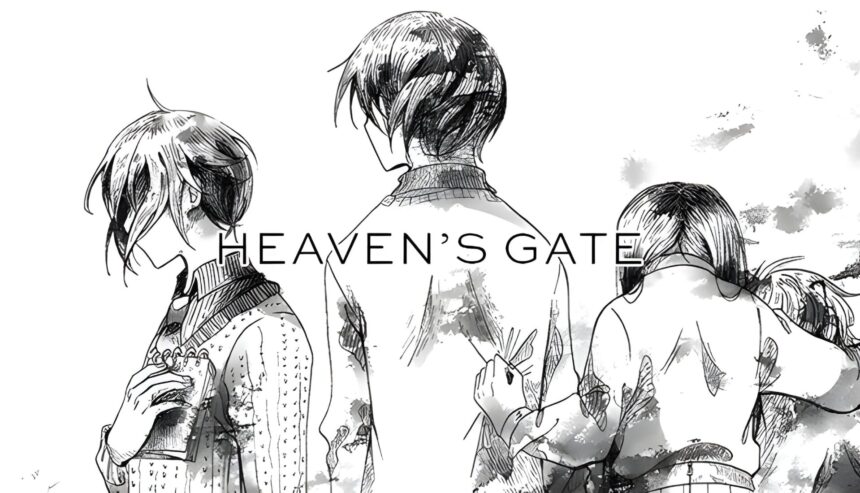
Set in a parallel universe, Heaven’s Gate follows alternate versions of True Realm characters Charles, Anri, and Vincent from the Hello Charlotte series. Rather than reproducing the surreal scale of the main trilogy, etherane turns their story into a short, linear coming-of-age drama following Charles from childhood through high-school graduation and tracing how his relationships with Vincent and Anri change along the way. Playing the main Hello Charlotte games first is explicitly recommended, and that context matters because much of the appeal comes from seeing familiar characters rearranged into a more mundane world without becoming fundamentally different people.
Charles is the right person to narrate that experiment. He is quiet, alienated, deeply insecure, uncomfortable socially, and inclined to treat himself as a burden while focusing more readily on Vincent and Anri’s problems than his own. His OCD is also part of his characterization rather than an incidental label. What interested me was how those traits affect the way I understand everyone else. Charles cares intensely about his friends, but caring about someone doesn’t automatically mean understanding them, and his narration leaves enough distance between those two things for the story to become increasingly uncomfortable.
Vincent benefits most from that distance. His friendship with Charles stretches across years, giving their relationship time to change gradually instead of being defined by one dramatic event. As they grow older, Vincent becomes connected to an online group called Heaven’s Gate, initially associated with material he helped create as a prank before it develops into something much more troubling. The story doesn’t need the elaborate horror machinery of the main trilogy to make that progression disturbing. Watching Charles realize that someone he knows intimately may also contain parts he cannot reach is enough.
That is where the alternate-universe framing became more than a novelty for me. Heaven’s Gate doesn’t simply relocate the trio and replay their personalities in different scenery. It strips away enough of the original series’ surrealism that ordinary pressures become harder to ignore. School, family, social isolation, friendship, identity, and the gradual distance that can develop between people who once seemed inseparable occupy space that a larger supernatural plot might otherwise have consumed.
Anri is especially important because she prevents the story from collapsing entirely into Charles and Vincent’s increasingly strained relationship. She meets Charles during their school years, becomes part of the friendship surrounding the two boys, and has enough friction with Charles to keep their conversations from becoming sentimental. I liked that their closeness could include irritation, misunderstanding, and disagreement. It made the trio feel less like characters assembled around a tragedy and more like young people whose relationships are constantly changing while they are still figuring themselves out.
The quieter format gives those changes unusual weight. Heaven’s Gate is a kinetic novel with no routes to manage or choices capable of redirecting what happens. Etherane lists the average reading time at around 40 minutes, making this dramatically smaller than a full Hello Charlotte installment. That sounds almost too brief for three central characters, but the game isn’t trying to introduce them from nothing. It relies on what I already know and uses that familiarity to skip the kind of groundwork a standalone story would need.
That dependence is also its biggest limitation. Someone starting here would get the events, but not necessarily the significance behind seeing these particular people under these particular circumstances. Heaven’s Gate isn’t interested in stopping every few scenes to explain the True Realm or summarize why Charles, Anri, and Vincent matter elsewhere in the series. I appreciated that confidence as someone approaching it as a companion piece, but it makes this a poor introduction to Hello Charlotte.
The presentation reinforces the smaller scale rather than fighting it. There is no official voice acting, leaving Charles’s narration and the dialogue to establish the emotional rhythm without performances interpreting every line for me. The game is fully illustrated, but compared with the main series, the overall experience feels deliberately restrained: less interested in overwhelming me than in giving these characters enough quiet space to become uncomfortable in subtler ways.
The paid version adds Diary, and this is where the package becomes particularly useful as a companion to the larger series. Unlike the main Heaven’s Gate scenario, which takes place in a parallel universe, Diary concerns the True Realm version of Anri and is compatible with the main continuity. That distinction gives the bonus story a reason to exist beyond simply making a 40-minute visual novel longer. The main scenario asks me to reconsider familiar characters through another reality; Diary can bring that attention back toward the version of Anri connected to the original story.
I also think the brevity prevents the melancholy from becoming exhausting. There isn’t enough time for every aspect of Charles, Vincent, and Anri to receive equal exploration, but Heaven’s Gate isn’t pretending to be another epic installment. Its strength comes from concentration: years pass quickly, relationships shift, and moments that might have been minor inside a much larger game become the entire reason a scene exists.
Most importantly, the parallel universe never gave me the comforting feeling that these characters had simply been granted better lives. Their problems are different in scale and circumstance, but the same difficulty of reaching another person remains. Charles can care about Vincent and still fail to fully understand him. Anri can care about Charles without always knowing how to reach him either. Moving everyone into another reality changes the shape of their lives, not the basic fact that closeness can coexist with enormous distance. That makes Heaven’s Gate a much sadder “what if” than its premise initially sounds like. The interesting question isn’t whether Charles, Anri, and Vincent would have been happier somewhere else. It’s whether putting them somewhere quieter makes it easier to see what was already hurting. For forty minutes, the answer is often yes.
Verdict
Hello Charlotte: Heaven’s Gate earns its place beside the main trilogy by becoming smaller instead of trying to compete with it. Charles’s alienated narration gives the parallel-universe experiment a strong perspective, while his changing relationships with Vincent and Anri turn an otherwise ordinary coming-of-age timeline into something increasingly melancholy. Its roughly 40-minute kinetic structure leaves little room for newcomers and deliberately sacrifices player agency, but that concentration is also why the character work lands. Heaven’s Gate isn’t another grand chapter of Hello Charlotte; it’s a quieter angle on three people the series has already given me reasons to care about, and sometimes that reduced distance makes them considerably harder to look away from.