Dear Devere asks me to become invested in two people it refuses to show me. No character sprites, no portraits appearing beside the dialogue, no carefully staged CG waiting to reveal what either lead looks like. I know Angela and Devere almost entirely through what they choose to put on paper, and before long, imagining the people behind those letters became more interesting than having the game define them for me.
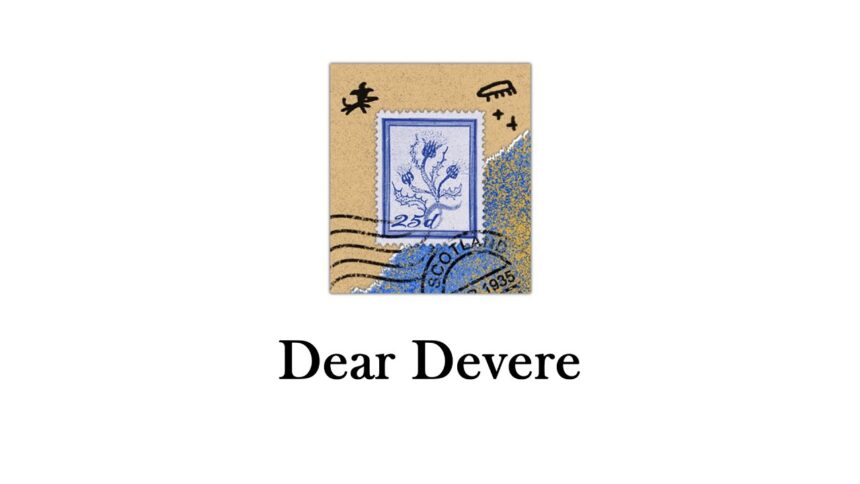
The correspondence itself becomes the presentation. Letters, postcards, maps, and other documents fill the screen, with individually illustrated envelopes giving each exchange a physical identity before I even begin reading it. Jasmine Osler, credited as Katy133 on the original release, handled the writing, artwork, and programming, and that consistency gives the entire project an unusually personal quality. Even without conventional character art, I never felt as though I was looking at placeholder visuals around a written story. The documents are the visual novel.
Chintarmanya Vivian and Mike Young make that unusual approach considerably easier to sustain. Vivian voices Angela while Young plays Devere, and because neither character appears physically on screen, their performances effectively become their expressions. A hesitation or change in delivery can communicate what another visual novel might handle with a sprite change. I liked having voices attached to people whose faces remained entirely mine to imagine.
Paul Robins’ original music works similarly, sitting beneath the correspondence without overwhelming it. There is already something intimate about hearing a private letter read aloud, so a louder score could easily have pushed scenes too aggressively toward whatever emotion I was supposed to feel. Instead, the soundtrack leaves enough space for the writing and performances to establish the mood themselves.
Only then did the circumstances surrounding those letters become stranger. It is 1935, and Angela Bard lives a quiet, solitary life in the Scottish isles. A letter she never expected anyone to answer somehow receives a response from a mysterious man calling himself Devere. More unsettling than the response itself is where it apparently comes from: the forest at the edge of Angela’s town.
Angela initially has every reason to question what is happening. Devere’s replies are strange and esoteric, and the impossibility surrounding their correspondence creates an obvious mystery, but Dear Devere never lets solving it completely swallow the relationship developing alongside it. The letters gradually become less about proving who Devere is and more about understanding the person writing from somewhere Angela cannot explain.
That balance became the story’s strongest quality for me. Every new letter carried two questions at once. I wanted to understand the mechanics behind this impossible correspondence, but I also wanted to know what Angela would be willing to tell Devere next. Watching the formality between them gradually soften gave their relationship a sense of progression without requiring either character to appear in the same room.
The game even reflects that development in something as small as how they address each other. Jasmine Osler has explained that Angela and Devere initially use formal names for one another before those conventions begin falling away as they become closer. I liked that kind of detail because it makes the relationship visible on the page itself. Dear Devere does not have facial expressions available to show increasing intimacy, so changes in language have to do that work instead. There is more happening around their correspondence than romance alone. Scottish folklore influenced parts of the setting and supernatural material, while the fictional town of New Sorne was based partly on the history and geography surrounding Sorn and Glengorm Castle on the Isle of Mull. That grounding helped the stranger elements work for me. The mystery feels connected to a specific place rather than occurring inside an interchangeable historical backdrop.
Choices eventually determine which of multiple endings I reach, but I never felt as though Dear Devere suddenly became a route-management exercise. The central question remained what I believed about the relationship and the increasingly unusual circumstances surrounding it. I will leave those endings untouched, because deciding what to make of Devere is much more interesting without knowing where each interpretation might lead.
Accessibility is unusually well considered for such a small free project. Dear Devere includes an OpenDyslexic font option, self-voicing and descriptive-text settings, and a dedicated text-to-speech mode. A Simplified Chinese translation was later added while retaining the English voice performances. Those features fit particularly well here because reading and listening are not secondary ways of interacting with the game; they essentially are the game.
It also remains free on both Steam and itch.io. Dear Devere began as a NaNoRenO 2020 project before growing through later updates, but its small scale is part of what I liked about it. There is no attempt to inflate a correspondence between two people into something much larger simply because visual novels can run for dozens of hours. It finds a format suited to the story and commits to it.
What stayed with me was how little I ultimately needed to see. I never needed a sprite to tell me when Angela was becoming less guarded or a portrait to make Devere feel increasingly familiar. Their voices, wording, envelopes, and the increasingly personal things they were willing to send each other filled in those spaces. The mystery made me open the next letter; the people writing them made me care what was inside.
Verdict
Dear Devere turns the absence of conventional visual-novel presentation into its defining strength. Illustrated correspondence replaces character sprites, while Chintarmanya Vivian and Mike Young give Angela and Devere enough presence that never seeing their faces becomes part of the intimacy rather than a limitation. The supernatural mystery gives their letters an immediate hook, but I became far more invested in watching the distance between two strangers gradually disappear through the way they wrote to each other. It is small, unusual, and remarkably confident about how little it actually needs to show.