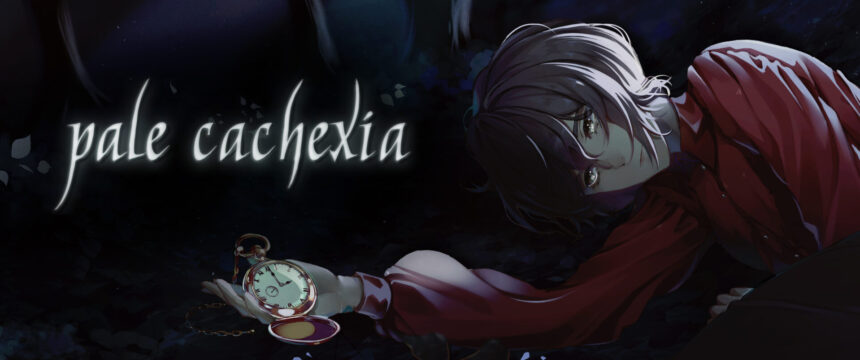
Desperation drives plenty of fairy-tale journeys into dark forests, and Esther has more reason than most to keep walking once common sense says she should turn around. Pale Cachexia gives its heroine a disease that is slowly stealing her life, then dangles the possibility of a cure somewhere beyond civilization. What begins as a familiar search for salvation gradually becomes something much more intimate: a story about what two lonely people can mean to each other when neither has much left to hold onto.
Esther suffers from the Pale Cachexia, a mysterious plague that gradually drains its victims of life. With no known treatment available to her, rumors of a possible cure send her alone into a forgotten forest. Instead of simply finding the apothecary she hoped might save her, Esther discovers a towering manor inhabited by Seina, a girl living there entirely alone. The manor, the nearby graveyard, Esther’s increasingly strange dreams, and Seina herself gradually turn that straightforward search for a cure into a much darker mystery.
What carries the story for me is how quickly that search stops being its only emotional concern. Esther enters the forest because she desperately wants to live, but getting to know Seina gives her another person to care about at precisely the point when her own future is becoming increasingly uncertain. Their friendship develops without needing a large supporting cast or constant changes of scenery to keep it moving, and that concentration gives their quieter conversations more importance than they might have had in a busier visual novel.
Seina benefits especially from that restraint. Pale Cachexia spends enough uninterrupted time with the two girls that I could become comfortable simply watching them talk before the larger mystery demanded my attention again. The warmth between them never completely removes the sadness surrounding Esther’s illness or Seina’s isolation, which is exactly why it works. Their friendship provides relief without pretending either character’s circumstances have suddenly become less painful.
The limited setting reinforces that feeling. Most of the story remains concentrated around the manor, forest, and graveyard, and I gradually stopped seeing the small number of locations as restrictive. Repeatedly returning to the same rooms makes the manor increasingly familiar, while the forest continues to feel like a boundary separating Esther from the ordinary world she left behind. That familiarity becomes useful once the story starts changing what I understand about the place.
Pale Cachexia’s gothic atmosphere is strongest when it relies on suggestion rather than spectacle. NicCo’s character sprites give Esther and Seina enough expression to carry long conversations despite the absence of voice acting, while Malthus Wolf’s backgrounds make the manor imposing without turning every room into obvious horror scenery. NumiRen’s CG artwork provides the larger illustrative moments, and I liked that those images appear selectively rather than constantly competing with the prose for attention.
The soundtrack works in much the same way. Ray Kim, Murcielo, and scarless arms contribute music that shifts between melancholy, unease, and occasional warmth without letting the darker mood disappear entirely. Even some of the gentler moments retain enough sadness underneath them to remind me that Esther’s illness hasn’t stopped progressing simply because she has found companionship.
That mixture of comfort and sorrow is more important than the horror itself. Pale Cachexia keeps circling grief, guilt, loneliness, and the consequences that can follow decisions made with understandable intentions. I found those ideas more affecting than simply wondering what supernatural explanation might be waiting behind the manor’s mysteries. The painful moments work because I can understand why these characters want what they want even when those desires begin pushing them toward consequences they cannot easily undo.
Esther’s illness gives those ideas urgency without becoming her entire personality. She is dying, but the story doesn’t reduce every interaction to reminding me of that fact. Giving her time to become invested in Seina makes the Pale Cachexia more effective as a source of tension because the question gradually becomes larger than whether Esther can save herself. Her shrinking future begins colliding with a relationship that gives that future more value.
Mechanically, Pale Cachexia removes player agency completely. It is a kinetic novel with no dialogue choices, routes, or alternate endings, running approximately 48,000 to 49,000 words and taking around four to five hours to complete. Once Esther enters the forest, I can only follow the path the story has prepared for her.
That structure is both useful and limiting. The writers can control exactly when information is revealed and how one discovery changes the meaning of another without accounting for several competing branches. The mystery benefits from that precision. At the same time, there were moments when I wanted to intervene rather than simply watch Esther continue forward. Anyone who primarily comes to visual novels for route selection and meaningful decision-making should know that Pale Cachexia offers none of it.
The runtime keeps that limitation manageable. Four or five hours gives Esther and Seina enough space to build a believable connection while preventing the manor mystery from accumulating unnecessary subplots. Argent Games had discussed a larger 60,000-to-80,000-word target during development, but the finished script came in considerably shorter, and I think the tighter version suits the story better. Another twenty thousand words wouldn’t automatically have made this relationship or its consequences more meaningful.
There is no full voice acting, but I rarely missed it. The combination of expressive sprites, atmospheric backgrounds, CGs, prose, and music already gives the story enough emotional texture, and silence arguably suits the isolation surrounding the manor. The game also includes sound and music captions, an OpenDyslexic font option, and the ability to disable bright flashes.
Pale Cachexia was produced by Argent Games, a two-person development team, with Dovah credited for writing, design, and programming and Gamma for project management and additional programming. Outside contributors handled much of the artwork and music, but the finished experience feels remarkably cohesive. More importantly, the team never seems interested in disguising a focused project as something larger. The limited cast, contained setting, single storyline, and relatively short runtime all point in the same direction.
Esther enters the forest because she wants to save her own life, but Pale Cachexia gradually makes survival only one part of what she is fighting for. By the time the manor feels familiar and Seina’s company has become something worth protecting, the possibility of losing either carries considerably more weight than the mystery that first drew me forward. That’s where the game’s small scale pays off most: there are very few places to go and very few people to meet, so when one person starts to matter, she matters enormously.
Verdict
Pale Cachexia succeeds by concentrating almost everything it has on Esther and Seina. Its isolated manor, surrounding forest, tiny cast, and completely linear structure create the intimacy needed for their friendship to carry a gothic story built around illness, loneliness, grief, and consequences that become increasingly difficult to escape. NicCo’s expressive sprites, Malthus Wolf’s atmospheric backgrounds, NumiRen’s CG work, and the melancholic soundtrack give that small world a strong identity even without voice acting. I occasionally wanted more agency than its kinetic format allows, but at roughly four to five hours, the game never stretches that limitation beyond what its story can support. It’s a compact, carefully controlled piece of gothic fantasy whose emotional weight comes less from how much it contains than from how much importance it gives to the two people at its center.