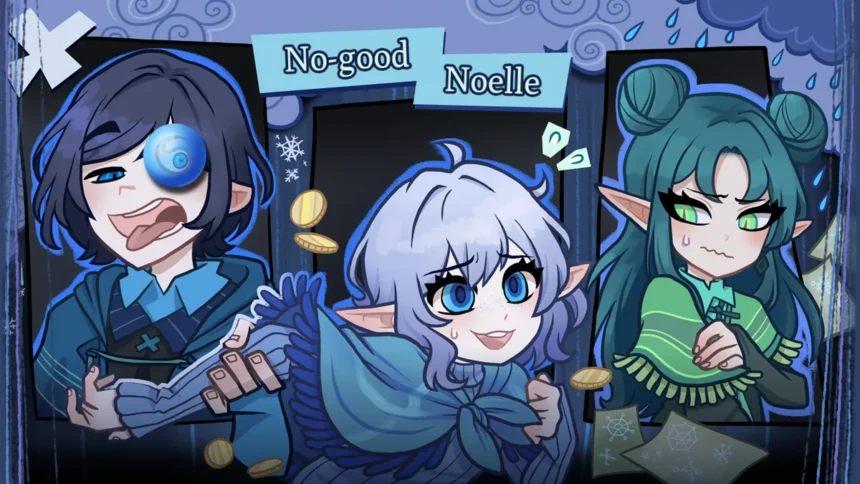
There are moments when losing isn’t the thing that hurts most. Sometimes it’s watching the person standing beside you become proof that your own life could have turned out differently. No-good Noelle opens with that quiet fracture already beginning to spread. Noelle and her closest friend, Ivy, both dream of becoming apprentices to the Snowflake Maker Joutilainen, but only one of them succeeds. Instead of exploding into immediate drama, the disappointment settles between them in small, uncomfortable ways, and I appreciated how the story trusted those changes to speak louder than a dramatic confrontation ever could.
Developed by Nemlei as the creator’s fifth visual novel, No-good Noelle released on itch.io in December 2022 as a name-your-own-price Ren’Py visual novel. At roughly 23,000 words, it can be finished in under two hours while offering two endings shaped by a handful of meaningful choices rather than constant branching. That compact structure worked in the game’s favor because every decision felt like it permanently nudged Noelle’s relationships in a different direction rather than simply steering me toward another route.
Noelle herself is easy to sympathize with because her mistakes never come from cruelty. She wants recognition, stability, and a place where she belongs, but she also spends much of the story avoiding difficult conversations that could have prevented larger problems later. Whether she tells Ivy the truth about the apprenticeship changes more than a single friendship. It reshapes how Ivy’s father responds to both young women, and I liked that the consequences grew naturally out of one seemingly simple decision instead of relying on arbitrary route flags.
Joutilainen became my favorite member of the supporting cast. His criticism is relentless, and he rarely softens his words, yet he also proves to be one of the few adults willing to judge Noelle by her willingness to improve rather than by a single failure. Even after learning she cheated during her first trial, he responds with disappointment instead of contempt. That balance kept him from becoming the predictable harsh mentor I initially expected.
The story changes again once Yule enters the picture. An imp trapped outside his original body, he persuades Noelle to lead him into her village, exploiting the fact that outsiders cannot simply walk in uninvited. From there, his influence steadily pushes her toward choices that become harder and harder to justify. I never felt that Yule existed simply to create conflict. He constantly tests the weaknesses Noelle already carries, making him feel like an extension of the story’s central ideas rather than a separate villain dropped into the plot.
That focus on relationships gives the writing its strongest moments. Noelle and Ivy’s friendship is damaged by jealousy, pride, insecurity, and simple misunderstandings instead of one dramatic betrayal. Watching those smaller wounds accumulate affected me more than any fantasy conflict because I could always understand why each person believed they were right, even when I disagreed with what they were doing.
Nemlei handled the entire production, including the writing, character art, and programming, while the game combines original artwork with licensed music and sound effects from multiple contributors. The expressive portraits do most of the emotional work, allowing subtle changes in posture and expression to communicate feelings that the dialogue often leaves unsaid. The backgrounds remain simple throughout, but they never distracted me because the characters carried nearly every important scene.
The soundtrack supports those quieter conversations better than the larger dramatic moments. Rather than pushing scenes toward melodrama, the music usually stays restrained, letting awkward silences and emotional distance linger. No full voice acting is present, yet I rarely found myself wishing for it because the sprite work already conveyed most of what the dialogue needed.
By the time I reached the ending, I cared much less about who ultimately “won” than about whether Noelle could stop letting one disappointment define every relationship around her. The two endings answer that question differently without undermining the emotional path leading there. More importantly, neither treats friendship as something guaranteed to survive simply because two people once cared about each other. That honesty is what stayed with me after the credits.
Verdict
No-good Noelle tells a surprisingly layered story about envy, regret, and the slow collapse of trust inside a friendship that once felt secure. Its fantasy setting gives the conflict room to grow, but the emotional core never loses sight of the ordinary feelings driving every major decision. The presentation remains modest, yet the strong character writing, meaningful choices, and believable relationships make its short runtime feel more substantial than many visual novels several times its length.