A flowchart can look almost reassuring in a mystery game. Every branch has a place, every scene sits somewhere visible, and eventually all those disconnected boxes should resolve into something comprehensible. SYNESTHESIA gives the player exactly that kind of structure, then spends much of its story making the people inside it feel considerably less orderly. Different heroine routes expose different pieces of the same larger problem, earlier conversations change meaning once new information surfaces, and an unlockable True Route waits beyond the initial endings. I appreciated having a clear record of where I had been because the story itself increasingly made me question what I thought I understood.
That structure suits Ziek, a college-level student at the Huntley Scientific Research Institute in 2029 who would much rather enjoy an uneventful life with his friends than become the center of a conspiracy. Huntley exists because a tiny portion of the new generation, around 0.016 percent, has begun developing unusual mental abilities known as Extrasensory Perceptions. Ziek’s own ability is a rare form of synesthesia that lets him perceive hidden significance through sudden bursts of color attached to objects, places, and other people. The useful part is knowing that something matters. The dangerous part is having no control over when the ability activates and no immediate explanation for what the colors are trying to tell him.
That uncertainty is what gives the central power its weight. If Ziek simply looked at an object and received the answer to a mystery, his ability would amount to an elaborate hint system. Instead, it creates questions faster than it solves them. Something ordinary can suddenly become significant without explaining why, leaving him with the choice between investigating further or trying to preserve the comfortable interpretation he already had. What got under my skin was watching those flashes increasingly point toward his friends and his own life. The mystery hurts because the people involved are not strangers he can examine from a safe distance.
The heroine routes deepen that discomfort by changing which pieces of Huntley’s larger story become visible. Choices branch into multiple character endings before the True Route opens, so completing one path rarely feels like closing the case. It feels more like gaining a viewpoint the other routes did not provide. That makes replaying materially useful. Instead of repeating most of the game simply to reach another romantic conclusion, I was accumulating information that could alter how I read scenes elsewhere.
The flowchart is essential once those paths begin intersecting. Completed sections fill in visually, unlocked scenes can be revisited, and the game makes it easy to understand where a particular decision sent the story in another direction. An accompanying tips and reference system handles the terminology accumulating around Huntley, ESPs, characters, and story-specific concepts. SYNESTHESIA is dense enough that both systems earn their place. A mystery becomes much less satisfying when the challenge is remembering where the interface buried a piece of information instead of interpreting what that information means.
Ziek’s perception also escapes the dialogue box through the game’s investigation sequences. Point-and-click sections and minigame puzzles ask the player to observe scenes, identify details, and interact with information instead of simply waiting for the script to reveal the next clue. Those moments are not complex enough to turn the game into a dedicated puzzle adventure, but I liked their presence because they stop Ziek’s special perception from existing entirely in narration. If the story is going to insist that he notices patterns other people miss, occasionally making me look carefully alongside him gives that idea mechanical substance.
That becomes especially valuable over a game capable of stretching well beyond a dozen hours depending on reading speed and how thoroughly the routes are completed. SYNESTHESIA has a lot of text, and its science-fiction terminology can become heavy when the central mystery is expanding quickly. Investigation sequences, branching decisions, route management, and smaller puzzles keep the pacing from relying on dialogue alone. The game remains a visual novel first, but it understands that a mystery benefits from giving the player something to do with all the information being accumulated.
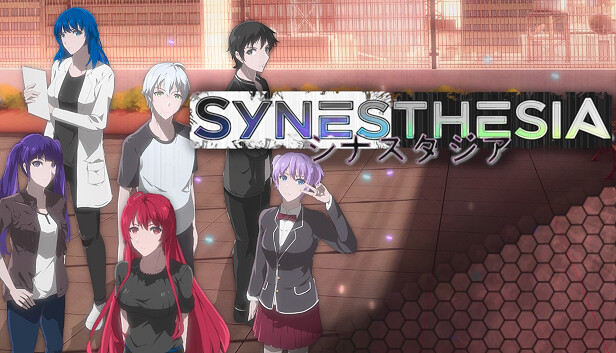
The Huntley Institute itself is presented through a clean anime-inspired visual style deliberately reminiscent of visual novels from the 2000s and early 2010s. That influence works well for a story combining school life, speculative psychology, romance, and conspiracy because it gives the game a familiar genre language before stranger details begin intruding. Character portraits and CGs remain readable and expressive without pushing the near-future setting toward elaborate science-fiction excess. Huntley looks advanced enough to support research into unusual mental abilities while remaining recognizable as a place where students could plausibly build ordinary friendships.
Caleb Coles’s original soundtrack supports that balance with more than twenty pieces covering the quieter institute scenes and the darker mystery material. The music does not make Huntley sound sinister from the first minute, which matters because Ziek’s desire to preserve his existing life needs to make sense. There has to be something comfortable to lose before the conspiracy can become threatening. As the investigation deepens, the score has room to become more uneasy because it did not begin at maximum tension.
Voice acting is more complicated. Ziek remains unvoiced while the other major characters receive spoken dialogue through a mixture of human performances and speech synthesis. The ambition is obvious, especially for an independent English-language visual novel with this much material, but the difference between the two approaches can sometimes be noticeable. Synthesized delivery does not always carry emotion as naturally as the human performances surrounding it, which can make individual exchanges feel inconsistent. At the same time, hearing most of the cast gives Huntley more personality than an entirely silent presentation would, and leaving Ziek unvoiced keeps his internal perspective clearly separate from everyone he is observing.
Dedicated opening and ending sequences add another layer of polish, but what impressed me more was how many of the production choices support navigation rather than spectacle. The flowchart, reference material, route tracking, puzzles, and interface conveniences all acknowledge that SYNESTHESIA is asking the player to manage a substantial mystery. The game does not merely provide a lot of branches and hope I remember them. It gives me tools for understanding how the structure fits together.
That matters once the heroine endings begin feeding into the larger route progression. A common weakness of visual novels with an unlockable True Ending is that earlier routes can start feeling like prerequisites rather than worthwhile conclusions. SYNESTHESIA largely avoids that by making those paths sources of distinct information and relationships. What Ziek learns in one route changes what the player can understand elsewhere, even when that route does not contain the final explanation of Huntley’s mysteries. The True Route therefore feels more like accumulated knowledge finally converging than the game informing me that every earlier ending was wrong.
Spire Games originally released SYNESTHESIA on Steam in June 2023 for Windows, macOS, and Linux. Ratalaika Games later handled the console editions, bringing the visual novel to PlayStation, Xbox, and Nintendo Switch in May 2025, with the Switch version arriving on May 16. The console release kept the systems that make the game distinctive rather than simplifying it into a straight read-through, including its branching progression, flowchart, puzzles, and extensive voice implementation. That preservation is important because the interface is part of how the mystery remains manageable.
The roughest element remains the unevenness created by mixing synthesized and human voices, and the amount of specialized terminology means the opening requires attention before the larger plot begins paying it back. Neither issue changed what I found most effective. SYNESTHESIA understands that a power based on recognizing significance should become frightening once the protagonist realizes significance is not the same thing as good news. Ziek cannot decide that a clue is emotionally inconvenient and make the colors disappear.
By the later routes, that becomes the real cost of his ability. He wants an ordinary life badly enough that discovering the truth does not automatically feel heroic. Every answer has the potential to damage a friendship, change what he believes about Huntley, or force him to reconsider something about himself. I kept moving through the branches because I wanted those answers, while understanding more and more clearly why Ziek might not. That tension between player curiosity and protagonist reluctance is where the mystery finds its strongest emotional hook.
Verdict
SYNESTHESIA makes its branching structure part of the mystery rather than treating alternate routes as separate romantic detours. The flowchart and reference systems keep its many paths approachable, while the heroine endings gradually expose enough of Huntley’s secrets to make the unlockable True Route feel like a culmination of accumulated knowledge. Ziek’s synesthesia is the idea holding all of that together. Seeing hidden significance sounds useful until those colors begin appearing around the people and memories he would rather leave unquestioned. Point-and-click investigations and observational puzzles give that perception a mechanical role, Caleb Coles’s soundtrack gives Huntley an effective near-future atmosphere, and the extensive voice implementation is ambitious even when the blend of human performances and speech synthesis produces uneven results. What stayed with me was the gap between wanting to know the truth as a player and increasingly understanding why Ziek might prefer not to find it.