The Morning Star understands that the worst part of meeting a stranger at midnight is not knowing enough to decide whether being polite is foolish. Alec reaches a bus stop on a freezing winter night with no memory of how he ended up in the nearby field or what happened earlier. Another traveler is already waiting. Nothing immediately forces Alec to speak to him, and that small freedom is what gives the encounter its tension. Ignoring the Stranger feels sensible. Talking to him feels almost inevitable.
The game stays remarkably disciplined about that setup. Alec is reserved, dislikes small talk, and would rather keep to himself while waiting for a way out. The Stranger, meanwhile, carries a familiarity Alec cannot place. He does not arrive with an obvious threat attached to him. There is simply something about his presence that makes coincidence harder to accept the longer the conversation lasts. That ambiguity mattered more to me than any overt scare could have. I kept wondering whether trusting him was a mistake, but Alec’s missing memory makes distrust difficult too. He does not know enough about his own night to confidently decide what another person represents. The Stranger may be withholding something, but Alec is effectively withholding information from himself at the same time.
Choices determine how much of that distance closes. The game runs to roughly 10,000 words and reaches three endings, each shaped by how Alec handles the encounter and what he manages to understand before the night is over. That compact structure suits the story because there is no room for the bus stop to become ordinary. Conversations remain loaded with the possibility that one answer could completely change what Alec thinks is happening.
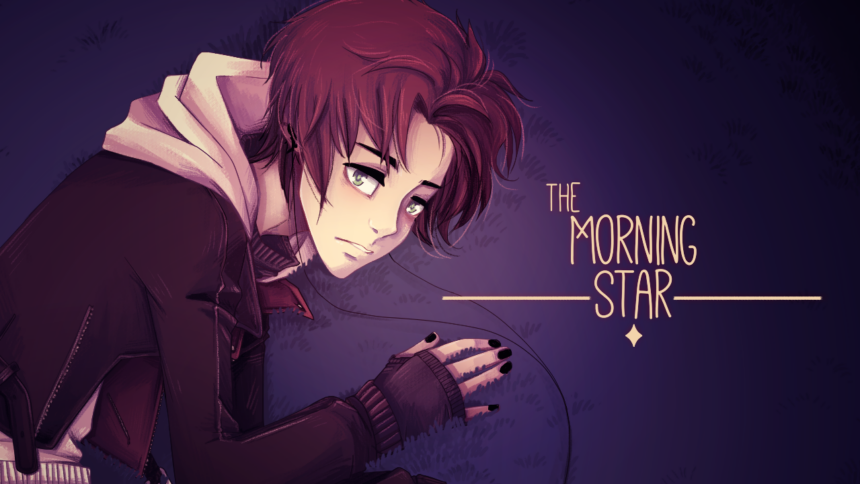
The visuals strengthen that feeling without overcomplicating it. Ronove’s character art has a moody, doll-like quality, with blinking, shifting expressions, and small movements keeping the two figures from feeling frozen against the night. Eleven unlockable illustrations punctuate the story, but the quieter sprite work does just as much to sell the unease. The limited setting becomes an advantage because I started paying closer attention to small changes rather than waiting for some huge location shift. The music works the same way. It stays restrained enough that the conversation remains the focus, but the background never feels empty. In a story this short, repetition could have become obvious quickly. Instead, the atmosphere holds together without the soundtrack trying to manufacture tension that the writing has already earned.
Ronove wrote, drew, and coded the game in Ren’Py, with BáiYù contributing coding help and the Android port. The Morning Star originally released in February 2021 for Windows, macOS, and Linux, with Android support following days later. It remains free with an optional donation, which fits a debut this small and self-contained.
The simplicity is ultimately the point. There is no large cast to distract from Alec’s uncertainty, no complicated mythology demanding explanation, and no mechanical system competing with the conversation. The entire game keeps circling one uncomfortable decision: when you know almost nothing about your own situation, how much can you afford to trust the only other person standing there? That question stayed with me after the ending more than the answer did. The Stranger’s familiarity becomes increasingly difficult to dismiss, but The Morning Star never needs to turn him into a conventional horror figure to make the encounter unsettling. The tension comes from Alec having to decide whether connection is safer than isolation before he has enough information to know.
Verdict
The Morning Star makes one bus stop and one stranger enough to sustain an entire mystery. Its short runtime, restrained art, and three endings keep the focus exactly where it belongs: on Alec deciding whether familiarity is a reason to trust someone or a reason to be afraid.