Burnout can turn self-sufficiency into something strangely destructive. The more exhausted someone becomes, the easier it is to interpret accepting help as proof that they have failed to manage their own life properly. Solitude can sound like the cleanest solution because nobody else is there to witness the struggle. The problem is that removing every interruption does not necessarily remove the thing making it impossible to move forward. Sometimes it only leaves more room to hear it.
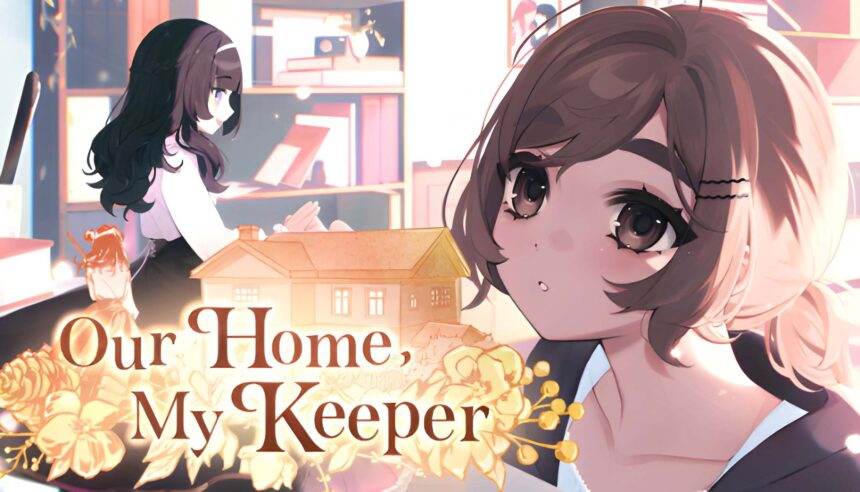
That tension sits between Paige Crowley and Faye long before their relationship becomes romantic. Paige has already found success writing children’s books, but the expectation that she follow them with a fantasy epic has become tangled up with writer’s block and exhaustion. Leaving London for an old house in the English countryside is supposed to give her the quiet needed to work again, except the house already belongs emotionally to someone else. Faye, a brownie who has watched over the property for centuries, has no intention of treating Paige like an intruder, but her mere presence complicates the fantasy that a new address can solve everything. Paige has gone somewhere remote to handle her problems alone and immediately meets someone whose entire existence revolves around caring for a home and the people inside it.
Our Home, My Keeper is strongest when it lets that contrast carry the story without rushing either woman toward an obvious romantic role. Paige’s exhaustion is recognizably human, tied to deadlines, creative pressure, and the fear that an ability she once relied on may have disappeared. Faye operates on an entirely different timescale, with centuries attached to the house and a relationship to it that Paige cannot replicate simply by buying the property. Their closeness develops from learning how to occupy the same space before it develops into anything more intimate. That made the relationship feel less like two characters being paired because the genre requires it and more like two incompatible ideas about home gradually becoming compatible. What got to me was watching Paige learn to lean on another person after exhausting herself trying to manage everything alone, and the story gives that adjustment enough time that reliance never feels like an instant cure.
The setting helps because the house is not simply an attractive countryside backdrop. It is where Paige expects to become productive again, where Faye has spent an enormous portion of her existence, and where both women have to negotiate what belonging actually means. The fantasy material grows outward from that domestic space rather than overwhelming it. Faye being a brownie matters, but the game is less interested in treating her as a catalogue of magical abilities than in what centuries of guardianship have done to the way she understands companionship and responsibility. Paige, meanwhile, has to confront the awkward fact that moving somewhere new does not make her the only person with a claim to its history. The house gradually becomes the point where creative recovery, fairy-tale magic, and intimacy overlap.
Madi, working as weeniedesu, gives that domestic fantasy a visual identity clearly shaped around faerie imagery and ball-jointed dolls. Faye’s design especially benefits from that influence, since her otherworldliness comes through without making her look disconnected from the quiet interiors and countryside surrounding her. The game uses a substantial amount of custom illustration rather than asking a small handful of sprites to carry every major beat, which gives important scenes more visual variation than the intimate scale might suggest. The softness of the character art also suits a story where much of the tension comes from emotional hesitation instead of external danger. There are darker elements beneath the fairy-tale surface, but the presentation never needs to abandon its gentler visual language to make those moments register.
Singto Conley’s score gives the same setting more range than its peaceful premise initially suggests. The official soundtrack runs to 36 tracks and moves through piano pieces, ambient material, orchestral textures, music-box variations, and more electronic sounds, giving the house different emotional colours as Paige’s relationship with it changes. Faye and Paige receive their own musical identities, while recurring pieces return in altered forms as the story develops. The closing song, “My Keeper,” was created with Moon Jelly, who provided its lyrics and vocals, giving the ending a piece written specifically for the relationship rather than simply letting the background score play over the credits. There is no full voice acting, so the writing, character art, music, and sound design carry the emotional timing themselves. For a story this focused on quiet conversation and the gradual lowering of emotional defenses, that relatively uncluttered presentation fits.
The writing is where the project most clearly reflects the collaboration behind it. ebi-hime wrote the scenario, while Studio Élan co-developed the finished visual novel and published it on April 30, 2026. The story runs beyond 75,000 words and is presented as a linear experience rather than a route-driven romance, which keeps the attention almost entirely on how Paige and Faye change around one another. That choice suits the material because neither woman needs to compete with alternate love interests or branching outcomes for emotional space. Paige’s burnout, Faye’s attachment to the house, and the history surrounding both of them can accumulate without every conversation doubling as a route-selection test. Studio Élan’s catalogue already leans heavily toward stories about women, romance, fantasy, and magic, while ebi-hime has spent years writing yuri visual novels such as The Fairy’s Song, Strawberry Vinegar, Rituals in the Dark, and Salome’s Kiss, so the collaboration feels naturally aligned rather than assembled around a one-off genre experiment.
That experience also keeps the story from treating creative burnout as a problem solved by romance alone. Faye can support Paige, but she cannot simply write the book for her or remove every insecurity attached to it. What changes is Paige’s willingness to stop treating every difficulty as something she must privately overpower. The quieter scenes mattered most to me because the relationship grows through that shift in behaviour rather than through one dramatic declaration that suddenly reorganizes her life. Faye’s patience could easily have turned her into an idealized caretaker who exists entirely for Paige’s benefit, but her long relationship with the house and her own perspective keep the bond from feeling completely one-sided. The romance works because accepting care gradually becomes reciprocal rather than remaining a service one character provides to another.
The game’s size supports that focus. At roughly four to eight hours depending on reading speed, it has enough room for Paige’s exhaustion and Faye’s presence to stop feeling like introductory traits without stretching their central conflict across an unnecessarily long route. The linear structure also means there is little pressure to repeat setup material for multiple outcomes. Our Home, My Keeper knows the relationship it wants to follow and gives that relationship nearly all of its narrative space. That confidence matters in a genre where additional choices and endings can sometimes be added simply because visual novels are expected to have them. Here, the absence of branching makes the experience feel more like reading a carefully paced fairy tale than solving for the correct romance.
The finished release extends beyond the main visual novel without making those extras necessary to complete the story. Steam offers a Deluxe Edition combining the base game with the official soundtrack and a 25-plus-page artbook containing artwork and developer commentary. Those additions make sense for a project where the visual development and original music are substantial parts of its identity, but the relationship between Paige and Faye does not depend on owning any of them. The main story already feels complete on its own. By the end, what stayed with me was not simply that Paige had found companionship in the countryside, but that she had stopped treating needing another person as evidence that her attempt at independence had failed.
Verdict
Our Home, My Keeper works because it understands that creative burnout and loneliness are related without pretending they are the same problem. Paige moves to the countryside expecting isolation to give her back control, only to find Faye already embedded in the home she intended to make entirely her own. Their differences in age, experience, and relationship to the house give the romance enough friction to keep its warmth from feeling automatic, while weeniedesu’s faerie-inspired character art and Singto Conley’s expansive score give the domestic setting more texture than its small scale suggests. The linear structure keeps every part of the story pointed toward the same relationship, and the absence of competing routes gives Paige’s gradual willingness to rely on Faye room to develop naturally. What stayed with me was how quietly that dependence changes meaning, from something Paige would rather avoid into part of what finally allows the house to feel like a home.