Venus, Jupiter, and Neptune are spending their final week at Summer Scouts, a religious camp for teenagers who have already been marked as difficult, disappointing, or otherwise wrong. Before they can go home, they are sent to spend twelve hours in an isolated cabin and wait for the devil. In their world, that is not campfire superstition. The devil is real, and the adults sending them into the woods know it.
What made the setup work for me was how little the game needs the devil at first. The uncomfortable part is already there whenever I have to choose which two teenagers spend time together. We Know the Devil has no single protagonist to protect from exclusion. Instead, the story keeps forming temporary pairs out of three people who all badly want connection while being terrible at asking for it.
Every pairing creates its own atmosphere. Neptune is the sharpest of the three, quick to turn discomfort outward before somebody else can use it against her. Jupiter approaches things with a tougher, more direct energy, the kind that can look uncomplicated until the pressure underneath starts showing. Venus is quieter and much more willing to disappear into the space other people leave available. None of them feels like the obvious emotional center because each becomes easier to understand depending on who is standing beside them.
That is why choosing two never felt like a simple popularity decision. When Jupiter and Neptune spend time together, Venus is not merely absent from the scene. Her absence becomes part of how I read the conversation. The same thing happens when the other pairings form. Whoever gets left behind becomes impossible to forget precisely because the game refuses to give me a fourth person who could keep them company.
The constant exclusion was what got to me more than the horror itself. I could enjoy a scene between two characters and still feel guilty about the person who had been pushed outside it. We Know the Devil makes intimacy feel slightly cruel without suggesting that wanting closeness is itself wrong. The problem is the structure surrounding these three, where belonging always seems to require somebody else being designated as the problem.
Summer Scouts has already taught them to think that way. The camp is religious, authoritarian, and built around the assumption that certain children require correction. Venus, Jupiter, and Neptune are not treated like promising young heroes preparing to fight evil. They occupy the lower end of a system that has already decided they are less deserving of support.
The stranger pieces of the world sharpen that idea. Radios can carry God’s voice. Crystals and specialized technology sit beside religious ritual. Other Scouts can receive transformation sequences and better equipment for confronting the devil, while these three talk about those privileges as things reserved for kids who have proven themselves worthy enough to receive them. The magical-girl language is recognizable, but the fantasy of transformation has been turned into another institutional reward.
I liked how casually those details appear. Nobody stops to explain the complete cosmology because Venus, Jupiter, and Neptune already live inside it. A radio capable of reaching God can be treated with the same irritation as bad camp food because, to them, both are simply parts of a miserable week. That restraint makes the world feel stranger than a long explanation would have.
It also makes the religious imagery harder to separate from the social pressure. The devil matters, but so does the possibility that the people claiming to protect these teenagers have constructed a system where being different is itself evidence of corruption. The three are constantly being measured against an idea of what a good Scout should be, and none of them can quite perform that goodness convincingly enough.
Neptune responds by making herself difficult before anyone else can decide she is weak. Jupiter tries harder to operate within the rules even when those rules give her little reason to trust them. Venus turns inward, absorbing the feeling that if something is wrong in the group, the safest explanation may be that the problem is him. Their personalities therefore work as more than contrasting archetypes. They are different survival strategies.
Watching those strategies collide gave the short runtime much of its tension. A remark that would be harmless between two other characters can land differently here because everyone is already watching for proof that they are unwanted. Affection, teasing, irritation, and jealousy sit close enough together that I was frequently less interested in what someone literally said than in who was present when they said it.
That is where the choice structure becomes more effective than a larger branching system would have been. We Know the Devil does not ask me to decide whether Venus should be brave, whether Jupiter should confess something, or whether Neptune should become kinder. My control is more limited and more uncomfortable. I decide who receives time together.
The endings grow out of that accumulation. Three conclusions correspond to the possible pairings, while another ending waits behind a different pattern of attention. I will not explain what any of them do with the devil or with the person left outside. The important part is that the game remembers the social pattern I created long before it asks what that pattern means.
Knowing that somebody must repeatedly be excluded also changed how I approached later choices. Once I became attached to all three, there was no clean answer left. Supporting one relationship meant weakening another. Trying to protect one character meant accepting that someone else would continue spending time alone. The system turns an ordinary visual-novel instinct, choosing the scenes I most want to see, into something I became increasingly conscious of doing to another person.
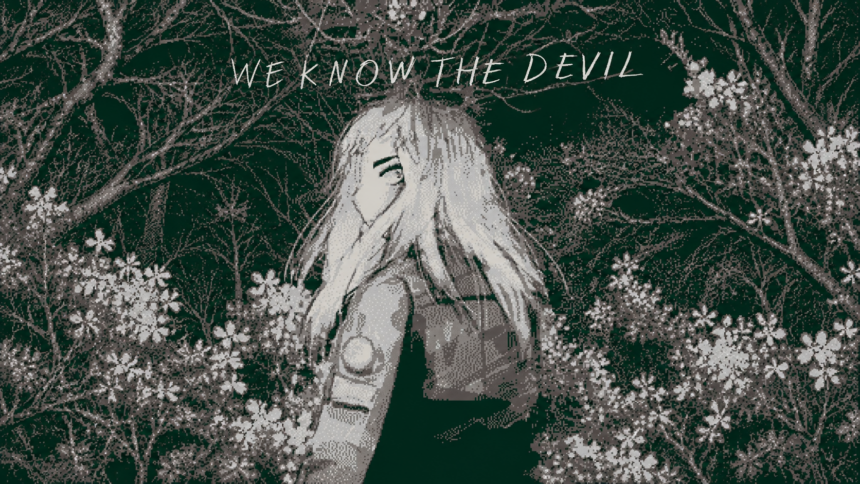
Mia Schwartz’s artwork makes that discomfort feel even more intimate. The characters are drawn cleanly and expressively against backgrounds built from washed-out, overexposed photographs taken on disposable cameras. That mixture gives Summer Scouts the texture of a half-remembered place rather than a polished fictional environment. Cabins and woods feel like somewhere I might have seen in an old box of photographs, which makes everything supernatural intruding on them feel slightly wrong.
The photography also gives the camp a specifically adolescent ugliness. Nothing looks romanticized into an idyllic summer retreat. The blown-out light, rough texture, and ordinary locations suit three teenagers who are counting the days until they can leave. Even before the horror develops, the place already looks like somewhere memories would fade badly.
Character art and photographic backgrounds should clash more than they do. Instead, the contrast reinforces how disconnected Venus, Jupiter, and Neptune feel from their surroundings. They look almost too clear against a world that has been bleached and blurred around them, three people desperately aware of one another inside an institution that seems barely interested in seeing them correctly.
Alec Lambert’s soundtrack pushes the atmosphere in another direction, leaning into synth-heavy horror that deliberately recalls the 1980s even while the photography gives the camp a nineties texture. The mismatch works because We Know the Devil is already mixing cultural memories together. Religious summer camp, magical girls, VHS-era adolescence, analogue radios, and horror-film synths all sit beside each other without needing to belong to one exact historical moment.
The music becomes especially effective whenever the supernatural pressure starts invading conversations that had previously felt painfully ordinary. A disagreement between teenagers does not suddenly stop mattering because the devil is near. Instead, the horror score makes emotional problems that were already there feel dangerous enough to manifest.
There is no voice acting, which suits how closely I ended up reading the dialogue. The writing depends heavily on pauses, interruptions, repeated phrases, and the uncomfortable distance between what a teenager says and what they are actually trying to ask for. Keeping those exchanges entirely in text left me room to sit with that uncertainty rather than having a performance settle every emotional inflection for me.
Aevee Bee wrote the game, with Mia Schwartz handling illustration and creative direction, Jo Fu producing, Conrad Kreyling serving as technical lead, and Alec Lambert composing the score. Date Nighto originally released We Know the Devil on September 12, 2015, before its Steam release followed on February 15, 2016. The production is small, but the narrow scale fits a story that only needs three teenagers, one cabin, and one terrible social equation.
The game later received a separately published art book and a short prequel demo. Aevee Bee, Mia Schwartz, and Alec Lambert would also work together again on Heaven Will Be Mine, a spiritual follow-up that leaves Summer Scouts behind for an entirely different cast and setting while continuing their interest in queer characters struggling against systems that have already decided what kinds of people they are allowed to become.
None of that later work changes how contained We Know the Devil feels. It does not need a large route map or dozens of characters to make its choices uncomfortable. Its central mechanic is barely more complicated than repeatedly choosing two names from a group of three, yet every repetition makes the social consequences harder to ignore.
That simplicity is why the devil never became the part I feared most. The supernatural threat can be named. The quieter cruelty of watching two people become closer while a third learns to expect exclusion is harder to isolate because nothing about it looks dramatic from the outside. It happens at camp tables, during chores, in cabins, and in all the ordinary spaces where teenagers learn what everyone else thinks they deserve.
Verdict
We Know the Devil turns the smallest possible relationship choice into something cruel enough to sustain an entire horror story. Venus, Jupiter, and Neptune each cope differently with being treated as wrong, and every decision to bring two of them together makes the absence of the third impossible to ignore. The disposable-camera backgrounds and Alec Lambert’s synth-heavy score give Summer Scouts a distinctive unease, while the magical-girl and religious imagery turn transformation itself into something these teenagers have been told they must earn. What stayed with me was not any single appearance of the devil. It was the guilt attached to every moment of closeness, knowing that somebody else was always being taught what it felt like to be left outside.