The first playthrough feels like a story about someone trying to finally write something that belongs to them. The second makes that assumption much harder to trust. Titan Arum starts with a protagonist who has spent years ghostwriting other people’s work, then quietly turns authorship itself into part of the horror. A familiar house, a book picked up almost casually, and three men who seem to belong to very different parts of the protagonist’s life gradually stop feeling like separate ingredients. The unnerving part is realizing that the game is paying attention to the player too, and that replaying may not mean starting over as cleanly as I expected.
The protagonist has spent years traveling for ghostwriting jobs before finally getting the chance to focus on their own work. Plans change, and they end up alone in a recently purchased family home while everyone else is away on vacation. It sounds almost ideal for a writer who needs uninterrupted time, especially after years spent putting words into other people’s mouths. Instead, the isolation leaves too much room for the house, the book they find, and the people drifting back into their life to start feeling connected in ways the protagonist does not immediately understand.
That setup suits the unreliable-narrator theme Titan Arum was built around. The game was created in ten days for the 2023 Velox Fabula jam, where that theme shaped the entire structure. Rather than simply making the protagonist lie to the player, the story keeps destabilizing what counts as reliable information in the first place. Memories, details in the house, the protagonist’s own interpretation of events, and later playthroughs all become difficult to separate from whatever force is influencing the story.
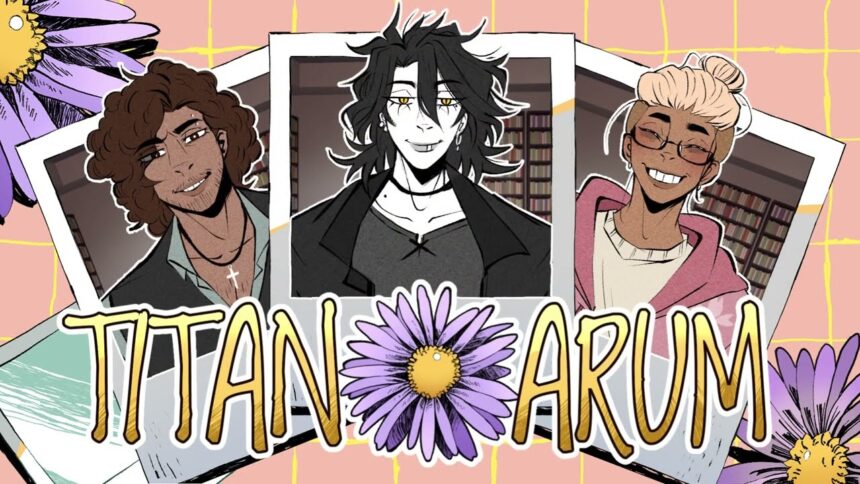
Theo initially feels like the safest point of contact because he belongs to the protagonist’s past. He is presented as a friend, someone familiar enough that reconnecting after the move carries emotional history rather than immediate mystery. That familiarity gives his route a grounded quality at first, which makes the darker material later in the path hit harder. His story can turn bloody, but the more effective part is how long the route lets normal affection and unease occupy the same space before forcing them apart.
Oscar comes from another recognizable part of the protagonist’s life as a former coworker. His dynamic is different from Theo’s because there is less of that old emotional intimacy and more of the shorthand that develops between people who have already spent enough time working around one another. He feels grounded in a way that makes the stranger elements surrounding the house easier to measure against something ordinary. Whenever the horror starts pushing reality too far, Oscar’s presence gives the story another version of what a normal life might look like.
Aster never offers that comfort. He is introduced as the stranger of the three, and the game makes his presence feel wrong before it fully explains why. There is attraction there, but it sits beside something that reads as eldritch rather than merely mysterious. Even when he is charming, the relationship never lets me forget that he understands things the protagonist does not. The imbalance is the point. Theo and Oscar can feel like people the protagonist might build an ordinary future with, while Aster makes ordinary itself feel negotiable.
That contrast becomes much more interesting once replaying enters the picture. Titan Arum has five endings across its three love interests, but Aster is not simply another option waiting beside Theo and Oscar from the beginning. Repetition matters. The game changes after earlier routes have been seen, and Aster’s path depends on engaging with the story as something that remembers progress rather than treating every restart as a completely separate timeline.
That was the part that genuinely unsettled me. I reused the protagonist’s name across playthroughs expecting the usual visual-novel reset, only for Aster to behave as though he recognized someone who had already been there before. The exact name I entered stopped feeling like a neutral customization choice once the game started treating returning as part of the fiction. A character acknowledging previous attempts is already effective fourth-wall horror. Having that awareness attached to the one person who already feels least bound by ordinary reality makes it much worse.
The protagonist’s name therefore becomes more interesting than a standard rename field. Titan Arum explicitly supports a renameable, gender-neutral protagonist, but the system eventually participates in the story instead of remaining a purely cosmetic feature. The player normally controls a name because the game grants that authority. Aster’s recognition weakens that authority, suggesting that whatever identity I typed into the box is not enough to convince him that this is a new person or a new beginning.
That replay awareness also fits the protagonist’s profession surprisingly well. Ghostwriting is built around producing words under somebody else’s identity, while the protagonist enters the game wanting to tell their own story at last. The horror gradually makes ownership harder to define. They are trying to become the author of something personal while existing inside a narrative whose structure may already know more about them than they know about themselves. The game does not need to state that parallel directly because the mechanics start doing the work.
The fictional book found early in the story pushes the idea further. At first it can look like environmental flavor, the kind of object a writer would naturally notice while settling into a house. It gradually becomes harder to separate the book from the horror surrounding the protagonist. Reading, writing, memory, and narration begin collapsing into the same problem. The protagonist wants control over their own story at exactly the moment the game begins suggesting that stories can also exert control over the people reading them.
This is where Titan Arum’s short runtime helps it. Each route is estimated at roughly thirty to forty-five minutes, and the total script sits at around 27,000 words. There is not enough room for the horror to bury itself under hours of lore before anything strange happens. The story can establish Theo and Oscar as familiar emotional anchors, let Aster intrude on that structure, and then use replaying to make the player question what has actually carried over.
The tradeoff is that some relationships move quickly. A jam made in ten days with three love interests, five endings, and a complete horror framework simply does not have the space of a full-length commercial visual novel. Theo and Oscar sometimes reach emotional territory faster than a longer story might have allowed. Aster benefits from the compressed structure because abruptness suits him, but the more grounded romances occasionally feel as though another scene or two could have deepened the transition from reconnection into intimacy.
The horror pacing has a similar unevenness. Titan Arum can move from genuinely disturbing imagery or sound design into music that feels much calmer and warmer almost immediately. Sometimes that contrast works because the protagonist is trying to return to normal after something impossible. Other times the emotional temperature changes faster than the scene has earned, undercutting some of the dread. The game is strongest when the comfortable material feels contaminated by what just happened rather than completely resetting the mood.
Eric Jeffrey Tan’s music and sound engineering still do a lot to create that unease. The original soundtrack shifts between warmer relationship scenes and more oppressive horror material, while sudden sounds become especially effective because so much of the experience is spent reading in relative quiet. The audio does not need constant intensity to make the darker moments work. In several places, the contrast itself becomes part of what makes the house feel unstable.
There is also limited voice work rather than traditional full dialogue performance. Short vocal sounds help give Theo, Oscar, and Aster more presence without turning the 27,000-word script into a fully voiced production. That approach suits the jam scale. The voices function more like another layer of character texture beside the sound design than the primary way the personalities are communicated.
Minthe Draws handles the sprite and cover artwork, while Aixen provides the CG art and Njike the backgrounds. Those separate contributions still fit together coherently enough that the house never feels assembled from unrelated pieces. The sprites are attractive enough to support the romance without softening the stranger expressions once the horror starts intruding. Three unlockable CGs mark larger character moments, but much of the unease comes from how the existing interface and artwork are manipulated rather than from constantly introducing new illustrations.
Siyokoy’s GUI work becomes particularly important once the game begins destabilizing its own presentation. Menus, effects, text behavior, and interface changes can participate in the horror instead of sitting outside it as neutral controls. That is one of the smarter ways Titan Arum stretches its limited production time. It does not need dozens of monster CGs when making the familiar interface behave incorrectly can create the same feeling that something has crossed a boundary.
Cath directed the project, handled game and narrative design, and wrote Aster and Oscar, while Crescence wrote Theo and also contributed game design, editing, programming, QA, and bonus art. Vivi Contrast contributed editing and writing, Xenubin led programming, and Rottentief handled programming, QA, editing, and additional art. That broad team made the ten-day development schedule possible, and the finished game feels much more cohesive than something assembled under that kind of deadline has any right to.
The jam results reflect how well those pieces came together. Titan Arum placed first overall in Velox Fabula 2023, also taking first in theme use and writing/narrative. That makes sense because the unreliable-narrator requirement is not simply pasted onto the dialogue. It reaches into the protagonist’s profession, the book, the changing routes, the interface, and eventually the player’s expectation that restarting means returning to a neutral state.
The story is also careful about what kind of horror it contains. Its warnings cover mild gore, blood, violence, night terrors or sleep paralysis, descriptions of suffocation, flashing imagery, sudden noises, references to insects, and mention of past animal death. Those elements are used more to create psychological instability than to turn the game into sustained gore. The most memorable threat is still the feeling that the protagonist’s perception, and eventually the player’s own relationship with the game, cannot be treated as completely reliable.
That is why Aster stayed with me more than any individual scare. Theo and Oscar offer recognizable emotional possibilities, which makes them important rather than disposable alternatives, but Aster changes what replaying means. Once a character reacts to returning as though there is history between us, opening the game again stops feeling mechanically innocent. I was no longer just hunting another ending. I was returning to something that behaved as though it had noticed me leave.
Verdict
Titan Arum turns replaying into part of its horror, which gives its short three-route structure far more weight than its size suggests. Theo and Oscar provide grounded emotional contrast, while Aster’s awareness makes the game’s metafiction genuinely unnerving. Some tonal shifts are abrupt, but the unreliable narration, interface tricks, and writing-theme connections make this an unusually confident jam horror romance.