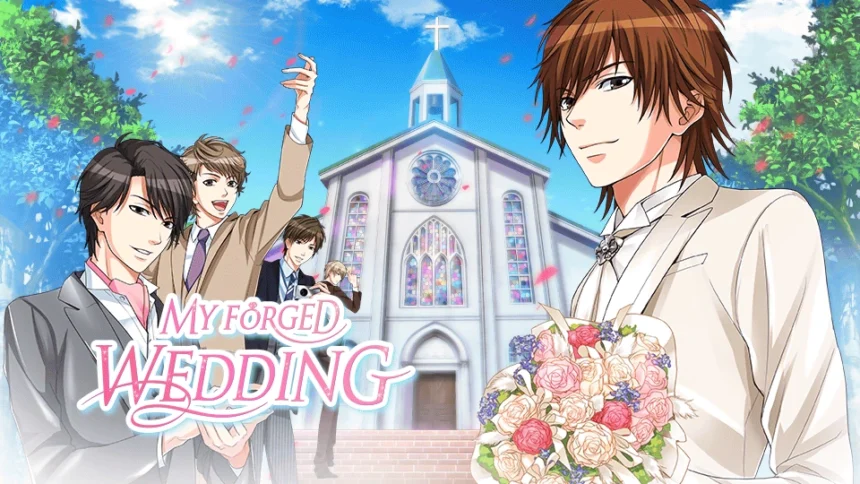
My Forged Wedding builds its entire premise around a job-hunting favor that comes with unusual strings attached. Voltage Inc. developed it, originally releasing the game in Japan on December 12, 2011 under the title Chikai no Kisu wa Totsuzen ni, literally A Sudden Kiss of Oath, with an English version following on March 8, 2012.
After graduating university, the protagonist leaves her hometown in Kyushu for Tokyo, hoping her distant relative Kunihiko Aikawa, owner of both a sports bar and a thriving technology company, can help her land a job. Getting to his address alone becomes its own small introduction to the cast, buying groceries with Yamato’s help along the way, spotting Ren staring into a bridal shop window, and finally getting walked the rest of the way by Yuta. She doesn’t even realize six different men are waiting for her until she actually arrives. Kunihiko’s help comes with strings attached, asking her to pose as one of five friends’ fiancée in exchange, each of them carrying a personal problem only that arrangement can solve.
Yamato Kougami brings a snarky edge as a physics teacher, quick enough with the nickname Pouty that it sticks for the rest of his story. That sits in sharp contrast to Takamasa Saeki’s flirtatious charm as a scriptwriter for television dramas. Ren Shibasaki carries a quieter focus as a pharmaceutical researcher developing a new drug, saying less than either of them but making every word count more because of it. Takao Maruyama grounds the group with a defense attorney’s steadiness and an older brother instinct for looking out for everyone else’s problems before his own. Yuta Kajima rounds things out chasing his own dream as an up-and-coming comedian in a duo called Fukumimi, flirting his way through scenes in nearly every route but his own.
Kunihiko himself eventually got a route of his own too, added well after the original five, and the game leans into the discomfort of that decision rather than pretending it away, since the protagonist spends most of the other five stories calling him her uncle. He turns out more serious and considerate than that framing suggests once his own story actually gets going.
The forged marriage itself only really drives each character’s initial main route, and once that ruse ends, later epilogues, sequels, and side stories keep tracking the relationship long after the pretending stops mattering. By the third sequel, appropriately titled Wedding Bells, the couple ends up actually, legally married, a real payoff for a premise that started as pure deception.
Some of these stories are confirmed by the developer to include scenes of a sexual nature not suitable for all audiences, a detail worth knowing going in rather than something the game hides.
Music runs on a set of numbered piano themes rather than one continuous score, circulated widely enough among fans over the years that sheet music transcriptions of individual tracks like Theme 3 and Theme 4 still turn up on their own. That piano-first sound fits a story this focused on quiet, one-on-one scenes, though no individual composer credit for the soundtrack turned up anywhere I could confirm.
Voltage brought the game to Nintendo Switch through the eShop on September 17, 2020 in North America, a day later than its September 16 European release. It launched at 24.99 US dollars, 19.99 British pounds, and 29.99 Canadian dollars depending on the region. The Switch release carries an ESRB Mature 17+ rating in North America and a 16 rating under Europe’s system, and it has no voice acting anywhere in the experience. It bundles the same main stories originally found in the Love 365, Find Your Story app, the game having already been pulled from mobile storefronts by that point. Yamato, Saeki, Ren, and Takao’s stories run through each of their own Honeymoon Epilogues on that release, while Yuta’s content continues all the way through his own Wedding Bells Epilogue instead.
Everything unfolds in Azabu, a residential Tokyo neighborhood, and the story shares its universe with another Voltage title, My Wedding and 7 Rings, where Yamato and Ren reappear as potential romance options for other players entirely. A separate social spinoff, My Forged Wedding Party, reuses the same five men under a noticeably different setup, opening instead on a protagonist whose real fiancé calls off their engagement in a letter rather than any job-hunting favor at all. Years of side content followed the core five men too, event stories built around holidays and tournaments, an alternate high school timeline, and multi-volume specials like He’s the One. All of it gave long-term fans of the couples reasons to keep coming back well past the games’ initial main routes.
Smaller characters add real texture around the edges too. Yuri Onodera, one of Yamato’s students, spends part of his route pushing the protagonist to break things off with him. That complication carries real weight given Yuri is still in high school and Yamato is her teacher. Saeki’s own father turns out to be a well known author in his own right, giving that route a family dynamic beyond just the central romance. Takao’s story eventually introduces a mischievous younger brother, and a later sequel adds a baby nicknamed Nom-Nom into his corner of the world, small additions that keep his arc from staying static even once the initial ruse resolves.
What actually carried the story for me wasn’t the initial deception so much as watching that pretend arrangement slowly turn into something neither the protagonist nor her chosen man ever expected to actually want. I won’t say how any individual route’s romance plays out, only that the shift from obligation to real affection felt earned rather than rushed.
Verdict
Five very different men share one forged premise in My Forged Wedding, and the game gets real mileage out of following each pairing well past the initial ruse, all the way through actual engagement and marriage for at least one of them. Yamato’s snark, Saeki’s flirtation, Ren’s quiet focus, Takao’s steadiness, and Yuta’s earnest ambition give the cast range a single romantic archetype never could have managed on its own. It shows its age in places as an early Voltage title, but the version of this premise it landed on still holds up as one of the more fully tracked relationships the studio has put out.