The narrator has turned reviewing visual novels into something closer to a daily ritual than a hobby. He chooses another old Japanese game from his collection, installs it on hardware appropriate to its era, disappears into its story, and then writes about the experience for the private blog that has become one of the few outward-facing parts of his life. There is genuine knowledge behind the routine, enough that his digressions about PC-98 games, old computers, and visual novel history can sound like the work of someone preserving a culture most people around him have forgotten. The uncomfortable part is realizing how perfectly that expertise has also helped him construct a life in which he barely needs another human being.
Digital Seclusion understands that obsession becomes more interesting when the object of that obsession is not treated as inherently ridiculous. Its unnamed narrator genuinely loves visual novels, and Zalor’s script knows enough about the medium to make that affection convincing. The room he has effectively converted into a shrine contains period hardware acquired so he can experience older Japanese games on machines closer to what they were designed for, while money inherited after his parents’ deaths allows him to sustain a lifestyle largely detached from ordinary work and social obligations. His isolation therefore does not begin from ignorance or failure to understand what he loves. He has built an extraordinarily informed life around it. The question is what has disappeared while he was doing so.
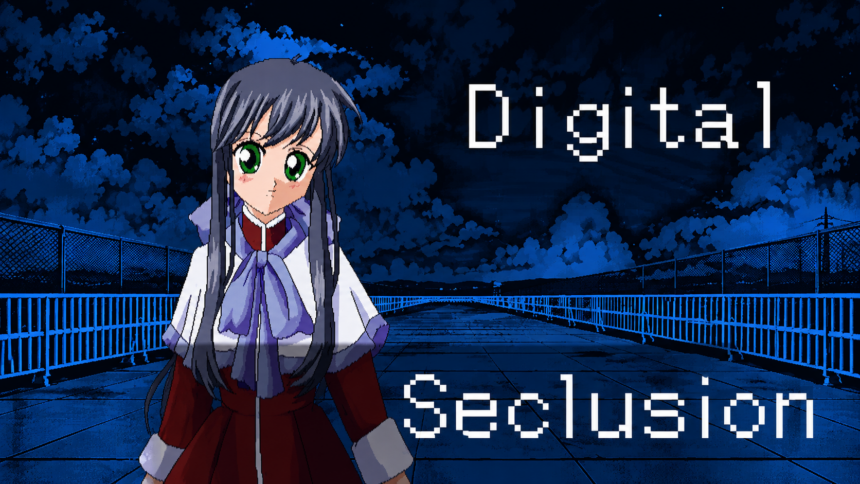
That makes the moment when one of his fictional heroines steps out of a visual novel cover especially effective. A lesser version of the premise could treat her appearance as straightforward wish fulfillment, finally rewarding the lonely enthusiast with the impossible 2D girl he has spent years surrounding himself with. Instead, her arrival disrupts the one thing his secluded life depends upon: predictability. Characters inside games follow scripts. Reviews can be written after he has already processed an experience. Hardware behaves according to rules he understands. A girl who looks like she belongs inside one of those games but can speak to him freely, face to face and without a predetermined line of dialogue, is frightening precisely because she introduces another will into a room designed to contain only his own.
The kinetic structure works well around that idea. There are no branching routes or choices offering me a cleaner version of the narrator’s decisions, and the roughly ninety-minute to two-hour runtime keeps the story focused on watching the situation develop rather than turning the premise into a larger supernatural system. Digital Seclusion is interested in what this impossible visitor means to one particular person, not in explaining an entire universe where visual novel characters can cross into reality. That restraint helps the metafiction because the game can stay focused on the boundary between scripted affection and relationships that make demands no script can control.
The narrator’s voice is what gives that boundary most of its friction. He is knowledgeable, deeply opinionated, and capable of discussing obscure visual novel history with enough specificity that his fictional game reviews can briefly feel like essays from an enthusiast site. At the same time, the more he talks, the harder it becomes to accept his framing of his own life without question. He never needs to announce himself as unreliable. His descriptions of seclusion can sound comfortable or even enviable until enough small details accumulate to suggest that what he calls independence may also be withdrawal, and what he calls dedication may be doing the work of avoidance.
I liked that the story lets those contradictions sit instead of turning him into an easy caricature of the antisocial otaku. His interest in old games is real. His historical commentary has substance. The affection for the medium is obvious enough that Digital Seclusion was explicitly created as a love letter to visual novels, and that affection prevents the story from making the cheap argument that spending too much time with games automatically ruins a life. The darker point is more specific. Something meaningful can still become part of an unhealthy structure when it is used to eliminate every situation that cannot be controlled as easily as fiction.
That makes the fictional visual novels scattered through his commentary more than decorative parody. They provide a vocabulary through which he has learned to interpret emotion, romance, sexuality, and even his own isolation. His habit of reviewing them turns experience into criticism almost immediately, as though explaining why something works is safer than simply admitting what it makes him feel. The metafiction is strongest when the game quietly applies that same scrutiny back onto him. He knows how to analyze fictional characters remarkably well. Understanding the person doing the analysis proves much harder.
EternalSweatyHands’ character art supports that distinction by making the fictional “2D girls” visually convincing as products of the sort of older visual novels the narrator venerates while still giving them separate identities. Their designs need to work twice: first as characters he could plausibly become attached to inside fictional games, and then as visual intrusions once the boundary between his media collection and physical space starts collapsing. The restrained presentation fits the short runtime because the art does not need to build an enormous cast or world. It needs to make the objects of his fixation feel specific enough that his attachment to them makes emotional sense.
The audio works in a similarly understated way. The soundtrack shifts with the mood rather than constantly demanding attention, giving the room different emotional textures as what initially feels like an eccentric retro-media sanctuary becomes increasingly uncomfortable. I liked that the music did not oversell every unsettling moment. Digital Seclusion already has a protagonist whose thought process fills a great deal of the space, so quieter musical support leaves room for his narration to become disturbing on its own terms.
There is no voice acting, which ends up suiting how intensely internal the experience is. Nearly everything arrives through text because the story is trapped inside the narrator’s interpretations almost as thoroughly as he is trapped inside the room he has constructed around himself. Hearing an external performance might have created more distance from him. Reading his thoughts directly instead keeps me closer to someone whose self-understanding becomes increasingly difficult to trust.
The absence of choices strengthens that discomfort. I could not redirect him toward a healthier decision, pursue another relationship, or use a route split to test whether a different approach would fix things. Kinetic novels live or die on whether the predetermined path feels worth following, and here that lack of agency becomes appropriate to the character study. I am not role-playing his isolation. I am watching the logic supporting it continue to unfold until its costs are impossible to ignore.
Depression and withdrawal sit underneath the retro-computing enthusiasm without being used as spectacle. The story never needed a graphic breakdown to convince me that something had gone badly wrong. The room itself, the inherited money, the private reviewing routine, and the absence of meaningful physical-world relationships do enough. What actually stayed with me was how gradually the charming image of somebody devoting his life to obscure visual novels stopped feeling charming at all. Nothing about his collection suddenly became sinister. The meaning changed because I understood more about what the collection had replaced.
Sexuality and temptation enter that picture briefly, but they never become the main attraction. That restraint matters because the obvious version of a story about a lonely visual novel obsessive and a fictional woman entering reality could easily collapse into erotic wish fulfillment. Digital Seclusion is much more interested in what desire exposes about the narrator than in using that desire as a reward for him. The game keeps returning to the difference between wanting an idealized connection and being capable of sustaining a real one.
Zalor wrote and directed the project, with EternalSweatyHands handling the character art and later editorial work credited to Zakamutt. The finished version is available free for Windows, macOS, and Linux, and its small scale suits the specificity of what it is trying to do. It does not need multiple routes, elaborate animation, or a large cast because almost everything important is contained inside one person’s relationship with his room, his media collection, and the possibility that the boundary he constructed between fiction and reality is no longer secure.
By the end, the girl stepping out of the artwork felt less important to me than why her appearance threatens him so completely. She is impossible, but impossibility is not the real problem. The problem is that she cannot be consumed and filed away like another game. She can respond. She can disrupt the interpretation he has already chosen. She turns an environment designed around one-way relationships into something that might demand reciprocity, and that is much more destabilizing than the supernatural event itself.
That is what makes Digital Seclusion’s love of visual novels feel sincere rather than contradictory to its criticism. It understands why somebody could build an enormous part of their identity around these stories because the game itself was clearly made by somebody who cares deeply about the medium. The warning lies somewhere else. Loving fiction is not the same thing as being able to live entirely inside it, and knowing everything about a medium cannot protect someone from what they may be using that knowledge to avoid.
Verdict
Digital Seclusion gets more unsettling the less unusual its narrator’s obsession begins to seem. His knowledge of PC-98 era visual novels and old hardware is genuine, and the game never mocks him for caring deeply about either one. Instead, it slowly reveals what his carefully controlled life has pushed out, turning a room full of beloved games from an enthusiast’s paradise into evidence of how completely he has withdrawn from everything beyond it. The metafictional image of a girl stepping directly out of a visual novel cover gives the story its impossible hook, but the stronger idea is that she can answer back in a life built almost entirely around scripted relationships. EternalSweatyHands’ character art and the restrained soundtrack support that intimacy without overwhelming it, while the kinetic structure refuses to let the player solve the narrator by choosing a healthier branch for him. For a short free visual novel, it reaches surprisingly far into the uncomfortable space between loving fiction and using it as somewhere to disappear.