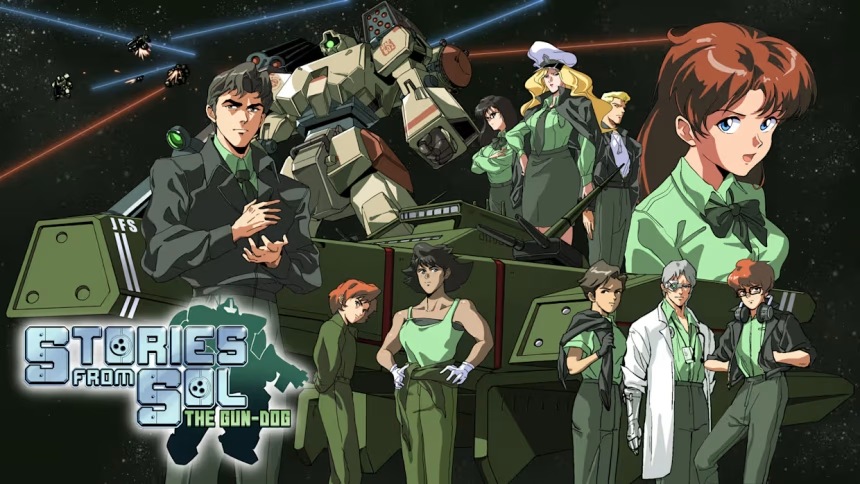
Four years earlier, the protagonist here was a cadet pilot stationed aboard the carrier Kalyke, meant to fly a mech unit called a Frame in the final battle of a three-year conflict between Earth’s Solar Federation and the rebelling Martian Territories and Jovian Unified Colony Fleet. The Frame never launched. Most of the squadron didn’t come back. By the time Stories from Sol: The Gun-Dog actually opens, that war has settled into an uneasy peace, and that same pilot, now customizable down to name, gender, and pronouns, has been reassigned as security officer aboard the JFS Gun-Dog, a patrol ship known for taking in crew nobody else wanted.
Space Colony Studios built the whole thing under director and writer Jonathan Durham, working out of Wales, with a small international team, programmer Ben in England, composer Daniel Goodman also in England, and pixel artist Kevin Butler working from the United States. The team leaned on Ren’Py, reworked to support the kind of point-and-click adventure structure the game actually needed rather than a standard branching visual novel, and released it in February 2025 across PC, PlayStation 4 and 5, and Switch, with a physical edition available specifically for the PS5 and Switch versions.
Captain Merys Bartermews runs a tight ship right up until the moment a system failure forces the protagonist into her quarters for emergency reboot codes, revealing a private struggle with alcoholism that’s already cost her most of her eyesight. That vulnerability sits in sharp contrast to Lieutenant Commander Cassandra Quinn, the protagonist’s own girlfriend aboard ship, whose steady cheerfulness gives the crew something to hold onto even as things get stranger, while Chief Mackenzie Cathays brings a sharper, more assertive edge that keeps conversations from settling into easy comfort. Cadet Dalton Grange and warrant officer Dylan Dee round out a crew already full of specific, lived-in personalities, Dylan in particular carrying a rock-nerd streak that gave even his smaller scenes a distinct flavor apart from the ship’s more central relationships. Watching those very different temperaments manage the same slow-building crisis gave the ship’s dynamic more texture than a simple crew roster would suggest, and it says something that the strength of this exact cast is what convinced Astrolabe Games to sign on as publisher in the first place.
The mission that kicks off the real crisis leans into a small, knowing joke too, since the Gun-Dog’s sister ship turns up unresponsive under the name O’Brien, and the first voice to answer belongs to a Lieutenant Bashir, names borrowed straight from Star Trek: Deep Space Nine alongside several other crew members who share names with that same show’s cast. Outside the main plot, small personal touches carried real weight for me as well, the protagonist reading a thinly veiled stand-in for Legend of the Galactic Heroes in quiet moments and following the music of a pop star called Lynn Minnie-May, details that gave this world a lived-in pop culture of its own rather than existing purely to serve the plot.
Navigating the Gun-Dog itself runs through a sidebar offering move, look, use, talk, and item options rather than traditional puzzles, and a built-in tasks screen keeps things from ever feeling truly lost. Using an item works differently from most games in the genre too, since there’s no open-anytime inventory menu, the Item button built into the scene’s own decorative frame only lights up at the specific moment a given object actually matters, and missing that cue can mean losing the chance to use it at all rather than just holding onto it for later. That small design choice turned even mundane objects into something worth paying real attention to instead of a checklist to clear whenever convenient. A rewind function lets you step back through recent lines of dialogue at any point too, letting me immediately reconsider a choice the moment I saw where it led rather than committing to a whole new playthrough to see the alternative.
The story unfolds across distinct episodes, starting with a slower tour meant to familiarize the crew before a power outage and the discovery of that unresponsive sister ship push things into genuine crisis. A full playthrough runs somewhere around five hours despite the game’s enormous word count, with the third act branching enough to reward going back through for the choices that get skipped the first time, and there’s no real fail state anywhere in the campaign, so a wrong guess never actually locks you out of finishing the story. That structure works better as pacing than as challenge, since simply examining and using whatever’s interactable in a room tends to move things forward regardless of how carefully I actually read the clues, and a few stretches lean so heavily into describing routine tasks, resetting a breaker, swapping a spacesuit battery, that the momentum of an otherwise tense mystery occasionally slackened under its own thoroughness. Two tile-spinning hacking puzzles show up late in the campaign specifically, a clear step up in actual mechanical challenge from everything that came before them, though the fact that they stand out so much only underlines how light-touch the rest of the game’s puzzle design stays by comparison.
Visually this is a full commitment to the PC-9800 era, with Kevin Butler’s character designs echoing the anime art of Kenichi Sonoda and Haruhiko Mikimoto while still prioritizing real expressiveness in posture and small bursts of motion over pure nostalgia. The Frame mechs themselves land closer to Mobile Suit Gundam’s silhouettes, while the ship and its crew carry more of a Space Battleship Yamato feel, and the era-accurate framing device around every scene, that same thick, decorated border PC-98 games used to house their UI, is what the Item button itself actually lives inside rather than sitting in some separate modern menu. Three separate visual modes let you pick how to experience all of that, full vivid color, a greenscale mode modeled after the original Game Boy, and a third option the team calls Doujin mode, greenscale paired with an entirely distinct set of character sprites rather than just a recolor of the default cast. Action beats get real cinematic cut-ins when the Frames themselves enter a scene, and those brief animated flourishes carry more weight precisely because the rest of the game stays comparatively still.
Composer Daniel Goodman built the score in Famitracker, and in talking about the project has pointed to a specific lineage behind it, naming influences like Yuzo Koshiro, Koji Kondo, Nobuo Uematsu, and Konami’s in-house sound team from that same eight and sixteen-bit era. That chiptune identity carries real emotional weight on its own, since there’s no voice acting anywhere in the game, every line delivered purely through text in keeping with the era it’s recreating, and the ambient sound design around it, the constant low rumble of the engine room, the quieter bustle of the bridge, the total silence of open space, does just as much work establishing where you actually are as the music itself. Durham himself has cited Blade Runner, Alien, and Terminator alongside Martian Successor Nadesico, Mobile Suit Gundam, and Macross as the project’s biggest influences on its world and tone, with Japanese adventure games like Policenauts, Snatcher, and Phoenix Wright shaping the actual structure and mechanics underneath all of that atmosphere.
Later in the story, the protagonist and Cassie end up captured by forces belonging to something called Mother AI, trapped inside a simulation designed to keep them from realizing anything is wrong. Not knowing which crew members inside that simulation could be trusted kept me second-guessing conversations I’d have otherwise taken at face value, and that uncertainty carried the emotional weight of the back half of the game more than any single reveal did on its own.
Running past three hundred thousand words, this marks the first entry in a planned wider Stories from Sol series, and it closes with several threads left deliberately open rather than tied off. A digital soundtrack, HIBIKI of the Cosmos, and a digital artbook, KISEKI of the Gun-Dog, are both available separately through Steam for anyone who wants more of the world once the credits roll.
Verdict
Stories from Sol: The Gun-Dog commits fully to its PC-98 inspiration, and that commitment carries real weight through Bartermews, Cassie, and Cathays even when the adventure mechanics underneath don’t ask for much precision. Daniel Goodman’s chiptune score does real emotional heavy lifting in a game with no voice acting to lean on instead, and small touches like the crew’s own pop culture tastes and its Deep Space Nine-flavored cameo make the ship feel actually inhabited. It’s a confident, visually striking first chapter that occasionally coasts on style, and sometimes on sheer procedural detail, where its mystery could have pushed harder.