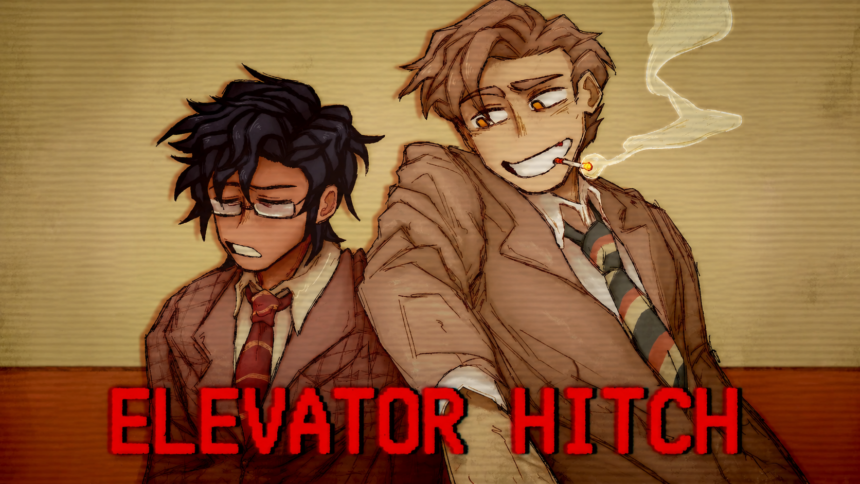
The elevator becomes frightening long before anything visibly impossible happens. Protag gets in because he has a job interview upstairs, Co-Worker follows because he already belongs to the company, and for a few minutes the situation can still pass as the sort of awkward encounter nobody remembers after lunch. Then the elevator stops behaving like transportation and starts behaving like a trap. Floors open onto spaces that resemble an office only loosely enough to make the differences worse, and every attempt to continue upward reveals another version of normality that has been bent slightly out of shape. Elevator Hitch understands that an office is already a place where waiting, following instructions, and pretending not to be uncomfortable are expected, which makes it almost perfect for surreal horror.
Protag and Co-Worker react to that environment so differently that most of the game’s tension grows out of their conversations before the puzzles even matter. Protag is visibly unnerved, increasingly desperate to understand what is happening and get back to the interview he was supposed to attend. Co-Worker carries himself like someone who has already spent long enough inside this company to stop being surprised by anything it does. He jokes, flirts with danger, and changes his own name with such casual confidence that I stopped treating introductions from him as reliable information. Chase Beckley, Bryce Styker, or whatever identity he decides to offer next all seem equally believable to him.
That shifting identity made him much harder to read than if he had simply been secretive. He does not behave like someone desperately hiding his real name. He behaves like the idea of having one stable answer is less important to him than it is to Protag. The effect is funny at first because Protag is too stressed to play along, but the longer they remain trapped together, the stranger Co-Worker’s comfort becomes. His private office and familiarity with the building suggest someone deeply embedded in the same corporate world that is currently trying to kill them.
The contrast keeps the game from becoming an uninterrupted series of grotesque rooms. Co-Worker can turn a horrifying situation into dry workplace banter, while Protag reacts like the only person still aware that none of this should be happening. That mismatch creates a rhythm where I could laugh at one exchange and become suspicious of the exact same character a few lines later. The humor never makes the danger feel harmless because Co-Worker’s calm is itself one of the things I do not completely trust.
Each floor pushes the game further away from ordinary office logic while still borrowing enough of its language and furniture to remain recognizable. Desks, interview spaces, cubicles, doors, phones, and workplace procedures keep returning in forms that are either useless or actively hostile. Elevator Hitch does not abandon its corporate setting once the horror begins. It keeps asking what an office would look like if every tedious rule, passive-aggressive interaction, and unspoken expectation could become physically dangerous.
The emergency call button gave me the clearest example of that. Pressing it produces the kind of calm procedural response I expected from a building system, right up until the voice signs off with “I love you” and the line dies. Nothing about the phrase is threatening by itself. That is exactly why it bothered me. The building suddenly sounds intimate in a way an automated system has no right to be, and the moment made me much more uncomfortable than some of the game’s explicit gore.
Exploration is what lets those moments land differently from a conventional visual novel. Elevator Hitch uses RPG Maker to create a small 3D environment that I can move through and inspect before returning to more familiar dialogue and CG presentation. Each floor becomes a compact escape-room problem where objects, environmental details, and conversations all matter. The perspective took me a little while to get comfortable with because judging where I could move or interact was not always immediately intuitive. Once the movement clicked, the game found a good rhythm between wandering, noticing something strange, solving a puzzle, and returning to the elevator to discover what fresh problem was waiting next.
The puzzles are rarely elaborate enough to stop the story for long, which is the right choice for a game this short. They exist mostly to make me participate in the environment instead of watching Protag solve everything through narration. A wrong decision can end a run abruptly, and many failures receive their own dedicated artwork rather than simply sending me back with a generic game-over message. That made experimenting feel dangerous without becoming tedious.
There is no manual saving, but the game is designed around repeated failure and automatic progress rather than expecting a completely clean run. Fifteen endings branch away from the journey, many of them representing specific ways Protag can get himself killed or trapped. The lack of manual saving sounds harsher than it feels because the game remembers enough after failures to keep experimentation moving. An ending can become both punishment and another piece of the larger joke about how many ways this company can ruin somebody’s day.
The deaths are not restrained. Elevator Hitch includes graphic gore, blood, body horror, disturbing imagery and audio, flashing or shaking effects, and lightly implied family abuse. That warning matches the actual tone rather than functioning as an overly cautious label attached to mild horror. The game can become visually nasty very quickly, and some of the bad outcomes are designed around showing exactly what a wrong choice has done to Protag. What makes the gore work is that the game does not rely on it as the only escalation. The atmosphere can be uncomfortable when nothing is bleeding. A room can be wrong because its proportions feel strange, because an office object is behaving incorrectly, or because Co-Worker says something with just enough confidence to make me wonder whether he knows more than he is admitting. The violence becomes more effective because the quieter discomfort has already taught me not to trust the environment.
The presentation is remarkably dense for something made in less than a month. Elevator Hitch contains more than sixty collectible CGs and over ten backgrounds, alongside its 3D map sections and character sprites. That amount of artwork means failed runs, strange encounters, and route variations frequently receive their own visual payoff. I never felt as though the game was stretching three illustrations across fifteen endings.
The CGs also let the horror become much more expressive than the small exploration spaces alone could manage. A wrong choice can suddenly replace the controlled office framing with a full illustration of whatever consequence I triggered. The jump between the mundane environment and that larger artwork gives failures an impact they would lose if everything happened through tiny sprites. Even comedy benefits from the same willingness to illustrate specific outcomes.
RachelDrawsThis and Ekrix handled development, story, and graphics, while BellKalengar composed the soundtrack and handled sound design. The audio is especially important because so much of Elevator Hitch’s atmosphere depends on spaces that should feel quiet without ever feeling safe. Mechanical noises, sudden effects, and music changes give the elevator and its surrounding floors more personality than their limited physical scale would suggest. The emergency-call scene would not have stayed with me nearly as strongly without the calm delivery and dead air around it.
The project was completed in twenty-eight days for the 2022 Spooktober Visual Novel Jam and finished second overall. That compressed development history is easy to believe in a few rough edges, particularly the initial awkwardness of moving around the 3D sections, but much harder to believe when looking at the amount of route-specific artwork and endings packed into the finished game. It feels focused rather than unfinished. Nearly everything exists to serve the same idea of a corporate environment becoming less understandable the harder Protag tries to escape it.
The game also became the first release associated with Studio Investigrave, which makes its identity especially interesting in hindsight. The combination of horror, comedy, distinctive character dynamics, RPG Maker exploration, and sudden illustrated violence already feels fully formed here. Elevator Hitch is not experimenting randomly with several genres to see what sticks. It knows exactly what tone it wants from the first awkward elevator conversation onward.
That does not mean every puzzle or death is equally memorable. Some endings feel more like quick jokes than substantial alternate conclusions, and once I understood the game’s logic, a few wrong choices became easier to anticipate. The 3D navigation never became my favorite part of the experience either. I enjoyed what the exploration allowed the game to do far more than I enjoyed the act of moving through every space.
Co-Worker is what kept those weaker moments from dragging. Every new floor gave me another reason to reconsider whether his calm was reassuring or alarming. His changing names became funnier the less funny the situation around him became, and his apparent familiarity with the company only made me more suspicious of what “working here” actually meant. Protag’s discomfort gave that mystery something solid to bounce against.
The short runtime helps considerably. A normal run lasts around an hour to an hour and twenty minutes, which is long enough for the elevator’s logic to become increasingly absurd without exhausting the premise. The fifteen endings then give replaying a purpose without requiring another full evening for every variation. Elevator Hitch understands that liminal horror becomes weaker once the impossible space starts feeling too familiar, so it leaves before the building can completely lose its strangeness.
What stayed with me was not the bloodiest ending or the cleverest puzzle. It was the feeling that the elevator itself had stopped being neutral. Once an emergency system can calmly tell me it loves me, buttons, floors, and company procedures no longer feel like background objects. They feel like parts of something that has noticed Protag and decided he belongs there.
Verdict
Elevator Hitch turns office routine into surreal horror without losing its dry sense of humor. The 3D navigation can be awkward, but Co-Worker’s shifting identity, fifteen endings, strong sound design, and inventive visual payoffs make the short run unusually memorable. Its best scares come from making the workplace itself feel aware.