Perfect Love is most effective when it stops asking whether Milo is becoming dangerous and starts asking how much responsibility I have for making him that way. The protagonist begins the story already convinced that ordinary romance is not enough. What they want is something obsessive, consuming, and completely devoted, and when Milo Change appears vulnerable enough to mold into that fantasy, the game lets me participate in the process rather than watching it happen from a safe distance. That inversion matters. The yandere is not simply a frightening love interest appearing fully formed. Milo becomes one through choices that often start small enough to excuse.
The protagonist is customizable, including name and pronouns, with Eris serving as the default name. They encounter Milo on campus while he is being bullied, and almost immediately recognize traits that make him useful: he is meek, obedient, gullible, and already interested in them. Sympathy is not the dominant reaction. Eris sees possibility. Milo’s softness becomes material that can be shaped into the kind of love they have been unable to find naturally.
That makes Eris much more unsettling than a protagonist who simply stumbles into a dangerous romance. They are calculating from the beginning and rarely need to raise their voice for the manipulation to feel cruel. Milo, meanwhile, is trusting enough that many of the early interactions can almost resemble a normal romance if I ignore what Eris is thinking underneath them. The gap between those perspectives gives the opening its tension. Milo interprets attention as affection while Eris is already thinking several steps ahead about what that affection can become.
I found myself rooting for the plan to work more often than I was comfortable admitting. Part of that comes from how deliberately the game places control in my hands. I knew Eris was treating Milo like a project, but every successful manipulation still produced the same satisfaction as watching any other visual-novel strategy succeed. That creates an ugly little feedback loop where mechanical success and moral failure can happen at the same time. Perfect Love understands that making the player complicit is more disturbing than simply telling them the protagonist is terrible.
The major split comes early. A choice about how the first date unfolds sends Milo toward one of two substantially different versions of himself, Violence Milo or Manipulation Milo. From there, the routes develop their own relationship dynamics, behaviors, interface changes, and endings rather than simply swapping a few lines before converging again. I replayed because I wanted to see how extensive the divergence actually was, and the difference was large enough that the second path felt like another interpretation of the same experiment rather than a recycled route.
That split is also reflected visually. Milo does not simply receive different dialogue depending on the direction Eris pushes him. His appearance and expressions change with him. Posture, face, and general presentation gradually make the two versions feel like people who have been shaped toward different kinds of obsession. The game even lets those choices alter parts of the UI, pushing the transformation beyond the character sprite and into the surrounding presentation.
Ryan and Desmond get pulled into that process as well, although neither fully understands what Eris is constructing until the consequences have already spread outward. They function as useful reminders that manipulation rarely stays contained between manipulator and target. Eris may be focused on creating a perfect version of Milo, but other people become variables in that project whether they volunteered or not. Depending on the route, their involvement takes on different weight because Milo himself is no longer responding to problems in the same way.
The two-path structure ultimately leads into eight standard endings, four attached to Violence Milo and four to Manipulation Milo, followed by a separate Perfect Love ending with additional requirements. That progression gives completion a purpose beyond collecting CGs. Seeing every major outcome becomes part of understanding just how many forms Eris’s original desire can take once Milo has been pushed far enough. The endings range widely in tone, but they all grow from the same basic mistake: treating another person’s personality as something that can be engineered for private satisfaction.
The true completion path goes further by recognizing what the player has already done. Unlocking it requires seeing the other endings first, which makes repetition part of the fiction rather than a purely mechanical exercise. The game remembers completion progress and uses that knowledge to make the final material feel less detached from everything that came before. It is another way Perfect Love turns familiar visual-novel behavior into something uncomfortable. Replaying is normally harmless. Here, every replay means deliberately putting Milo through another variation of the same manipulation.
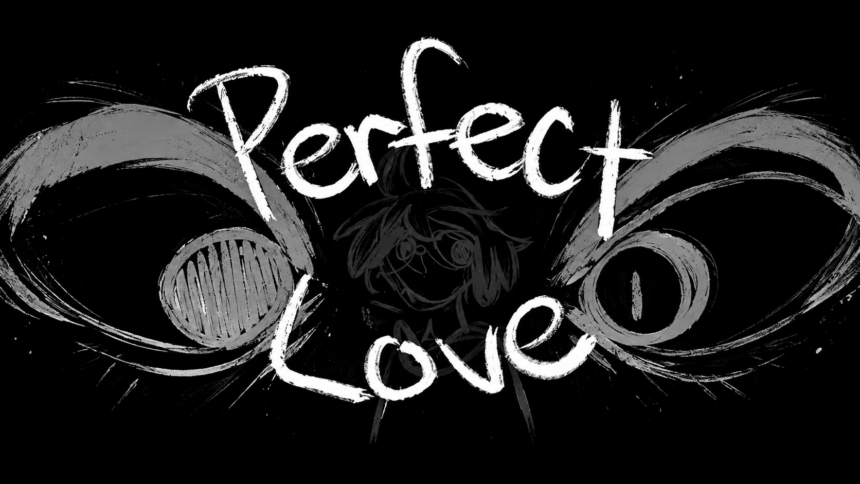
The art makes that process feel even more intimate. Perfect Love uses a greyscale palette and sketch-like line work, with line-boil animation keeping characters from looking completely static even when they are standing still. The limited color range suits a story built around control because the world already feels stripped down to Eris’s fixation. Instead of making the production look unfinished, the hand-drawn roughness gives scenes a nervous quality that cleaner rendering might have softened.
The unusual framing adds to that effect. Scenes feel slightly boxed in rather than generously open, which fits how closely the story stays attached to Eris and Milo. There is very little visual relief from the relationship once it becomes unhealthy. Even campus scenes can feel constrained because the aesthetic keeps pulling attention back toward faces, reactions, and the changes happening to Milo.
Eris’s design is especially effective because the tightly spiraling curls make them immediately recognizable without needing an exaggerated horror appearance. They can look composed even while saying or thinking something cruel, which is much more disturbing than turning them visibly monstrous. Milo begins softer by comparison, and that contrast becomes less stable as the routes progress. The more Eris succeeds, the less visually innocent he remains.
The game contains more than one hundred mini-CGs alongside eight larger CGs and a gallery. That quantity allows small reaction images and route-specific details to appear frequently without saving every visual flourish for a major ending. It is useful in a story where gradual transformation matters more than isolated spectacle. A changed expression or altered version of Milo can carry more meaning than a large dramatic illustration if I remember what he looked like several scenes earlier.
There is no conventional voice acting. Instead, Milo and other characters use small thematic noises rather than spoken lines. I did not expect those sounds to matter much at first, but once I started associating particular noises with different versions of Milo, they became another indicator of what Eris had done to him. The effect sits somewhere between cute and dehumanizing, which is exactly why it works. Milo is being trained into a form Eris finds desirable, and reducing parts of his expression to animal-like sounds fits the uncomfortable ownership running through the relationship.
The soundtrack is assembled from credited external music rather than being written entirely for the project, but the selections are used carefully enough that the lack of one composer never became a distraction. Haunting tracks sit under quieter manipulation scenes without forcing every moment into overt horror. The music understands that Eris does not think they are living inside a tragedy. For them, much of what is happening is progress.
Perfect Love was originally intended for an earlier yandere jam but was ultimately submitted to Stained Red: A Yandere Game Jam and later also entered in Yandere Game Jam 2024. It is available free or name-your-own-price for Windows, macOS, and Linux through itch.io. Ren’Py and Adobe Photoshop form the technical base, which suits a project whose ambition comes from branching, presentation tricks, and character transformation rather than complex mechanics.
Its jam origins explain the compact focus. There is one love interest, one manipulative protagonist, and one central question being explored through multiple variations. The game does not waste time constructing a broad dating pool or elaborate common route because Milo is the experiment. Every significant system points back toward changing him, including his appearance, personality, sounds, interface, endings, and the player’s own expectations of what a yandere game normally asks them to do.
That concentration does leave the supporting cast feeling like an area with more room to grow. Ryan and Desmond have enough presence to make me interested in what their lives look like outside Eris’s plans, but the game understandably keeps dragging attention back toward Milo. I wanted more time with them precisely because the surrounding cast helps reveal how unnatural Eris’s behavior actually is. Milo can normalize almost anything once he has been manipulated long enough. People outside that relationship are better positioned to expose how far things have drifted.
What stayed with me most was how harmless some of the earliest compromises felt while I was making them. The game does not begin by asking me whether Milo should become monstrous. It offers smaller decisions that can be rationalized as helping, protecting, flirting, or steering him away from someone else. Three or four scenes later, those choices have developed consequences that make the original decision look much uglier in retrospect. By the time later options are framed around protection or loyalty, Eris has already redefined those words enough that agreeing with them feels dangerous.
I finished one route and sat with the ending for a moment because I was not entirely sure how much of my discomfort belonged to Eris and how much belonged to me. The game never makes the protagonist secretly innocent just because the player is holding the mouse. Eris wants this. I helped them get it. That difference between understanding a character’s plan and actively advancing it is where Perfect Love becomes more than another yandere romance.
Verdict
Perfect Love makes its yandere premise sharper by turning the player into Milo’s sculptor rather than his victim. The two major paths genuinely reshape him, while the greyscale art, interface changes, and unsettling sound design make that transformation visible. I only wanted more room for the supporting cast, but Eris and Milo’s dynamic is disturbing enough to carry the game on its own.