
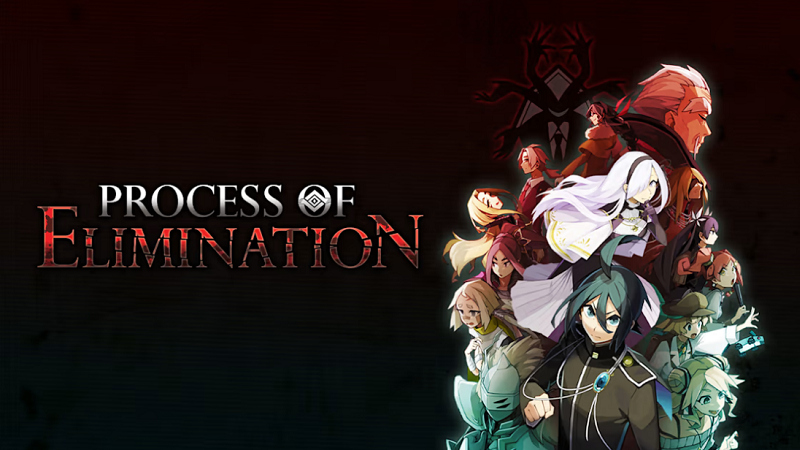
Process of Elimination builds its entire premise around a serial killer nobody expects to find inside their own investigation. A private island called Morgue hosts the Detective Alliance, a coalition of the world’s sharpest investigators gathered to hunt down the Quartering Duke, a killer with over a hundred confirmed victims who broadcasts the aftermath of his crimes to an audience that keeps tuning in. Partway through their own operation, the Alliance realizes the Duke isn’t outside their circle. He’s inside it.
Wato Hojo gets swept into all of this almost by accident, an aspiring detective with none of his colleagues’ polish, and the game doesn’t let him forget it either. His official title among the Alliance is the Incompetent Detective. Unlike every other member of the fourteen-strong roster, he’s the only one without a special skill to lean on, which turns him into the player’s own stand-in for figuring things out the hard way rather than relying on a built-in gimmick.
That label sits in stark contrast next to teammates like the Corporate Slave Detective, grinding through cases like unpaid overtime, or the Science Detective, who treats every crime scene like a lab experiment. The Netherworld Detective works a similar occult angle from a different direction, ranked seventh in the Alliance and still chasing an unsolved Vampire Case even after cracking a Werewolf Case earlier in his career. The Gourmet Detective, ranked ninth, built a reputation solving a case involving sea turtle soup, a supertaster’s palate sharp enough to detect poison by taste alone. The Literary Detective rounds out the group with a visual memory precise enough to have closed a case over a buried family treasure, ranked fifteenth overall. Wato spends a lot of early scenes being underestimated by exactly the kind of people who’d normally solve a mystery in one clean deduction, and watching him claw his way into their respect scene by scene became one of the more satisfying threads running through the whole cast.
Every case unfolds in two halves that shouldn’t work together nearly as well as they do, blending a visual novel with something closer to a tactics game than most detective fiction ever attempts. The talking half plays like a straightforward visual novel, dialogue choices steering conversations and occasionally unlocking a piece of evidence I’d have otherwise missed. Then the game drops me onto a grid map and hands me command of a small squad of detectives, each with their own movement range and specialty stats measured directly against the mystery points a given piece of evidence demands. I’m suddenly managing turns like a tactics game while a clock ticks down on how much evidence I can actually recover. I fumbled through my first investigation without much of a clue what I was doing, misreading which detective could cover which tile, and only started to feel in control once I understood that positioning mattered as much as what anyone said in the next cutscene.
Some of those grid segments hide more than clues. Traps and lurking dangers force an inference check if a detective ends their turn too close, and getting that check wrong costs more than a wasted turn. It’s a rare thing for a murder mystery to put real, mechanical stakes behind a wrong guess instead of just narrating a bad outcome, and that tension carried into scenes where I genuinely didn’t know if I trusted my own read on a suspect. Wato’s own history feeds into that unease too. He’s carrying something from his own past, a specific, ugly moment the game keeps circling back to without ever cashing it in early, and by the time it starts to connect to the larger case I found myself second-guessing conversations I’d already moved past.
Character designer Mio Katsumata leans hard into that occupational-nickname structure for the cast’s look, giving each detective a silhouette and palette that telegraphs their gimmick before they say a word. The Literary Detective comes buried under layers that read like a walking bookshelf, while the Armored Detective looks dressed head to toe like he wandered out of a different kind of story entirely. It’s a smart shorthand for keeping fourteen characters visually distinct in a genre that usually struggles past six or seven, even if the static portrait style itself never strays far from standard visual novel presentation.
Composer a_hisa handles the score, and it does the quiet, patient work of keeping the investigation segments tense without ever tipping into melodrama, holding back until a scene actually earns a swell. Hinata Tadokoro voices the Netherworld Detective, Akiko Nakagawa voices the Gourmet Detective, and Nanami Yamashita voices the Literary Detective, each performance leaning into the exact quirks their case files already promise before they open their mouths. The ending theme, kotonoha, is performed by Anzu Suzuki, who also voices the Shibuya Detective. Hearing a cast member’s own singing voice close out a difficult case gave certain chapter endings a strange, personal weight I wasn’t expecting from what’s otherwise a fully Japanese-voiced production with no English dub. Reading along under performances I couldn’t fully follow occasionally cost a beat of comic timing, but never anything that dulled a serious scene.
Nippon Ichi Software originally released this under the title Tantei Bokumetsu on May 27, 2021 in Japan for 6,980 yen, directed by Munenori Hirose and written by Kento Jouhana. It was marketed there under the tagline The Sign of the Fourteen, playing on its full detective roster, and carried a CERO D rating reflecting content aimed at an older teen and adult audience rather than a general one. NIS America brought it west as Process of Elimination on April 11, 2023 for PS4 and Switch, with the European and Australian release following just a few days later on April 14, and kept that original Japanese voice cast intact rather than commissioning a dub. A free demo went up ahead of launch too, with save data ready to carry over into the full release for anyone who wanted a head start on the investigation. The western release carried a limited edition with a soundtrack, an art book, and a keychain for anyone wanting more than the case files themselves, and by the time I’d wrapped my own investigation I understood exactly why someone would want the soundtrack on its own.
Verdict
Fourteen detectives crammed onto one small island sounds like a cast a tactics game would buckle under, but Process of Elimination makes mastering both the talking half and the grid half feel like one connected skill rather than two tolerated genres. Wato’s climb from the group’s punchline to someone worth listening to gives the whole cast a reason to matter, and the grid investigations turn every case into something I had to actively solve rather than just read through. The opening turns ask more patience of a reader than they probably should, but the back half rewards that patience enough to make the slow start worth pushing through.