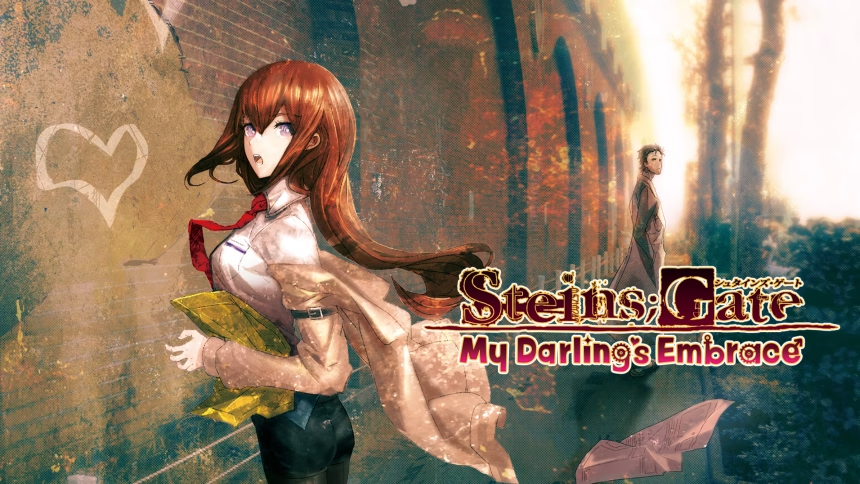
I went into Steins;Gate: My Darling’s Embrace nervous for a very simple reason: these characters had already earned their happiness the hard way. The original Steins;Gate made every small victory feel fragile, so taking the same cast and dropping them into a romantic comedy sounded dangerously close to trivializing everything that made their relationships matter. My Darling’s Embrace avoids that trap by never pretending it is another Steins;Gate. It gives the lab members permission to be ridiculous for a while, and once I accepted that, I had a much better time than I expected.
Repeated D-Mail experiments have pushed Okabe into the Delta Attractor Field, a cluster of world lines with divergence in the three-percent range where the Future Gadget Laboratory looks much healthier than the versions I remember. All eight lab members are together, SERN isn’t bearing down on them, and the immediate crisis is considerably less apocalyptic: the lab needs money. The common route eventually brings Okabe and Kurisu into contact with Future Gadget No. 12, “Darling, You Idiot!”, a pair of relationship-testing bracelets that punish arguments, forced removal, or moving too far apart with electric shocks. Attempts to escape that mess through D-Mails become the branching point into six routes centered on Kurisu, Moeka, Faris, Luka, Suzuha, and Mayuri.
The bracelet is exactly the kind of stupid invention this version of Steins;Gate needs. It takes Okabe and Kurisu’s constant bickering and turns it into a physical comedy routine without asking me to forget why their relationship worked in the original. More importantly, it establishes the game’s larger rule: familiar character traits are going to be exaggerated for comedy, but the characters themselves still have to feel recognizable.
That’s where My Darling’s Embrace succeeds most consistently. The routes don’t simply replace Kurisu with another heroine inside the same romance template. Each one builds itself around a different problem, and the shift in world line allows supporting characters who were consumed by the original game’s larger tragedy to receive more ordinary kinds of attention.
Moeka benefits enormously from that freedom. Seeing her removed from the circumstances that defined so much of her original role lets her awkwardness become funny and sympathetic instead of ominous. Her route leans into domestic chaos and her difficulty handling ordinary tasks, but I liked it less for the joke itself than for getting to spend time with a version of Moeka who is allowed to be socially uncomfortable without every scene carrying another layer of danger beneath it. She feels like someone Okabe can actually get to know rather than a problem the plot needs him to solve.
Luka’s route is more complicated and, for me, more interesting. Luka is male on this world line, and Okabe’s growing attraction forces him to confront feelings he doesn’t know how to categorize comfortably. Some of the comedy around his confusion has aged less gracefully than the emotional core underneath it, but I appreciated that the route doesn’t simply erase the issue to make the romance easier. Okabe’s discomfort belongs to Okabe, not Luka, and by the time the route settles into something warmer, the relationship feels more sincere because he has actually had to examine what is bothering him.
Faris works for almost the opposite reason. She already has such an aggressively constructed persona that it would have been easy to give her nothing except more maid-café jokes and “nyan” dialogue. Her route still embraces all of that because pretending Faris isn’t theatrical would be pointless, but giving her a dedicated story also creates more room for Rumiho beneath the persona. I came away appreciating her more because the route lets the performance and the person coexist instead of treating one as fake and the other as the truth.
Kurisu’s route is almost amusingly easy to reach. If I resist sending the D-Mails that branch toward the others, I naturally remain with her, which makes the central heroine of Steins;Gate function less like a secret reward and more like the default answer. I expected something grander because of everything Okabe and Kurisu already mean to each other, but the route deliberately operates on a smaller scale. Their chemistry is intact, their arguments are still funny, and the familiar rhythm between them makes the route comfortable almost immediately.
That comfort is also why I wanted slightly more from it. The original game already did the difficult work of making their relationship matter, so My Darling’s Embrace has the luxury of simply letting them spend time together. Sometimes it feels almost too cautious with that opportunity. The game repeatedly creates situations that look ready for a bigger romantic payoff, only for Okabe’s awkwardness or the comedy to pull things back before the scene fully commits.
That reluctance isn’t limited to Kurisu. My Darling’s Embrace is much more restrained than the premise and marketing initially made me expect. Despite essentially being a romance fandisc, it spends far more time on conversations, ridiculous problems, and Okabe helping the people around him than on overt fanservice. I actually prefer that approach, because these routes are strongest when they feel like extensions of relationships I already care about rather than excuses to put the cast into increasingly artificial romantic situations.
The tradeoff is that a few routes build toward moments that I wanted to land harder than they do.
Mayuri’s route comes closest to solving that problem. It is also the most awkward route to reach, requiring more deliberate use of the Phone Trigger system than simply sending one of the obvious D-Mails during the common route. That extra separation suits it. Mayuri and Okabe have such a deeply established bond that shifting their relationship toward romance needs more care than simply dropping him into another convenient world line and announcing that they’re attracted to each other.
The result is one of the routes where the game allows its comedy to step back enough for the emotional history between two characters to matter. Mayuri has always occupied a unique place in Okabe’s life, and the route understands that romance can’t simply overwrite that existing relationship. It has to grow out of it. The lighter structure makes the quieter emotional moments stand out precisely because the game has spent so much time reassuring me that nobody is about to die.
Suzuha’s route landed much less cleanly for me. Its conflict pulls Daru heavily into the story and depends on misunderstandings continuing longer than I found funny. Miscommunication can be perfect material for a romantic comedy, but there is a point where watching everyone avoid the one conversation that could resolve the situation stops creating tension and starts delaying the ending. Suzuha herself is still enjoyable, but I wanted more of the route’s energy directed toward her instead of the situation surrounding Daru.
The unevenness across six routes is almost inevitable, though, and I would rather have six stories that commit to different ideas than six romances built from the same sequence of dates and confessions. Even the routes I liked less reveal another version of what these characters might look like without the original game’s machinery constantly pushing them toward catastrophe.
The Phone Trigger remains the main interactive system tying everything together. I can answer or ignore calls, read and respond to emails, change wallpapers and ringtones, and decide when to send the D-Mails that determine major route branches. It is unmistakably Steins;Gate’s idea of interactivity: less about choosing dialogue from a menu and more about deciding whether Okabe bothers to use the device already sitting in his pocket.
I still like that concept, but this is not secretly a full dating simulator hiding inside a visual novel. There are no elaborate relationship stats, schedules, or management systems. Once I’m on a route, most of the experience is reading. Anyone coming specifically for deeper romance mechanics will find the actual system extremely light.
Presentation barely tries to reinvent the series, which is the right decision. Familiar portraits, backgrounds, interface ideas, and pieces of music return alongside new sprites, CGs, backgrounds, and tracks created for the additional material. Because these stories occupy alternate versions of the same Akihabara and the same characters, visual continuity matters more than novelty. The slightly brighter romantic-comedy tone changes how those familiar assets feel without making the game look disconnected from Steins;Gate.
The original Japanese cast is fully voiced, and hearing Mamoru Miyano, Asami Imai, Kana Hanazawa, Tomokazu Seki, Yukari Tamura, Haruko Momoi, Saori Goto, Yu Kobayashi, and the rest slip back into these roles is a major part of why the comedy works. Okabe’s theatrical nonsense needs Miyano’s commitment just as much here as his breakdowns needed it in the original, while the rest of the cast can push their personalities further because the script isn’t constantly preparing them for another disaster.
Takeshi Abo returns on music, and the soundtrack follows the same philosophy as the visuals: familiar enough to preserve the identity of Steins;Gate, with additional material supporting the lighter mood. I wouldn’t put the score above the main game’s work, but I never felt like I was listening to leftovers assembled for a minor spinoff either.
The English localization deserves mention because comedy is exactly where a stiff translation would have exposed itself. The script preserves the internet slang, ridiculous Hououin Kyouma performance, character-specific speech habits, and rapid exchanges without making everyone sound as though they were translated from the same neutral voice. Even graphical material in the opening received English treatment rather than being completely ignored. There are rough edges and bits of terminology that remain intentionally or awkwardly Japanese, but the humor usually survives the trip.
My Darling’s Embrace works best once I stop asking it to justify itself against Steins;Gate’s tragedy. It isn’t trying to prove these romances are more important than the original story or reveal some missing piece of canon. It takes characters who spent an entire game suffering under impossible circumstances and gives me several worlds where an unpaid bill, a stupid invention, an embarrassing misunderstanding, or realizing I might love my friend can temporarily qualify as a crisis.
After everything this cast has already survived, I didn’t need another world line worth saving. I was happy just to find one where they had time to waste.
Verdict
Steins;Gate: My Darling’s Embrace succeeds because it understands that lowering the stakes doesn’t require lowering the quality of the characters. Its six routes give Kurisu, Moeka, Faris, Luka, Suzuha, and Mayuri different kinds of space outside the original game’s tragedy, with Luka and Mayuri standing out most for me when the comedy gives way to something more sincere. Suzuha’s misunderstanding-heavy route is the weakest stretch, and several romantic setups stop just short of the payoff I wanted, but the game’s restraint is ultimately more strength than weakness. The Phone Trigger system remains mechanically light, yet the writing, localization, original voice cast, and familiar Steins;Gate presentation make this feel like a genuine alternate life for the lab rather than disposable fanservice. It isn’t where anyone should meet these characters for the first time. It’s where I enjoyed seeing them after I already knew exactly how much a quiet world line could mean.