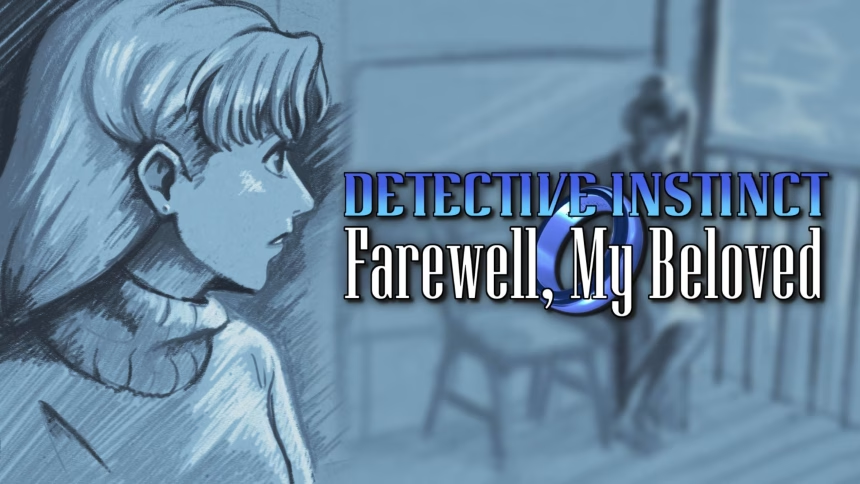
Solving a good jigsaw puzzle by hand takes a specific kind of patience, since the picture never actually reveals itself until dozens of small, unglamorous decisions line up in the right order first. Detective fiction runs on that exact same patience, and it is a rarer feeling in games than it should be. A man turns up dead in an empty hotel room the night before a study-abroad trip is supposed to end, and that is the moment Detective Instinct: Farewell, My Beloved actually starts. I am playing an American college student on a research trip through the fictional region of Vendreka, traveling alongside my tutor Emma and our professor Martin, and detective Daltrey pulls the two of us into investigating the murder almost by accident, deciding on the spot that we are qualified enough to help him work the scene.
That investigation is still unresolved when the group boards a train bound for London, and it is there that a second mystery opens up. Emma spends a few minutes talking with a woman she has never met before, and by morning that woman is gone, remembered by absolutely no one else on the train despite Emma insisting several other passengers saw her too. It is a clean, unsettling hook, and the game resists turning it into a body-count whodunit, building its tension on erasure and doubt rather than piling on corpses, closer to a slow-burn conspiracy thriller than a puzzle-box murder mystery, and that restraint kept me guessing longer than I expected to be.
The whole case runs across five chapters, each one clearly delineated by its own beats and achievements, from an early one built entirely around not answering a knock at your door too quickly to the murderer confrontation waiting at the very end of chapter five. Investigation itself splits between examining environments in short point-and-click segments and talking to people at the scene, with a menu that also lets me have my character think through what has already been gathered or bring theories directly to Emma. None of it reinvents anything from the genre’s DS-era heyday, but the interface stays clean enough that I never once lost track of what I was supposed to be doing next, and running theories past Emma works as a built-in hint system that never feels condescending when I lean on it.
Emma carries a lot of the emotional weight here, curious almost to a fault and quick with a theory, but written with enough real care for the people around her that she avoids sliding into the quirky-sidekick mold this genre leans on constantly. My own character worried me early on, since the game lets you name him yourself, which usually signals an empty vessel built purely for projection. That fear did not hold up. He has his own private reason for chasing this mystery that surfaces gradually, and by the later chapters he had become someone I actually cared about getting answers for, not just a stand-in for my own choices.
The side cast stays smaller than a lot of mystery visual novels bother with, and that turns out to be a strength. Daltrey drifts in and out with a freewheeling approach to police work and a moral compass that never quite points where I expect it to, a wealthy married couple named Veda and Monty, he works as a magician when he is not needling his own wife, bring a kind of brittle tension to every scene they are in, and the bartender working the train’s lounge car radiates exactly the right amount of I-know-more-than-I-am-telling-you. A pair of loud golfing enthusiasts round things out purely for comic relief, spinning increasingly unhinged theories about the case between rounds, and I caught myself laughing out loud at more than one of them. None of them blur together, and the political tension simmering between Vendreka and its neighboring region of Ganbrika gives even the smaller conversations somewhere to point without turning into a lore dump.
Presentation is where Armonica’s four-person team clearly spent its effort, leaning on three distinct visual techniques rather than just one, animated pixel-art portraits for characters, pre-rendered 3D environments for backgrounds, and traditional illustrations for select key moments. The portraits carry a lot of the emotional weight through small expressive shifts during dialogue-heavy stretches, and the more realistic backgrounds surprised me for a team this size. The clash between flat pixel sprites and those detailed environments does not always sit perfectly, and a few scenes felt like they were pulling from two different games at once, but it rarely broke the atmosphere the team was going for.
Music is a clear standout, moving between jazz and orchestral cues depending on the scene, confident enough in its own identity that it stops feeling like pure homage to Ace Attorney or Hotel Dusk after the first hour or two. Director Joey Lopes wrote, composed, and built the game’s score essentially solo, and Armonica sells the soundtrack separately for anyone who wants to keep it outside the game itself. There is no voice acting anywhere, which is standard for the genre it is drawing from, and the writing and score end up carrying the game’s longer, quieter dialogue stretches almost entirely on their own. Most of the time that is fine, though a couple of extended conversations had me wishing for even a small amount of vocal texture just to break up the silence.
The team itself came together during the pandemic after knowing each other for years through internet forums, and this is their first release under the Armonica name, built on an engine they made themselves rather than an off-the-shelf visual novel tool. A demo made the rounds during Steam Next Fest before the full release, which explains how confidently the final game handles pacing over its five chapters, systems that usually take a sequel or two to smooth out already feel settled here, which caught me off guard for a debut coming from a team this small.
The mystery’s resolution is where my own reservations live. Without spoiling how it lands, the pieces come together cleanly and the plot’s internal logic holds up, but the emotional stakes in the final stretch do not quite match the tension the middle chapters built, and a couple of character conflicts resolve a little too smoothly given what they had just been through. I closed the game wanting one more scene of consequence before the credits rolled.
Five to six hours is a tight, focused runtime for a case with this much moving underneath it, and the game never overstays its welcome, but I finished wanting more time in this specific world because the writing and atmosphere were strong enough to support it. There is no branching path structure and no alternate endings, so once the case is solved there is not much pulling me back beyond just enjoying the ride again.
Verdict
Detective Instinct: Farewell, My Beloved is a confident, atmospheric throwback that understands exactly which parts of its DS-era influences to borrow and which to leave behind, wrapping a quietly unsettling disappearance mystery around a small, well-drawn cast instead of chasing genre spectacle. The pixel-and-3D art clash and a resolution that resolves a touch too easily keep it from being a total knockout, and the short five-to-six hour runtime with no replay incentive will bother some players more than others, but as a four-person team’s first case, built on their own custom engine no less, it is a properly accomplished debut.