Landing my dream job as a fashion designer should have been the beginning of a new life. Getting thrown roughly 450 years into the past before I can properly start it is however, for lack of a better phrase, a considerably less convenience. Ikémen Sengoku: Romances Across Time wastes almost no time turning that disaster into an excuse to surround me with some of Japan’s most famous warlords, and the ridiculousness of that setup is part of the charm. A sudden time-slip sends me from modern Japan into the Sengoku period, where I accidentally save Nobunaga Oda from what should have been his death. That single intervention leaves history moving differently around me, and getting home isn’t as simple as reversing whatever just happened. I have roughly three months before another opportunity to return, leaving me stranded among Nobunaga and a growing collection of rival warlords, retainers, and other historical figures. Sasuke Sarutobi, another person displaced from the future, becomes one of the few people capable of understanding exactly how strange my situation is.
What makes the premise work for me is that the protagonist doesn’t immediately become passive simply because she’s surrounded by powerful men. Her modern perspective regularly collides with the expectations of the period, and her fashion background gives her an identity that existed before any romance route did. The time travel therefore gives the story more than an excuse to meet attractive historical figures; it creates a constant mismatch between the life she expected to begin and the one she’s suddenly being asked to survive.
The historical setting plays fast and loose with reality by necessity. These are romanticized interpretations of figures whose real lives don’t conveniently fit together into one dating-sim timeline, and their historical ages could differ dramatically. Date Masamune, for example, would have been around fourteen in 1582, while several other figures represented alongside him were decades older. The game wisely presents its cast as stylized fictional versions rather than trying to make those historical ages part of the romances.
Masamune is where that stylization worked particularly well for me. He initially fits an easy type: bold, mischievous, thrill-seeking, stubborn, and flirtatious enough to make his intentions difficult to miss. His route becomes more interesting once that surface confidence stops being his entire personality. His sense of responsibility toward the people under him gives the reckless behavior another dimension, and the contrast between someone who treats life like an adventure and someone who understands the consequences of commanding others makes him more compelling than the straightforward bad-boy role he could have occupied.
That balance matters because Ikémen Sengoku isn’t particularly interested in historical solemnity. The warlords are allowed to flirt, joke, argue, and behave like romance characters even while political alliances and military conflict continue around them. I preferred that approach to a game constantly interrupting its relationships to prove how educational it could be. History provides personalities, rivalries, and stakes; romance remains the reason I’m spending so much time with any individual warlord.
The route structure gives those relationships room to exist independently. Choosing a warlord means committing to his storyline rather than bouncing freely between the entire cast, with dialogue decisions accumulating toward different romantic outcomes. That focus lets the same historical situation feel different depending on whose perspective I’m closest to, and it gives replaying another route more purpose than simply swapping one romantic lead for another.
The mobile structure is much harder to ignore. The Japanese version distributes five free story tickets each day, while progression also includes Love Challenges built around Grace requirements and avatar attire. Grace can be earned through Princess Lessons, while attire challenges offer normal clothing obtainable through earned currency and premium alternatives tied to paid currency. I can live with that system when I’m treating the game as something to check in on each day. It becomes more frustrating when a route has momentum and the ticket limit tells me I’ve read enough for now. The same applies to Love Challenges: dressing the protagonist fits naturally with her fashion-designer identity, but tying required progression to accumulated resources makes the mechanic feel less like characterization and more like the freemium structure reminding me that it’s there.
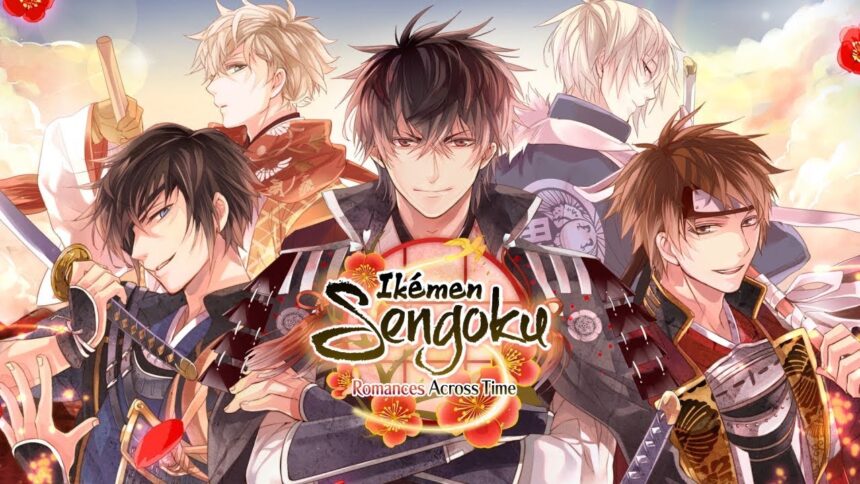
At least the presentation gives me reasons to tolerate the interruptions. Character illustrations lean fully into the romanticized-warrior fantasy rather than pretending these men are documentary recreations, and the elaborate clothing makes particularly good use of the Sengoku setting. Voice clips add personality to the cast, while music and decorative interface work help maintain the historical-romance atmosphere even when I’m between major story scenes.
The game’s success also pushed the concept well beyond its original mobile format. Ikémen Sengoku received an anime adaptation and a Japanese PlayStation Vita version, Ikémen Sengoku: Toki wo Kakeru Koi – Aratanaru Deai, extending the same basic premise into other formats. That expansion makes sense to me because the strongest part of the game isn’t any one mobile mechanic. It’s the cast and the flexibility of imagining this deliberately impossible version of the Sengoku period through different relationships.
That’s ultimately why the historical liberties never bothered me much. Ikémen Sengoku isn’t asking me to believe this is how Nobunaga, Masamune, or the rest actually lived. It takes recognizable names and conflicts, turns them into romantic archetypes, then gives those archetypes enough individual personality to carry entire routes. The history gets me through the door; whether I want to spend another three months in the past depends on the man waiting on the other side of it.
Verdict
Ikémen Sengoku: Romances Across Time understands that historical otome works best when history creates pressure rather than becoming homework. Its time-slip premise gives the protagonist a natural reason to challenge the world around her, while route-focused storytelling lets figures like Masamune grow beyond the archetypes their introductions suggest. The five-ticket daily structure and Love Challenges can interrupt that momentum, especially when I’d rather keep reading, but they don’t erase the appeal of a large cast built around dramatically different personalities and relationships. It’s unapologetically romanticized history, and that’s precisely where much of its fun comes from.