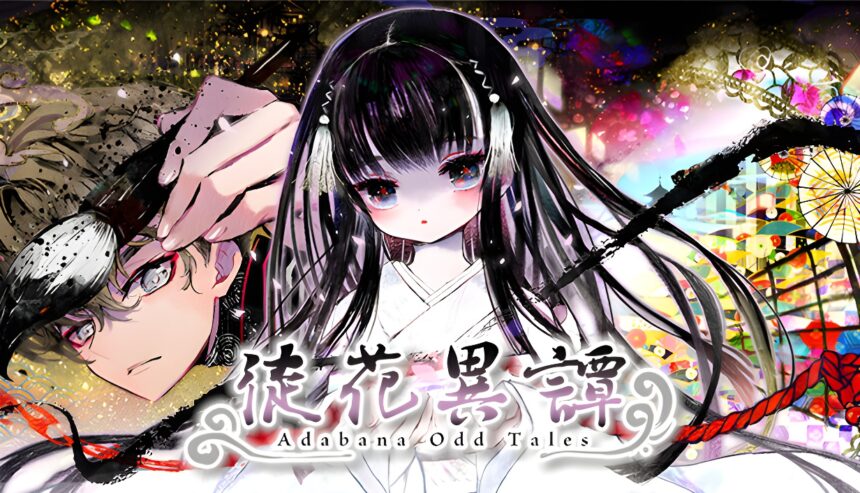
Amnesia is one of fiction’s laziest shortcuts, a way to drop a blank-slate character into a new world without earning that introduction honestly. Adabana Odd Tales leans on the same shortcut, then builds an entire poetic framework around it instead of hiding the trick. In this story, a monster corners a girl in an unfamiliar forest before she even has a name to call herself by, and the boy who cuts it down with a brush wielded like a sword greets her with a warmth she has no way to return. He calls himself Kurofude. He calls her Shirohime, a name she doesn’t recognize any more than she recognizes him. What he tells her next is stranger than the rescue itself. They stand in Adabana, a realm built from illustrated storybooks whose tales work like dreams, vivid from the inside and gone the moment anyone wakes. Their shared purpose is hunting down the distortions corrupting those stories. Their first stop is a reimagined telling of Hanasaka Jiisan.
Distortion in practice means creatures called Bookworms, somewhere between goldfish and catfish, eating through critical portions of a story until it can no longer move forward. Shirohime turns them to ink with a touch, and Kurofude returns that ink to the page to restore what the story lost. It’s a small mechanic, barely more than a recurring beat, but I liked how literally it treats the idea of a story falling apart from the inside.
Shirohime carries herself with a doll-like passivity at first, accepting Kurofude’s explanations the way someone accepts weather, and it’s Kurofude’s protective familiarity, warm toward a girl who has no way to return the recognition, that slowly complicates her into someone more than a blank page. Their dynamic works because neither half apologizes for what it is. He already knows her, she’s starting from nothing, and the story lets that imbalance sit uncomfortably rather than resolving it too fast. Later fairy tales bring in their own casts, a peach-born hero setting out to slay oni in one story, a princess beneath the sea in another. Each one gives Shirohime and Kurofude someone new to bounce off before the story circles back to their own unresolved history.
That episodic structure is also where the story’s real weakness shows. Jumping fairy tale to fairy tale gives the writing plenty of world to gesture at, but not much time to build anyone beyond the shape a given story needs from them. Characters function more as pieces the plot moves into place than as people I got to know slowly, and the tragedy baked into each fairy tale ends up doing more emotional work than the character writing around it does. More than one ending here moved me, and it still landed as tragedy borrowed from a familiar story rather than tragedy this particular telling had fully earned on its own.
Ryuko Oishi’s character art carries the whole thing visually, a fairytale look filtered through a feudal Japan sensibility that makes even a brief scene in a new storybook feel fully dressed rather than sketched in. I stopped mid-scene more than once just to look at how a background handled the transition between the real world and a story’s own illustrated one.
Momoko Sapporo and Shinichiro Matsumoto’s score stays quiet enough to let that art carry scenes without competing for attention. The full voice cast gives the leads real presence, too. Wataru Katoh’s Kurofude sounds exactly as unshakeable as the writing describes him, while Saki Minami plays Shirohime’s blankness without ever making her sound hollow. Yuuki Tamai, Yuuki Kuwahara, Natsumi Takamori, and Haruki Ishiya round out the fairy tale casts as Hanasaka Jiisan, Otohime, Urikohime, and Momotaro respectively.
Liar-soft built this with Nozomu Umihara handling scenario and planning, Ryuko Oishi on character design, and Silky’s Plus credited for system collaboration, under ANIPLEX.EXE as producer. It sits shorter and more contained than Liar-soft’s other work, like Gahkthun of the Golden Lightning or Kindred Spirits on the Roof. That scale worked in its favor for me as a way into the studio’s style without committing to something much longer.
Verdict
Adabana Odd Tales turns its storybook-realm premise into something that actually looks as good as the concept promises, using reimagined Japanese folklore and a fairytale aesthetic filtered through feudal Japan to get there. Shirohime and Kurofude’s central bond carries real chemistry even while the wider cast stays thinner than the concept deserves, leaning on each fairy tale’s built-in tragedy more than earned character development to generate its emotional weight. Ryuko Oishi’s art, backed by a cast that gives every fairy tale its own presence, makes this an easy, short read, and a solid entry point for anyone newer to visual novels who wants a complete story without a multi-route commitment.