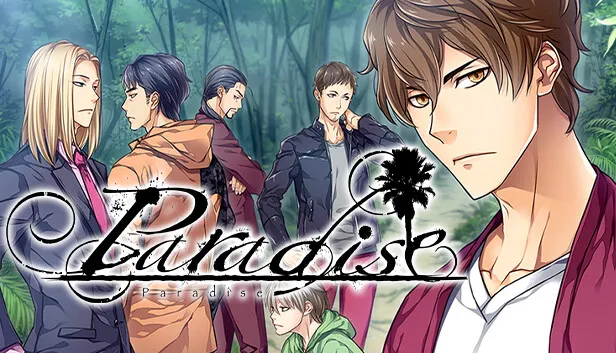
Winning a free island getaway sounds like exactly the kind of lucky break Azuma’s dead end convenience store job desperately needs, and for about a day, it plays out that way. Then the boat scheduled to restock Togashima Island’s food supplies never shows up, and the radio goes dead. PIL/SLASH spends the rest of this BL visual novel watching nine strangers’ civility crack under the very specific, very believable pressure of running out of food and water with no rescue in sight.
What makes the setup effective is how thoroughly the game commits to its own humans are the real monsters thesis. There are no wild animals stalking the island, no supernatural threat lurking in the trees, just people who were perfectly pleasant on day one slowly turning on each other as hunger and thirst do their work.
That grounded, almost procedural dread gives the story real tension even before anyone actually dies, and once a body does turn up under suspicious circumstances, the mystery of what actually happened, and who might be responsible, gives the remaining cast real reason to stop trusting each other.
Three romance routes anchor the story, and the game is upfront about how it wants them approached. Mitsugi and Matsuda’s routes open from the start, while Takara’s stays locked until both of the others have been cleared with their best endings, since his route ends up carrying a much heavier concentration of plot reveals than the other two. Fourteen endings wait across the whole game, one shared bad end plus five apiece for Mitsugi and Matsuda and three for Takara, two of those bad and one happy.
Mitsugi comes across rude and dismissive on the surface, with warmth that only reveals itself gradually as his route goes on. Matsuda’s arc lands as more purely tragic by comparison, his reliable, competent exterior hiding a temper that makes his position of authority over the group feel like an odd fit in hindsight.
Shimada, the group’s freelance photographer, adds an unsettling presence throughout, documenting even the worst moments with a fixation that unsettles the rest of the cast as much as it does a reader.
Where the game shows real restraint is in its Easy Mode, which nudges a reader toward which choices are more or less likely to unlock a given route without ever spoiling whether a specific choice leads toward a good or bad ending. That’s a thoughtful bit of accessibility design for a story built around this many possible bad endings scattered across all three routes.
Where it shows less restraint is in its horror content. At least one CG depicting a burned corpse stands out as some of the grimmest imagery I’ve come across in a visual novel, a deliberate choice that fits the survival horror tone but is worth knowing about clearly before diving in.
Azuma’s own voice work, performed by Kitayama Kyousuke, carries the weight of narrating that unraveling from the inside, close enough to the action that his own growing distrust of everyone around him never once feels like an outside observer’s account.
PIL/SLASH developed the game in collaboration with the writing team LOVE&DESTROY, with original artwork from Kotomi Youji throughout. Paradise also took seven years to reach English readers, releasing in Japan on November 30, 2017 before JAST Blue’s localization finally arrived on April 26, 2024.
Verdict
Paradise earns its reputation as a gripping BL survival thriller by trusting dwindling resources and eroding trust, rather than an external monster, to drive its horror, giving Azuma’s fellow castaways real, escalating reason to turn on each other. Mitsugi’s hidden warmth and Takara’s carefully withheld reveals give the three route structure real payoff, and a thoughtfully designed Easy Mode helps manage the game’s substantial number of bad endings without spoiling outcomes outright. Some real graphic content, including at least one CG that stands out as unusually grim, and Takara’s exposition heavy route are worth knowing about going in, but for readers drawn to tense, well written survival horror wrapped around a BL cast, this delivers.