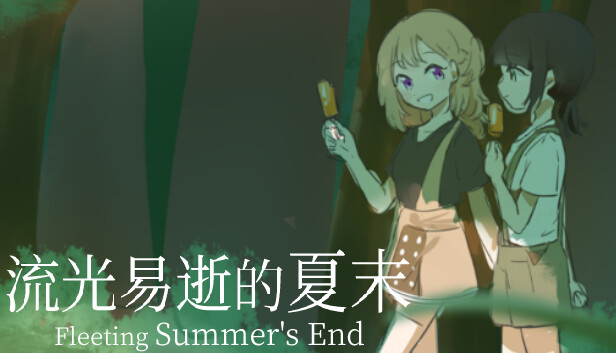
Teoswa is the English rendering of Chaoshan, a real, culturally distinct region of Guangdong Province in southern China known for its own dialect and traditions. Setting the story there rather than in a generic countryside gives Fleeting Summer’s End a specificity most small romance ADVs don’t bother reaching for. The story follows, Deng Ainyang, raised in the metropolis of Shenzhen, who follows her parents back to that ancestral countryside for regular sacrifice rites. It’s there, away from everything familiar about city life, that she has a chance encounter with a local girl, Deng Kangsui, whose upbringing couldn’t be more different from her own. The two share a surname, a detail that quietly ties them to the same extended lineage even before their own relationship develops.
YauYuenTong developed the game as its second release, following an earlier yuri title called Tinheung & Sayuri. The developer has been open that the first game carried real flaws, and the encouragement that project received clearly shaped the decision to keep building toward something more polished here.
That contrast between urban and rural life, between Ainyang’s unfamiliarity with her own ancestral customs and Kangsui’s easy comfort within them, gives the romance a real sense of place rather than treating the countryside setting as interchangeable scenery. The relationship develops from that initial chance meeting into something intimate, growing specifically out of how differently these two women were raised despite sharing the same family name.
Presentation uses pixel art, a stylistic choice that suits a small, focused ADV experience well, prioritizing intimacy and character over sprawling scope.
A city girl returning to her family’s ancestral countryside for a traditional ancestor worship ritual is a specific, culturally grounded setup, and it’s the kind of premise that immediately sets this small ADV apart from more generic romance backdrops.
Verdict
Fleeting Summer’s End distinguishes itself with a specific cultural setting, using a return to real Chaoshan ancestral traditions as the backdrop for a yuri romance between two women who share a surname but grew up worlds apart. Its pixel art presentation suits the small, focused scope of the story, and grounding the romance in a shared family name and two very different upbringings gives Ainyang and Kangsui’s connection somewhere specific to grow from. As YauYuenTong’s second release after the flawed but encouraging Tinheung & Sayuri, this reads like a studio finding its footing, and the result is a sincere, culturally grounded little romance worth a look for readers drawn to slice-of-life yuri stories.