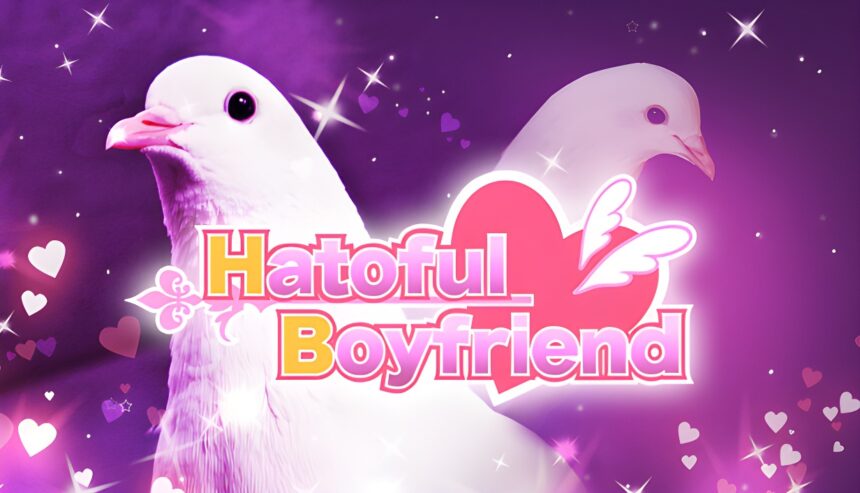
Some of the sincerest romance writing I’ve come across this year showed up wrapped in a joke I almost didn’t take seriously enough to start. A dating sim where every love interest is a pigeon reads like a punchline with nothing behind it, and Hatoful Boyfriend commits to that bit completely, using the skepticism as cover for a story with real weight sitting just past the punchline.
Being the only human ever admitted to St. Pigeonation’s Institute comes with a specific explanation baked into the setting itself. Birds have grown intelligent enough to rival humanity in this dystopian near future, and Hiyoko Tosaka’s natural resistance to H5N1 makes her the one candidate a fragile peace treaty can risk sending to a school otherwise made up entirely of gifted birds. Pursuing one of eight classmates, each mapped onto a familiar dating sim archetype, the shy one, the ladykiller, the haughty rich kid, plays out with real sincerity even while the premise never once stops being absurd on its face.
What sells that sincerity is how much personality the writing manages to layer onto characters who are, by every literal description, birds. Okosan’s pudding obsession could have stayed a one-note joke, and instead it turns into the kind of earnest, single-minded devotion that makes his softer moments land harder than they have any right to. Hiyoko herself holds her own against that cast too, an endearing, occasionally scatterbrained lead whose hunter-gatherer instincts and blunt honesty make even the silliest romantic beats feel like they’re coming from someone specific rather than a blank self-insert.
Individual routes run short enough that repeat playthroughs never feel like a slog, even with the shared common-route material inevitably repeating across different paths. That brevity turned out to be exactly what let me sit with each bird’s specific flavor of ridiculous without the joke wearing thin before the route’s own point had time to land.
Several routes in, the parody starts sharing space with something else entirely. Straightforward dating sim comedy folds into a mystery and science fiction undercurrent I did not see coming, built around a peace treaty holding humans and birds apart, lingering resentment on both sides, and a version of Hiyoko’s own arrival that carries far more weight than her introduction suggested. I want to be careful about how much of that turn I describe, since reaching it cold is a real part of what makes it work. The tonal shift still left me sitting with the ending longer than a pigeon dating sim had any business making me sit.
Hato Moa built the original as an April Fools’ joke in 2011 under her dojin circle PigeoNation Inc., and the Flash version apparently crashed its own web server twice from unexpected traffic before she expanded it into a full visual novel on the FamousWriter engine. Knowing that origin changed how I read the game’s tonal whiplash. Something built that quickly, on a dare to itself, has less reason to play it safe than a game designed from the start to be taken seriously.
Bird photographs stand in for the cast throughout, with an optional human-portrait toggle that swaps in anime-style illustrations of each love interest alongside the usual photorealistic pigeon. I left that toggle on for most of my time with it, and switching it off periodically to look at the actual bird underneath a character I’d grown attached to was a strange, specific kind of funny that never stopped working.
Mediatonic’s HD remake, published internationally by Devolver Digital, is the version most people will actually find today, running on Windows, Mac, Linux, PS4, PS Vita, iOS, and Android. It cleaned up the interface and presentation without touching the writing that made the original worth remaking in the first place.
Verdict
Hatoful Boyfriend uses its deliberately absurd premise as cover for a story with real emotional and narrative ambition, letting Hiyoko’s earnest pursuit of eight distinctly written birds gradually unfold into something darker and more thoughtful than the pastel dating sim surface suggests. Individual routes stay short and genre-typical on a first pass, but the fuller picture that emerges from patient exploration delivers a real surprise for anyone willing to commit past the surface joke. Between Okosan’s pudding-fueled sincerity, Hiyoko’s specific brand of hunter-gatherer charm, and an origin story as unlikely as the premise itself, this remains a thoroughly odd, thoroughly earned piece of work.