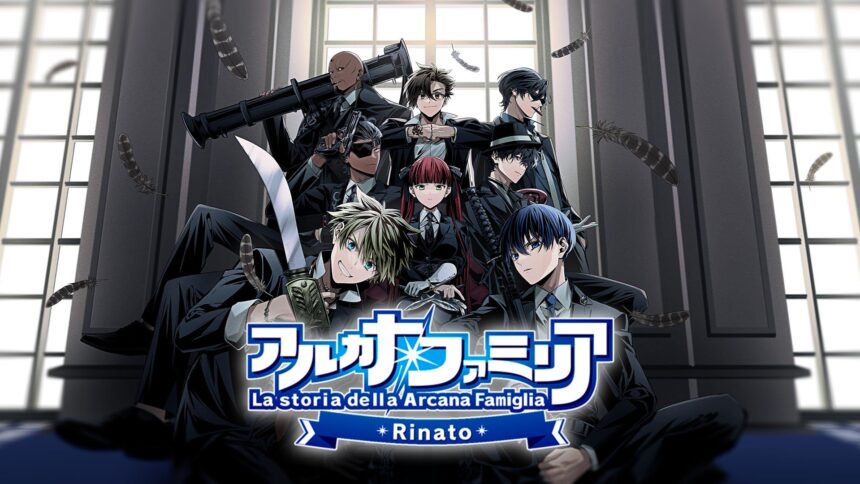
Rinato marks the third life for this story, following the original 2011 PSP release and a 2015 PS Vita edition called Ancora, ported and enhanced now for Switch and, as of February 5, 2026, Steam as well, timed specifically to mark the franchise’s thirteenth anniversary.
Winning a mafia duel and marrying the boss’s daughter as the prize sounds like the kind of premise where the daughter herself barely gets a say. HuneX and Dramatic Create clearly anticipated that objection, and Felicita’s response to her father’s tournament announcement, deciding to enter the Arcana Duello herself rather than sit on the sidelines as the trophy, sets the tone for a story that’s more interested in her agency than the marriage prize framing initially suggests.
The Arcana Famiglia protects the small Mediterranean island of Regalo through mysterious powers granted to select family members, and Felicita’s father Mondo uses his own April 1st birthday party to drop a bombshell. On June 1st, whoever wins the Arcana Duello becomes the organization’s new leader and, in the same breath, Felicita’s husband. Yomi Sarachi, the character designer and original artist on the franchise since its first release, returns for this port’s full HD illustrations.
What sets this apart visually from typical otome presentation is the Comiaru system, blending traditional character portraits with dynamic manga style panels complete with sound effect imagery, particularly during the game’s quick time event duel sequences. A separate mechanic called the Cocoaru system lets a reader glimpse the actual thoughts of whichever character Felicita happens to be focused on, giving otherwise silent internal reactions somewhere to actually surface within the story itself.
The cast carries real personality across the board, funny, bombastic, caring, and mysterious in roughly equal measure depending on which character a reader is spending time with.
Debito, the casino manager hiding real warmth underneath a womanizing, money obsessed exterior, calls Felicita Bambina, Italian for little girl. He covers the artificial eye Jolly built for him, the same one that lets him control his own Arcana power, with a patch he treats as more habit than necessity at this point. His rivalry with fellow childhood friends Luca and Pace gives the whole friend group dynamic real texture beyond simple romantic competition.
Jolly’s history as a subject of experiments tied to how the Arcana power gets forced onto certain family members adds real weight to a character whose backstory reframes his prickliness as earned rather than arbitrary.
Pace rounds out that same friend group as the Family’s cheerful mood maker, leader of the Wands division and bearer of the Strength Arcana, a power that gives him monstrous physical strength to match an oddly specific weakness for lasagna and famously poor eyesight.
Where the game runs into its clearest weakness is Felicita’s own silence. Despite being characterized through other people’s dialogue, and through her own assertive, strong willed actions, as someone compelling in her own right, she never actually speaks outside of the choices a reader makes for her, a real missed opportunity given how much personality everyone around her carries. It’s a structural choice that undercuts an otherwise dynamic, engaging otome.
Jun Fukuyama, Tsubasa Yonaga, Hiroyuki Yoshino, Tomokazu Sugita, Yuichi Nakamura, Jurota Kosugi, and Koji Yusa carry the Japanese voice cast across the main love interests and supporting Family members, giving even the most bombastic personalities a consistent, grounded read underneath the manga style presentation.
Reaching this port over a decade after the original PSP release, following an earlier fandisc that introduced characters Ash and Joshua and a full sequel called Capriccioso along the way, shows a franchise that’s kept finding new life well past its first tournament.
Verdict
Arcana Famiglia Rinato succeeds by blending shonen manga energy with otome storytelling, using its distinctive Comiaru and Cocoaru systems together to give both action and quieter emotional beats real visual dynamism that sets it apart from typical genre presentation. Felicita’s decision to fight for control over her own fate, rather than simply accept her role as tournament prize, gives the story real thematic backbone, and a cast ranging from Debito’s hidden warmth to Jolly’s earned prickliness carries the whole experience with real charm. Felicita’s own total silence as a protagonist is a real drawback given how compelling she reads through everyone else’s eyes, but a full voice cast and Yomi Sarachi’s original art, now in high definition, make this a distinctive entry in the otome space more than a decade after it first started.