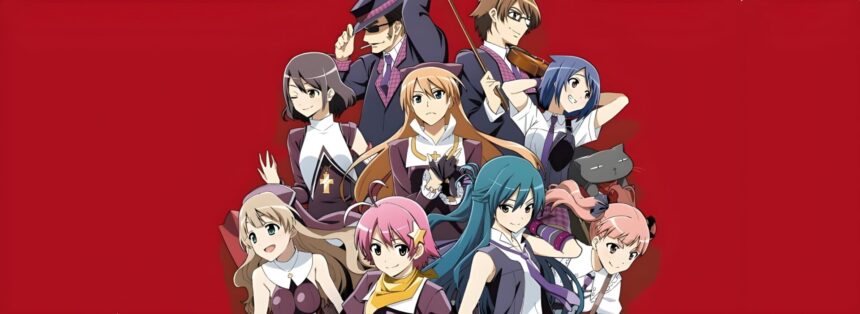
Crossovers between two separate visual novel franchises usually promise more than they deliver, a cameo here, a reference there, but nothing that actually changes what either story meant on its own. I went into this one expecting exactly that kind of surface-level gesture. d2b VS DEARDROPS -Cross the Future- had other plans, using a shared stage to finally close two separate stories at once.
Roughly ten years after the events of Kira☆Kira and about three years after DEARDROPS, Suganuma Shoichi, DEARDROPS’ violinist lead known as the Violin Prince, has spent that stretch of time in Germany following an earlier career setback, while his own band waits for his return. Unannounced, Kaguya Riho catches him performing on television alongside Kirari, the singer who anchored Kira☆Kira and the only member of that story’s old band, nicknamed d2b, to stay in music after everyone else settled into ordinary adult careers. Jealousy erupts before Shoichi even makes it home, and Riho greets his return with a flying kick to the face, setting off a pseudo-rivalry between the two bands that carries the rest of the story.
The whole thing runs as a fully linear, kinetic story with no branching choices anywhere, told from four separate points of view, Kaguya Riho and Suganuma Shoichi from DEARDROPS, and Maejima Shikanosuke and Shiino Kirari from Kira☆Kira. It plays out in a single sitting lasting only a few hours, built explicitly as a closing chapter to both franchises rather than a full new adventure in its own right. The DEARDROPS side lands closest to Riho’s own ending specifically. The Kira☆Kira side treats all four of that game’s original heroines as a combined cast rather than settling on any one of them by name, letting the crossover stay open to however each person originally finished either game.
What the writing does well is let the two casts actually intersect rather than treating one group as guests wandering into the other’s story. Each of the four leads gets real interiority within their own section, and returning to these characters gets specific payoffs tied to relationships the earlier games spent hours building up, not just a surface-level cameo appearance. DEARDROPS itself splits its own heroine routes across Kanade, Riho, Rimu, and Yayoi, and Kirari had already turned up once before as a cameo in Riho’s original route, acknowledged there as an already-famous singer well before this crossover made that connection its whole premise.
Tone is where the script struggles most. It leans hard into a persistently melodramatic, almost theatrical internal monologue style throughout, treating what’s fundamentally a personal rivalry between friends with a weight that reads closer to life-or-death stakes than the actual emotional reconciliation sitting at the center of the story. Certain individual scenes run longer than the material inside them can really support, a pacing issue that also showed up in the original DEARDROPS.
Watching two separate casts, ten years and three years removed from their original stories respectively, confront who they’ve become since is the real emotional center here. The specific sting of Riho watching Shoichi thrive on a stage she isn’t part of carries real weight from the start, well before the actual competition between the two bands takes shape.
Presentation leans hard on reused material. Nearly all of the background art, character art, and animation come directly from the two parent games rather than being freshly produced, right down to the DEARDROPS cast wearing the same outfits they wore three years earlier in the story’s own internal timeline. The Kira☆Kira cast specifically did receive redesigned art reflecting roughly a decade of aging, though, avoiding the immersion-breaking choice of keeping them looking artificially youthful after all that time.
Music follows the same recycled pattern almost entirely. The soundtrack is pulled directly from DEARDROPS specifically, with nothing carried over from Kira☆Kira’s own score. The one new piece of music is the end credits song, a duet meant to represent both bands finally playing together, built specifically for this release.
There’s a real, specific shortfall worth naming directly given how much this story revolves around singers. Several key beats reference Riho’s or Kirari’s singing through other characters’ reactions without the game ever actually playing the performance itself. Some of the most important musical moments in the story end up feeling narrated at me rather than something I actually got to experience.
Full Japanese voice acting carries over from both source games, with Ringo Aoba, Kenji Hamada, Hiromi Igarashi, and Yui Kano among the credited cast for this release specifically. MangaGamer published the English version on September 26, 2014, three years after OVERDRIVE’s original 2011 Japanese release, at $19.95 for Windows XP through Windows 7, with English text over the original Japanese voice work. This carries the same all-ages rating as both source games, since neither Kira☆Kira nor DEARDROPS ever had an adult content version to begin with.
Reading order matters going into this one. Starting with Kira☆Kira, then its own fandisc Kira☆Kira Curtain Call, then DEARDROPS, before finally reaching this crossover gives every callback and easter egg the context it depends on, since the crossover assumes you already know both casts rather than introducing either from scratch.
Verdict
d2b VS DEARDROPS -Cross the Future- earns real goodwill by letting two separate casts actually collide instead of just sharing a scene, using Riho’s jealousy and Shoichi’s return to give both franchises a real, shared ending. The heavy reliance on recycled art and music, along with a script that leans harder into melodrama than the material always needs, keeps it from being the fully realized sequel a crossover this significant probably deserved.