Knowing that something terrible might happen is one kind of fear. Having a warning name the next victim before it happens is worse, because suddenly the horror has a deadline and a face. Spirit Hunter: Death Mark II builds its central mystery around exactly that idea, then sends Kazuo Yashiki into a school where everyone has reason to wonder whose name will appear next.
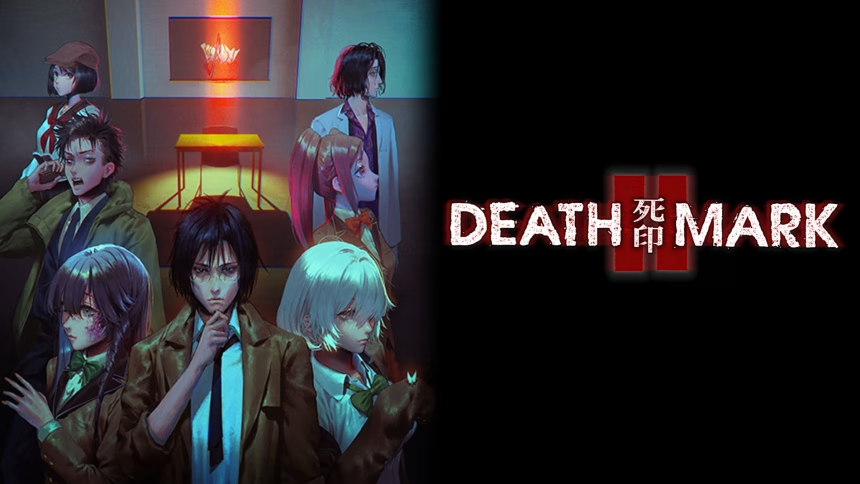
Konoehara Academy in Tokyo’s H City has become the center of a series of supernatural disappearances. Ominous notices announce people’s deaths, students vanish, and an entity known as The Departed appears to be behind it all. Kazuo Yashiki, the returning protagonist of the original Death Mark, infiltrates the academy as a teacher to investigate, only to discover that this isn’t simply another collection of unrelated hauntings. The Departed seems to want something from him personally.
That connection gives the larger mystery an urgency I appreciated. Yashiki isn’t an interchangeable investigator arriving to clean up someone else’s supernatural mess; his history with spirits follows him into the academy, and several familiar faces return to help. The school setting creates a different kind of vulnerability too. These hauntings unfold around students who still have classes, friendships, rumors, and ordinary lives continuing alongside them.
The individual spirits are where the mystery works best. Japanese myths and folklore remain an important foundation, but Death Mark II doesn’t simply drop supernatural creatures into a school and rely on familiarity to make them frightening. Each case asks me to investigate what happened, uncover the history behind a haunting, and understand the circumstances surrounding it before confronting the danger itself. A spirit becomes considerably more interesting once I understand the human story that produced it.
Yashiki’s unusual sensitivity to the supernatural makes that investigation particularly effective. He can perceive things other people cannot, which means an apparently ordinary environment can change depending on what he’s capable of noticing. I liked the uncertainty that creates. A hallway doesn’t need to look threatening when simply knowing Yashiki might see something there that everyone else walks past is enough to keep me alert.
Death Mark II also changes how I physically explore those environments. Movement between locations now uses 2D side-scrolling sections, while closer investigations switch into a first-person perspective. It’s a substantial departure from the more static navigation of the previous games and initially makes moving around Konoehara Academy feel much more immediate.
I’m less convinced that the school gives the new system enough material to justify itself. Konoehara Academy naturally requires revisiting many of the same spaces, and areas unrelated to the current investigation don’t always reward wandering. Once I’d become familiar with the layout, walking through another corridor could feel like transit rather than investigation. The side-scrolling itself isn’t the problem; the limited environmental variety means the novelty wears off before the game is finished.
The enhanced partner system has a more meaningful effect. Yashiki doesn’t investigate entirely alone, and the companion I bring with me can influence the success rate of actions during Suspensive Acts. That gives partner selection mechanical consequences instead of reducing returning characters to familiar faces standing beside the protagonist.
Suspensive Acts themselves fit the investigative structure because survival depends on understanding the situation rather than simply reacting quickly. I like the underlying idea that knowledge gathered while exploring can become important once a spirit finally corners me. It connects investigation and confrontation: paying attention beforehand isn’t separate from surviving afterward.
The presentation still understands that the most effective image in supernatural horror is often the one I don’t particularly want to keep looking at. Character and spirit artwork can be intensely detailed, especially during major confrontations, while the comparatively ordinary academy creates a useful contrast with whatever supernatural presence has invaded it. The school may become repetitive as an explorable space, but visually that familiarity can also make its corruption more unsettling.
Naoaki Jinbo handles the music, while Japanese voice acting gives Yashiki and the supporting cast additional presence, with Ryo Nezuka returning as Yashiki. Neither element needs to overpower the investigation; they’re most effective when making an otherwise quiet conversation or empty stretch of school feel slightly less safe than it should.
The game also makes no attempt to disguise how severe its horror can become. Blood and gore are part of the experience, fitting a series where investigating a haunting means confronting its consequences rather than merely hearing that something unpleasant happened somewhere off-screen.
What ultimately kept the school setting interesting wasn’t wondering what might be hiding in another classroom. It was the notices. Every new case carries the knowledge that someone has effectively been selected, turning investigation into a race against something that seems to know more than Yashiki does. Once The Departed’s attention begins pointing back toward the investigator himself, the question changes from who the next victim will be to why the thing choosing them has been waiting for him.
Verdict
Spirit Hunter: Death Mark II gives its supernatural investigation a strong central hook by turning death notices into promises the characters desperately need to break. The folklore-rooted cases and Yashiki’s personal connection to The Departed give the mystery enough substance to carry a familiar school setting, while partner-dependent Suspensive Acts make returning companions mechanically relevant. I like the immediacy of the new side-scrolling exploration, but repeated corridors and limited reasons to wander mean it eventually becomes more functional than frightening. The investigation itself fares much better: uncovering why these spirits exist remains the real attraction, and Death Mark II understands that knowing a ghost’s story can make confronting it more disturbing, not less.