Putrika 1st.cut: The Reason She Must Perish doesn’t spend much time pretending this is going somewhere happy. Tragedy hangs over the story almost immediately, but what interested me wasn’t simply how dark it could become. It was how quickly love, faith, suspicion, and fear could turn people who thought they were doing the right thing into participants in something terrible.
Lazriel wakes without any memories of who she is or where she came from and finds herself under the care of Remi, a quiet jewelry engineer who claims he was raised by demons and openly tells her that he isn’t human. Their strange arrangement gradually settles into something resembling peace, but Remi is clearly hiding things from her, and Lazriel soon begins experiencing recurring nightmares in which she becomes someone else entirely: Ilsa, a deeply religious village girl facing a terrible fate. As rumors of a malevolent witch spread, those dreams become increasingly difficult to separate from the mystery surrounding Lazriel’s own identity.
That dual perspective gives the story much of its tension. Lazriel’s scenes with Remi can be surprisingly quiet, even tender, while Ilsa’s side steadily introduces the fear and suspicion surrounding accusations of witchcraft. Moving between them means the calmer present never feels completely safe. Every new piece of Ilsa’s story gives me another reason to question what Lazriel doesn’t remember and what Remi refuses to explain.
Remi is particularly effective because the game doesn’t immediately reduce his secrecy to romantic mystery. He can be caring toward Lazriel while remaining difficult to trust, and that contradiction gives their developing relationship more weight than an immediate declaration of affection would have. The forbidden-love premise is established openly by the game itself, but the relationship works because there is enough uncertainty surrounding Remi for affection and suspicion to exist at the same time.
Ilsa’s story provides a harsher counterweight. Faith and accusations of witchcraft turn into an atmosphere where suspicion becomes dangerous in its own right, and innocent people can suffer because others have decided guilt exists before evidence does. The official description explicitly frames the story around false accusations and innocent people being condemned, so the tragedy isn’t simply supernatural horror; human certainty can be just as destructive.
That makes the mystery connecting Lazriel and Ilsa more compelling than either timeline would have been separately. Lazriel wants to understand herself, while Ilsa’s circumstances gradually suggest that whatever answer is waiting may be tied to something much older and uglier than ordinary amnesia. The story keeps those threads close enough together that I was always comparing one against the other rather than treating the dream sequences as interruptions.
Putrika is completely linear, and I think that suits it. There are no routes competing for attention or alternate outcomes asking the tragedy to accommodate several possible versions of itself. The game is officially presented as a kinetic novel, so my role is simply to follow the story as its mysteries converge. For something this concentrated, branching choices would probably have weakened the sense that events are steadily closing in on these characters.
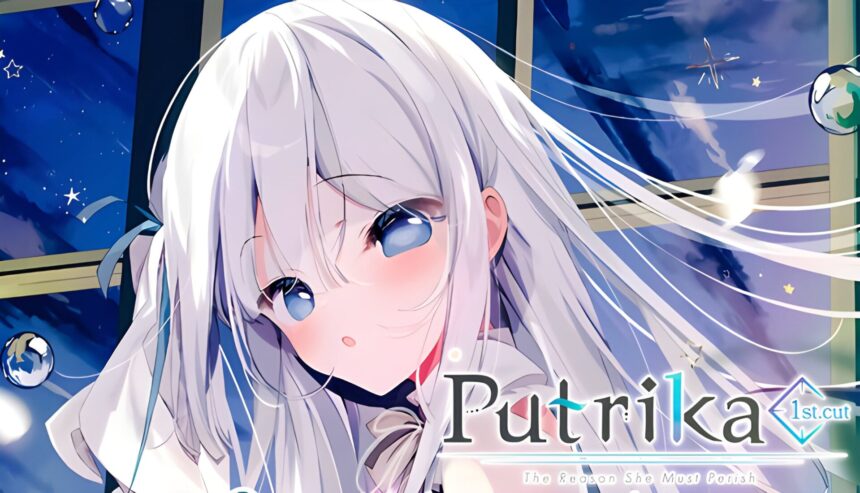
The visual direction gives that inevitability a distinctive face. The character designs use exaggerated eyes, sharp facial shapes, pale coloring, and elaborate clothing that initially took me some time to settle into, but I came to appreciate how immediately recognizable the style is. This doesn’t look like character artwork interchangeable with dozens of other fantasy visual novels. Even when I wasn’t equally fond of every design choice, I never found the presentation anonymous.
The larger illustrations are especially effective when the drama intensifies. Putrika is interested in beautiful imagery sitting beside deeply unpleasant circumstances, and that contrast fits a story where affection and tragedy are constantly being pushed together. The interface has a similarly polished feel, helping the whole production appear considerably more elaborate than its relatively focused structure might suggest.
The English release retains Japanese full audio, and the performances give Remi and Lazriel’s quieter exchanges as much importance as the larger dramatic scenes. That matters in a story where so much tension comes from what characters aren’t explaining to each other. A hesitant delivery or change in tone can make a seemingly ordinary conversation feel suspicious before the script actually confirms why.
The darker material of the game is substantial enough to deserve mentioning though. The developer specifically warns for violence, torture, and suicide-related content. Putrika is fundamentally a tragedy rather than a romance that occasionally wanders somewhere unpleasant, and anyone approaching it purely because of the softer character artwork should expect the tone to become considerably heavier. What makes that darkness work for me is the contrast surrounding it. Lazriel and Remi are allowed enough quieter time together that I have something to lose when the story tightens around them, while Ilsa’s experiences ensure I never become too comfortable with that peace. Putrika doesn’t need enormous scope to create dread; it just needs two timelines moving steadily toward the point where I finally understand why they belong in the same story.
Verdict
Putrika 1st.cut: The Reason She Must Perish makes good use of its kinetic structure, building a compact dark-fantasy tragedy around Lazriel’s missing identity, Remi’s secrecy, and the increasingly disturbing connection to Ilsa’s dreams. The relationship between Lazriel and Remi benefits from being allowed to remain uncertain rather than rushing toward romantic payoff, while the witchcraft accusations surrounding Ilsa give the mystery a harsher edge rooted as much in human fear as anything supernatural. Its distinctive character art won’t suit every taste, but it gives the game an identity of its own, and the full Japanese performances strengthen both the intimate and dramatic sides of the story. More importantly, the two timelines don’t feel like separate mysteries competing for attention; they steadily make each other more unsettling until the tragedy at the center of both becomes impossible to ignore.