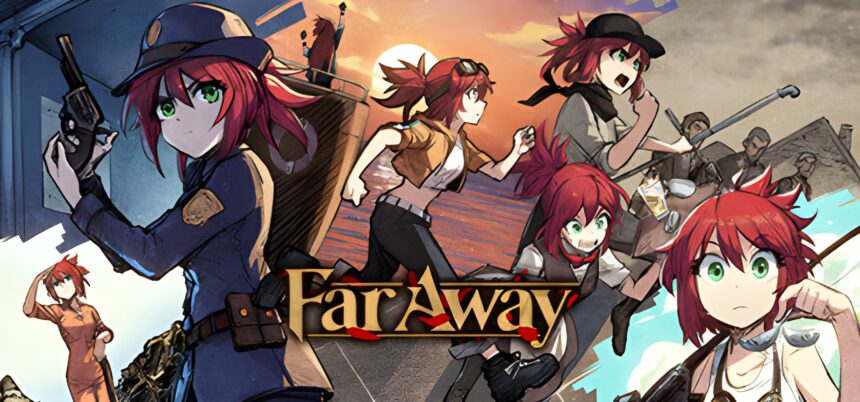
A mechanical arm and a dead end job at the docks is an unusual place to start a crime saga, and Far Away commits fully to letting Krosa Nonet’s ordinary life as a bay worker in the port city of Bedjan spiral into something considerably darker and stranger before the story reveals its actual shape. This Chinese visual novel builds an entire mystery adventure structure around gang conflicts, corrupt detectives, family grudges, and conspiracies threading through a steampunk port city that leans hard into the atmosphere and visual language of classic Hong Kong crime cinema despite its own fictional, late nineteenth century inspired setting. That steampunk backdrop turns out to matter more than a simple aesthetic choice too. Mechanical augmentation, Krosa’s arm included, sits at the center of how this world actually works rather than existing as pure set dressing.
What immediately sets this apart from typical genre entries is the structural ambition behind its branching choices. Rather than treating routes as competing romantic paths the way most visual novels of this scale tend to, Far Away builds entirely distinct adventures out of its choice system, letting players piece together fragments of intelligence and experience the same underlying timeline from different character perspectives before the full scope of Bedjan’s schemes and secrets becomes clear. Collecting fragments of intelligence across different playthroughs and characters means the same underlying timeline reads differently depending on whose perspective you’re following at any given point. That turns replaying less into repetition and more into actual investigation. I came to this genre through more romance focused titles myself, and found that deliberate absence refreshing rather than limiting. I never felt like the game was withholding a romance from me either, since the writing simply isn’t interested in that kind of relationship as its central hook, freeing up space for the mystery itself to carry every scene. The mystery itself carries enough weight to drive investment without needing a central love interest to hold reader attention, a rare accomplishment for a visual novel operating at this scale.
Bedjan sits on the fictional Colseth Continent, a coastal city built where late nineteenth century steampunk technology, mechanical limbs and embryonic electricity among them, meets a world still recovering from war. That alternate calendar and technological setup, advanced mechanical devices existing alongside electricity still in its earliest stages, gives Bedjan a specific, internally consistent identity. It reads as its own place rather than a generic steampunk backdrop borrowed wholesale from other fiction. Twenty years have passed since the last conflict here ground to a halt, and that surface peace hides an underworld scheme brewing underneath it that Krosa gets pulled into almost by accident. Bedjan’s own strategic coastal position, sitting where a continent’s competing powers all want a foothold, means the local gang conflicts Krosa first encounters are never fully separate from larger political maneuvering. That maneuvering keeps happening well above her head.
Krosa herself anchors the story with real specificity, introduced as an ordinary, mechanically augmented docker rather than someone predisposed toward danger or intrigue. Her gradual pull into the city’s underworld gives the mystery real, grounded stakes since she starts the story with more to lose than a typical world weary protagonist already embedded in that criminal world. Ava Narba, a traveling merchant from the desert dwelling Narban people trying to build her own caravan, becomes one of several companions Krosa can align herself with, while figures like the hardboiled detective Ellery Rath and the power hungry, hypocritical Enzo populate the wider cast of allies and antagonists she has to navigate. Tate and a self proclaimed Interpol agent named Tracys round out a wider supporting cast whose loyalties rarely stay simple for long. Both test how much Krosa is willing to trust anyone claiming to have Bedjan’s best interests at heart. None of Krosa’s potential allies read as purely trustworthy from the start either, which keeps every new alliance feeling like a real gamble rather than an obviously safe choice.
The atmosphere Bedjan itself generates deserves real credit too. Leaning fully into Hong Kong crime thriller conventions, right down to Cantonese voice dubbing meant to evoke that specific cinematic tradition, the city reads as a lived in, morally compromised place rather than generic noir set dressing layered over its own steampunk backdrop. That Cantonese dubbing choice specifically ties the game’s steampunk fantasy setting back to a very real cinematic tradition, an unusual pairing that somehow reads as a deliberate, considered choice rather than a mismatched genre mashup. Dark humor threaded throughout keeps the tone from tipping into pure grimness despite the heavy subject matter, and scattered references and Easter eggs nodding to anime and film give the writing a playful, self aware texture that balances the more serious conspiracy plot running underneath it.
Watching Krosa navigate different factions and alliances across the branching structure, with her own fate and the fates of Bedjan’s wider cast of citizens shaped in real ways by accumulated choices, gives even smaller decisions real, felt weight. The full game spans more than 500,000 words across nine main storylines, sixteen distinct full endings, and well over 300 individual choices, structural density that rewards multiple playthroughs rather than treating branching as a one time novelty. Over 300 individual choice points across that structure means even a careful, attentive playthrough leaves real material undiscovered, the kind of density that makes a second or third pass through Bedjan feel worthwhile rather than repetitive. A route built around a character named Lica specifically stands out to me as carrying noticeably fewer permanent losses than some of the others. I’ll leave exactly how that plays out for anyone who reaches it themselves to discover. Where the experience shows real limitation is in how the story currently concludes. The after story sequence points toward a continuation rather than full, definitive closure within this single release, and anyone going in should know they’re getting a substantial, satisfying chapter rather than a fully self contained saga with every thread resolved.
The visual presentation carries real pedigree behind it. Character art comes from artists with previous credits on established, visually distinctive titles like Girls’ Frontline and Arknights, and that background shows in character designs carrying real polish and individual visual identity well beyond what a visual novel at this price point typically manages. The overall aesthetic leans into a striking, contemporary anime style that gives Bedjan’s diverse cast real presence on screen, distinct enough from character to character that even a cast this large stays easy to track across a story spanning nine separate storylines. Backgrounds throughout Bedjan carry the same level of detail as the character art, sea mist and steamboats and mechanical infrastructure rendered specifically enough. The harbor district Krosa starts in feels like a real, functioning place rather than a painted backdrop.
Music plays a real role in setting Bedjan’s mood too, an original score the developers built specifically for the game rather than relying on stock or licensed tracks. That soundtrack later became available as a standalone digital release once the Kickstarter campaign’s stretch goals unlocked it, giving backers a way to hold onto the atmosphere past the credits.
HongCha Games, later restructured under the name Gratesca Studio, built Far Away as their first title aimed at a worldwide release. Founder HJL Misaki, a veteran video producer, assembled a team with prior credits on Shadowverse and Arknights to work on it, and the game originally released on Steam on August 17, 2021, published in the West by X.D. Network before Thermite Games took over console and further localization work. That Shadowverse and Arknights background shows up in how confidently the team handled a project this large for a debut release. Nine full storylines and over 500,000 words is a significant undertaking for any studio’s first game. A Kickstarter campaign specifically to fund English localization and console ports reached its base goal within twenty six hours, eventually unlocking a free digital soundtrack as a stretch reward for backers. That base Kickstarter goal reaching full funding within a single day speaks to how much of an existing audience the original Chinese release had already built before the English version even launched.
Verdict
Far Away succeeds by trading the visual novel format’s usual romantic core for a distinctive, branching crime mystery, using Krosa’s gradual pull into Bedjan’s underworld and a structure built around perspective and accumulated clues rather than competing love interests to earn real, sustained investment across its many storylines. Its steampunk take on Hong Kong crime cinema atmosphere and striking character art, backed by artists with real pedigree in the visual novel and mobile gaming space, give the whole package a real visual identity, even as the story’s clear setup for a continuation means this reads as a strong opening chapter rather than a fully closed saga. For anyone specifically seeking a visual novel built around real mystery and branching consequence rather than romance, this stands as a distinctive pick worth seeking out. Few visual novels commit this fully to letting mystery and consequence carry a story without ever leaning on romance as a safety net.