The word “trust” carries more weight in mystery fiction than almost any other word in the genre’s vocabulary, and few sub-genres lean on it as heavily as the puzzle-box thriller where every character’s motive, memory, and account of events might be a lie waiting to be caught. Games in the vein of Zero Escape built entire structures around exactly that anxiety, forcing players to second-guess allies as readily as enemies. Root Double borrows from that same well of unease, and manages its own careful balancing act between a ticking-clock survival thriller and a slower, exposition-heavy conspiracy plot without letting either half collapse under the other’s weight.
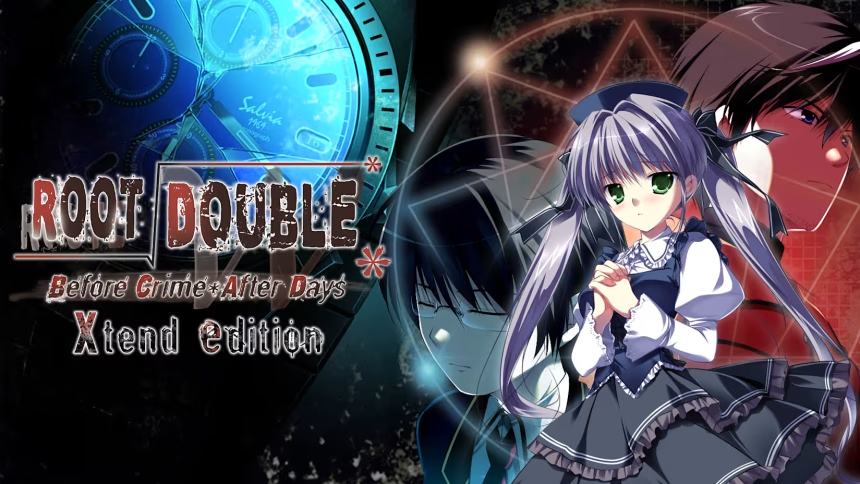
Root Double -Before Crime * After Days-, developed by Regista and Yeti and first released in Japan back in 2012, splits its opening disaster, a nuclear meltdown inside a research facility called LABO, into two separate starting perspectives that only converge much later into something stranger than either route suggests on its own. Watase Kasasagi, a rescue squad captain who loses his memory within minutes of the meltdown, anchors the After route, trapped inside the facility alongside survivors and a dwindling supply of anti-radiation medication as a lockdown countdown ticks toward zero. Natsuhiko Tenkawa, a high school student with limited telepathic ability, anchors the Before route, tracing the six days leading up to the disaster and the terrorist plot tangled up in causing it.
Reading through both openings back to back exposes how deliberately mismatched they feel by design. The After route runs on real, sustained tension, survival stakes ticking down in real time and trust between the trapped survivors fraying under pressure, with Watase’s own amnesia giving his allies genuine reason to view him with suspicion rather than sympathy. The Before route slows down considerably by comparison, settling into dense exposition about the world’s telepathic Communicators and the political friction surrounding Rokumei City’s research facilities. That table-setting eventually pays off once later routes connect threads planted here directly back to the meltdown, but the shift in pace between the two routes creates a real, noticeable dip in momentum for anyone playing through both in one sitting rather than treating them as separate sessions.
Sitting underneath both routes is the Senses Sympathy System, a mechanic that lets players adjust their character’s impression of everyone around them at key story beats, loosely built around the Enneagram personality framework. It’s a clever premise that doesn’t fully live up to its own promise. Small, careful adjustments rarely shift much of anything, and landing a genuinely different outcome tends to require drastic swings rather than the kind of nuanced emotional calibration the system’s pitch implies. Regista and Yeti clearly anticipated some of that friction though, since the game backs the system with real quality of life support, automatic saves after every scene, a hundred deep quick load log, and direct guidance on what needs changing if a bad ending turns up.
Density is this story’s most persistent complaint, and it’s a fair one. Scientific and worldbuilding explanations repeat more than they need to across multiple routes, and the story’s insistence on carefully justifying its own fictional elements sometimes draws more attention to how far fetched they are rather than making them easier to swallow. That density earns its keep eventually, though. Once the shorter C route and the considerably larger D route start pulling every earlier thread together, details that read as simple background color in the opening hours turn out to be load bearing pieces of a much bigger, more unsettling picture, and the payoff for staying patient through the slower stretches is real.
Character work benefits enormously from how much time the game spends with its cast on both sides of the split. The After route’s adult ensemble, including a physician and a teacher among the trapped survivors, carries a noticeably different emotional register than the Before route’s high school cast, and the writing does real work making both age groups feel like they belong in the same larger story rather than existing in two disconnected tonal registers stitched together after the fact.
Presentation wears its 2012 origins openly. Character art holds up reasonably well on its own terms, but the mostly static staging and limited animation make the game’s age obvious next to newer visual novels working with comparable budgets. The soundtrack does its job well enough during quieter scenes but leans toward heavy handed melodrama more often than it lands on anything memorable in its own right.
Full Japanese voice acting runs throughout and is performed with real conviction, particularly during the After route’s tenser exchanges, though the gap between reading speed and spoken dialogue pace eventually pushed me toward reading at my own rhythm with the voices turned off rather than fighting that mismatch scene after scene.
By the time the D route folds every earlier thread back into a single picture, moments that felt like throwaway worldbuilding hours earlier land with a weight I wasn’t expecting going in, and that recontextualization is the single strongest thing this story has going for it, dense stretches and all.
Verdict
Root Double -Before Crime * After Days- pulls off a real balancing act between the ticking clock urgency of its After route and the slower, denser conspiracy building of its Before route, and mostly holds that balance together across a runtime that stretches well past fifty hours for anyone chasing every ending. Its Senses Sympathy System is a clever idea that never quite delivers on the nuanced relationship management it promises, and its repeated exposition tests patience more than it probably should across four routes. Dated presentation aside, the way its later routes recontextualize everything that came before makes this a genuinely rewarding entry for anyone willing to sit with its density long enough to reach that payoff.