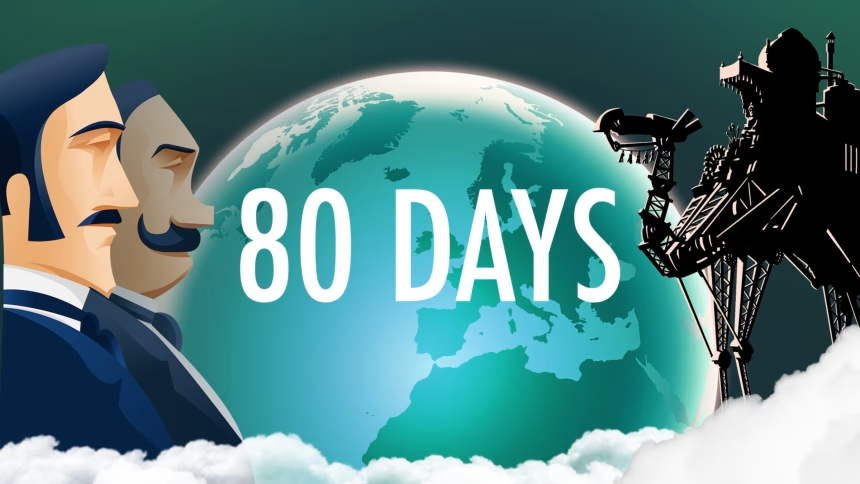
Travel promises completion, seeing everything, checking every box, and then teaches you the opposite. The more ground you cover, the more you realize how much you’ll never manage to close out. 80 Days turns that paradox into its entire structure, racing you around the globe while constantly reminding you how much of it you’re skipping.
The premise borrows its shape from Jules Verne’s 1873 novel Around the World in Eighty Days, reset in an alternate 1872 with a steampunk twist. Phileas Fogg wagers at London’s Reform Club that he can circumnavigate the globe in eighty days or less, and you control his long-suffering valet, Jean Passepartout, choosing every route, every purchase, and every risk along the way. Airships, submarines, mechanical camels, and steam trains all serve as legitimate options for closing the distance, and a real-time clock keeps ticking whether you’re making progress or not, across more than a hundred cities spread over the whole map.
Inkle, a small Cambridge studio run by Jon Ingold and Joseph Humfrey, built this as what started out as a side project during development of the third Sorcery! game, before it grew into something considerably larger than either of them originally planned. Ingold has described the underlying choice structure using a card game comparison, the same pattern as blackjack, where you keep getting another card, but every card makes the existing choice riskier than the one before it. That philosophy runs through the whole resource-management layer sitting underneath the travel itself.
Lead writer Meg Jayanth took this on as her first publisher-backed writing project after prior work with BBC games and Six to Start, working alongside Ingold, who co-wrote alongside her. The script Jayanth built eventually grew to roughly 750,000 words, putting it among the largest gamebooks ever produced, a scale Inkle’s own custom scripting language made feasible in the first place. Built specifically for projects like this one, the language introduced something the studio calls a weave format partway through development. It lets content flow naturally from one option to the next without demanding a labeled heading for every single branch, which let Jayanth write enormous amounts of material quickly without constantly running into structural errors.
What actually distinguishes that scale of writing is a specific creative choice Jayanth made early on. Rewriting the novel’s Indian character, originally a stereotype in Verne’s text, into someone with real interiority meant rewriting how India itself was portrayed. That single change cascaded into revising most of the rest of the world’s countries too, deliberately shrinking the footprint western colonialism plays in this version of 1872. Jayanth also introduced the idea of non-steam steampunk for regions where water was too scarce a resource to waste on steam power, a specific worldbuilding solution that grew to cover multiple regions across the whole map. That decision reshapes the entire journey, since the places you pass through carry real political and cultural texture rather than existing as background scenery for a European adventurer.
Mechanically, you’re constantly balancing three resources at once, Fogg’s health, your shared finances, and the ever-draining clock, while plotting a route across a 3D globe between cities that don’t always connect the way you’d expect. Bribing your way onto an earlier departure can save real time, but spend too freely and you risk going bankrupt, which leaves you sleeping rough and begging for aid instead of racing anywhere. Trading goods between cities helps fund the trip, though overpacking slows you down just as effectively as running out of money does. Underneath all of that sits the Artificers’ Guild, a world-spanning faction driving the development of automata across this alternate 1872, giving the steampunk elements a coherent institutional presence rather than just decorative machinery. Content in a given playthrough blends authored writing with procedurally arranged structure, so two people racing the same wager rarely see the same string of events, and multiple distinct endings wait depending on how the trip actually plays out.
Passepartout’s relationship with Fogg carries real weight through all of this, since earning his employer’s trust and respect isn’t guaranteed just by finishing the route on time. Every choice about how honestly to report setbacks, how much initiative to take without permission, and how to handle the strangers met along the way feeds into a dynamic between the two men. That dynamic shifts depending entirely on how you play, and the game never locks you into a single interpretation of who Passepartout actually is. That’s where the writing’s real achievement sits, less in the destination than in how much personality gets built into a servant character who spends the entire novel a step behind his employer.
Character and transport art comes primarily from Jaume Fabregat, working under the name Jaume Illustration, with Humfrey and artist Alan Dukes both contributing additional artwork across the project. The bold, flat, poster-like style gives the whole thing something close to a graphic novel feel rather than a conventional illustrated visual novel look. Composer Laurence Chapman scores the journey, shifting tone city by city to match wherever the route currently sits, giving each stretch of the map its own sonic identity rather than looping one general theme across the whole trip.
Nothing in 80 Days is spoken aloud. Every scene, every negotiation, and every disaster gets delivered entirely through prose, which fits a game where Jayanth’s prose alone has to carry the full weight of characterization.
iOS got the game first, on July 31, 2014, followed by Android that December, Windows and Mac the following September, and a Nintendo Switch port arriving October 1, 2019. The version most people encounter today on PC received a substantial content update after its initial Steam launch, adding thirty new cities across the Americas along with new characters and storylines, meaning the base experience today is considerably larger than what shipped at release. The official content rating notes infrequent mature or suggestive themes, some horror and fear elements, references to alcohol, tobacco, and drug use, and simulated gambling, none of it graphic, but worth knowing if you’re picking this up expecting something purely family friendly throughout.
Recognition for this one has been substantial and sustained. It was named TIME Magazine’s number one Game of the Year for 2014 and won the IGF Award for Excellence in Narrative in 2015. Four BAFTA nominations followed that same year, and as of 2025 it still sits at fifth place on the Interactive Fiction Database’s Top 100 list. Programming credits split by platform go to Ben Nicholson for the PC and Mac edition and Iain Merrick for the Android edition, reflecting how much individual engineering work went into making the same enormous script run cleanly across such different systems. Inkle has stayed a deliberately small studio in the years since, going on to make the four-part Sorcery! series, Heaven’s Vault, Overboard!, and Pendragon, funding each new project from the success of the last rather than relying on outside investment.
Verdict
80 Days earns its reputation through a rare combination, a steampunk adventure with real political imagination behind its worldbuilding, wrapped around a resource management structure that makes every choice about time, money, and honesty feel like it actually matters. Between Jayanth and Ingold’s script, Fabregat’s art, and Chapman’s shifting score, all built on a custom scripting language designed specifically to make writing at this scale possible, this remains one of the most fully realized pieces of interactive fiction on any platform.