WORLD END ECONOMiCA works best as an economics thriller that happens to be wearing the clothes of a teenage growing-up story, rather than the other way around. Its onboarding asks real patience, a rough opening stretch built around a lead who’s hard to root for at first, and I nearly bailed myself before any of it started paying off. Once the trilogy settles into its own rhythm, though, there’s always one more market swing to track, one more piece of financial history folded into the fiction, one more scene between two people slowly learning to trust each other. That momentum builds into a climax I still think about.
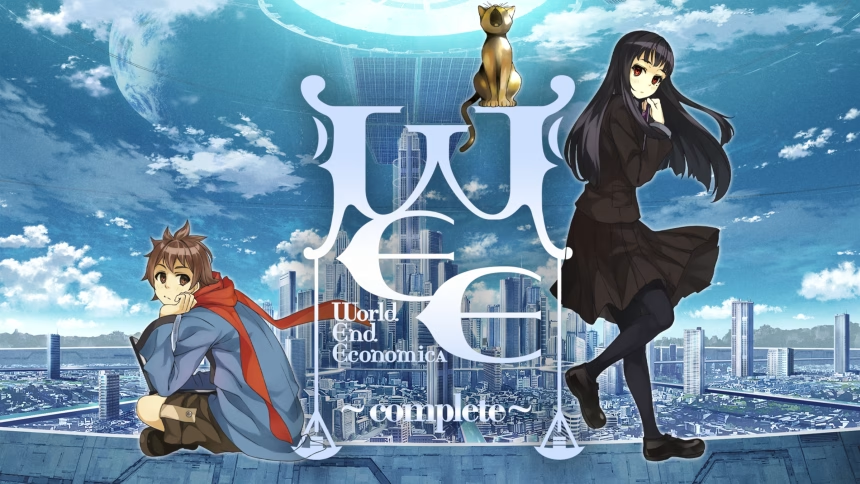
Yoshiharu Kawaura, known as Hal, is part of the first generation born on the Moon, sixteen years after Earth collapsed into pollution and poverty and humanity relocated there instead. He runs away from home chasing a vague but consuming ambition, to stand somewhere no one else ever has, and decides the fastest path there runs straight through the lunar financial markets. Petulant, self-centered, and prone to uncomfortable, mean-spirited thoughts about the people around him, he tested my patience for a real stretch of the first episode. That includes his early treatment of Hagana, the cold, mathematically gifted fellow runaway he ends up sharing a roof with after a young church owner named Lisa takes them both in.
It’s a real risk the writing takes, and I’m not convinced everyone will find the eventual payoff worth wading through that rough opening. Nothing about the structure softens the risk either. This is a kinetic novel with no branching choices anywhere, a straight linear read across three episodes rather than a story you steer. Those who do stick with it get to watch a transformation unfold that actually earns itself across the trilogy’s remaining two chapters. Hal softens into someone capable of real thoughtfulness and reliability, Hagana’s icy exterior cracks to reveal someone more vulnerable underneath, and their bond, staying entirely chaste throughout, grows into the emotional backbone the story needed all along.
What elevates the writing past a simple redemption arc is how seriously it takes its own subject matter. Real financial history, market bubbles, historical crashes, gets folded naturally into the fiction rather than delivered as a lecture, and Chris, a cash-strapped girl who ends up learning math from Hagana, gives that thread a human face beyond spreadsheets and theory. Four-year time gaps separate each episode, letting the story skip past repetitive detail while still selling the sense that these characters, and this lunar society, are changing between chapters. The Moon itself comes across as a believable, alien-but-human setting, ruled by cold pragmatism and profit above all else.
That pragmatism is exactly what makes the ending land the way it does. Without spoiling where Hal and Hagana actually end up, the trilogy’s climax pays off the market education and the relationship in the same breath. It left me feeling closer to vindicated than triumphant, like the early unpleasantness had been building toward something the story actually earned rather than something it stumbled into.
Presentation is the clear weak point across the whole package. The Complete edition remasters both character designs and backgrounds, and while that cleanup helps, the art was never going to be this story’s strongest asset, with inconsistency still visible across the cast. Music fares better, even if it never becomes especially memorable on its own. The soundtrack spans ninety-six tracks across four discs, blending atmospheric techno with occasional mellow orchestral pieces while giving Hal, Hagana, and Lisa their own character themes. Opening themes come from Kishida Kyoudan & the Akeboshi Rockets, with Kiyono handling the endings, and none of it fights for attention the writing hasn’t already earned.
Isuna Hasekura wrote this, better known for Spice & Wolf’s own take on economics through folklore, and developer Spicy Tails built it as a three-part kinetic novel first published in Japan across 2011, 2012, and 2013. Sekai Project handled the English localization starting in 2014, later running a Kickstarter to fund the Complete edition that bundles all three episodes together. Knowing Hasekura’s other work going in, I expected the folklore instinct to carry over more directly than it does. Instead, the market obsession turns out to be its own kind of mythology, just dressed in spreadsheets instead of fairy tales.
Verdict
WORLD END ECONOMiCA asks real patience before it pays off, opening with a protagonist hard to root for and a slow-burn first episode that nearly lost me before the trilogy earned its emotional weight. What waits on the other side is an ambitious sci-fi economic drama that treats real financial history and a believable lunar society with real care, rewarding that patience with a redemption arc for both Hal and Hagana that feels earned rather than convenient. Inconsistent art and a soundtrack that supports without standing out keep the presentation from matching the writing’s ambition, but as a genre experiment few other visual novels have attempted, this remains a flawed, occasionally frustrating, ultimately worthwhile trilogy for anyone willing to stick with it.