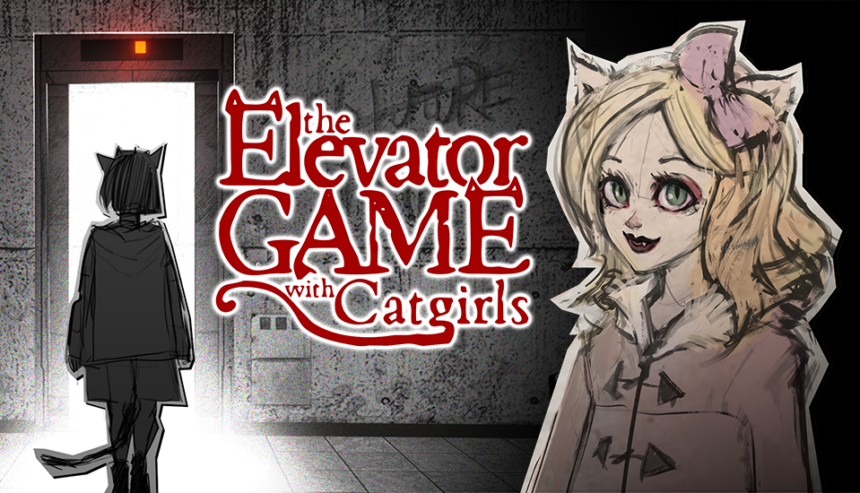
A girl stands across the street from an apartment building at two in the morning, checking her phone every few seconds and telling herself the silence just means bad reception. Nothing about that moment reads as silly, even once you learn the person waiting has the ears and tail of a cat, and even once you learn what she is actually waiting for. What happens if you get every rule right and still do not come back is the question at the center of The Elevator Game with Catgirls, a horror visual novel built around the real Korean legend of a ritual said to open a path into another world. Kirin takes a dare from a classmate and attempts the ritual herself, and when she does not come back, her girlfriend Asahi decides the only way to get her back is to walk through the same doorway.
More than five hundred individual backgrounds keep the story’s central apartment building feeling like an actual, specific place rather than a handful of repeated rooms standing in for an entire setting, and I noticed the difference immediately once Asahi started moving between floors that actually looked distinct from each other.
That level of finish did not happen by accident. A playable demo had already been circulating for a year before the full release, and the team spent part of that stretch running beta builds specifically to stress-test how much was going on under the hood, since a game mixing dialogue, point-and-click investigation, and branching endings has a lot more that can quietly break than a straight visual novel does. I never hit a dead clue or a broken flag during my run, and knowing there was a real testing pass behind that makes the smoothness feel earned rather than lucky.
Playing as Asahi, I split my time between dialogue heavy conversations and short point-and-click stretches, tapping through environments for clues and interactive details rather than just clicking through text boxes. A handful of choices come with a visible timer if you turn that option on, and I left it on for my first run, which turned a couple of otherwise calm scenes into moments where my hands were actually a little unsteady before I picked an answer.
Underneath the ritual is a much quieter story about bullying and the specific kind of guilt it leaves behind in the person targeted by it, and the game never rushes past that to get back to the scarier stuff. The dialogue during Asahi’s search stays grounded even when events get strange, which kept the investigation feeling like an actual conversation with worried people rather than an exposition dump. I expected the catgirl framing to soften that material, and instead it sat right alongside the horror without either one canceling the other out. The store page carries a discretion warning about disturbing content before you even start, and by the time I reached the back half I understood exactly why it was there.
Asahi and Kirin read as opposites in exactly the way that makes the setup hurt more, Kirin quick to take a dare she probably should not have and Asahi the one left running through every version of the night that could have stopped her. Their relationship gets treated with real weight rather than existing just to justify the search, and small details filled in during Asahi’s investigation, a shared joke, a habit, a promise neither of them treated as serious at the time, kept giving me new reasons to care exactly when the game needed me to.
Every line in the game is voiced in English, a feature that started as a Kickstarter stretch goal and made it into the final release rather than staying a promise. OddTillTheEnd composed the score, and outside of one proper vocal track it stays mostly instrumental and quiet, tracks like Cold Night and Black Tulip doing more atmospheric work than their plain names would suggest. That vocal track, Masks and Illusions, performed by Kylee Henke, gets reused across a few different arrangements depending on which part of the story you are in, a detail I only caught because the instrumental version stopped me in the middle of a tense scene and I had to place where I had heard the melody before. A second recurring cue, Otherworld, gets its own alternate version later on, and I will not say where it shows up beyond admitting it changed how I felt about the first time I heard it.
NoBreadStudio is a three person team, Nayru, KleeBentz, and Xolf, the same group behind the mystery romance SoulSet and the escape room styled Blankspace, and they funded this project through Kickstarter in November 2021 before releasing it about a year later. Backers who supported that campaign got keychains, T-shirts, and a mousepad with a choice of designs, and two years after launch the team followed up with a digital artbook running past a hundred and ten pages, packed with early character sketches, a gallery of the game’s three dimensional backgrounds, and enough finished assets that they warn you outright to finish the story first because of how much it gives away. That small scale shows up in the story’s length more than in its polish. Fifteen endings, eleven main paths and four secret ones, give you real reason to replay a game that otherwise wraps up in a single sitting, though the choices leading to some of those secret endings are not always signposted clearly, and I ended my first run without realizing how close I had come to a completely different outcome.
A small object Asahi finds early in her search does not mean much on its own until a much later scene gives it context, and that is where the emotional weight of the whole search caught up with me hardest. I will not say what that later scene actually reveals, only that it recontextualizes everything leading up to it, landing closer to hopeful than devastating once everything settled.
Verdict
The Elevator Game with Catgirls takes a premise that sounds like a joke on paper and treats it with real patience, using a real Korean urban legend to ground a story about guilt and bullying that never lets its horror trappings crowd out the human cost underneath. Its five hundred plus backgrounds and fully voiced English cast give a short, contained story more visual and audible texture than its scale would suggest, and fifteen endings reward digging past a single playthrough. Some of that replay value stays a little obscured without real hints, and a three person team’s resources only stretch so far, but as a small, sincere horror visual novel that respects both its silly premise and its serious one, it earns the couple of sittings it asks for.