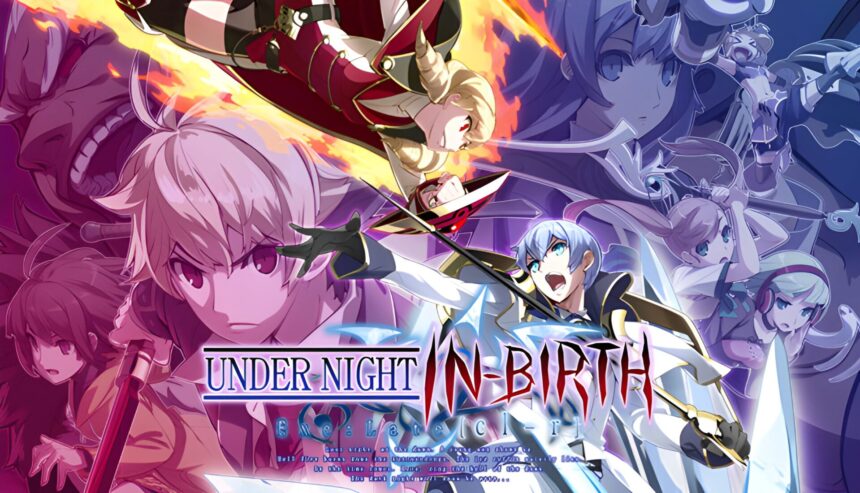
I spent roughly ten hours inside a fighting game without throwing a single punch. No training dummy, no story battle, no interrupted conversation forcing two characters into a match. Under Night In-Birth Exe:Late reserves Chronicle Mode entirely for reading, temporarily stripping away the combat system that made the series famous so its fighters can explain why they entered the Hollow Night in the first place. That reversal gives Chronicle Mode an unusual purpose. Fighting-game stories often introduce a disagreement, manufacture a reason for two characters to clash, and then let the match provide the real entertainment. Here, French-Bread delays the fighting altogether. The mode looks backward from the Arcade storyline, following members of the playable cast before the events that bring them together during the main conflict. Arc System Works describes its 23 chapters as stories tied to the central plot, while Arcade Mode separately preserves the version of the story originally presented in arcades.
The wider setting already gives the cast plenty to explain. During the Hollow Night, creatures called Voids consume the power that manifests there, while people known as In-Births gain access to that same supernatural force. Linne investigates an increase in both groups while pursuing Hilda, the leader of Amnesia, and Hyde follows because he needs answers about the power and weapon he has acquired. Chronicle Mode does not replace that Arcade narrative. It supplies the histories, loyalties, and private conflicts that exist before it begins.
I could open the chapters in the order I wanted rather than following one mandatory sequence from start to finish. Individual scenarios remain linear, but the menu let me decide whose background mattered most to me at a particular moment. That freedom suited a cast whose stories do not all begin in the same place. Some chapters explain organisations and rivalries central to the main plot, while others focus on more personal events that clarify a character’s behaviour without immediately advancing the larger conspiracy.
Choosing freely also carries a risk. The scenarios overlap, refer to shared history, and occasionally assume familiarity with names or factions introduced elsewhere. Reading entirely at random can make a later conversation harder to place. I still preferred that possibility to being forced through every character in a fixed roster order because it allowed curiosity, rather than combat progression, to determine the pace.
Chronicle Mode changed my understanding of the roster most effectively when it connected temperament to fighting style. Wagner’s battle design centres on a sword, shield, and flame-based attacks, while Enkidu fights without a conventional weapon. The game’s official command material confirms how mechanically different the two are, but Chronicle Mode supplies the outlooks that make those differences feel attached to people rather than selected from a move list.
Wagner, known as the Crimson Knight, approaches conflict with the certainty and discipline expected from her position. Her presentation in battle communicates force immediately, but the surrounding story gives that force institutional and personal context. I became more interested in what her title demanded from her than in the fire effects attached to her attacks.
Enkidu produced a different reaction. His bare-handed approach already separates him visually from weapon users, yet the important distinction is not simply that he punches people while Wagner carries steel. Chronicle Mode helped me see how his pursuit of strength governs the way he evaluates opponents, himself, and the purpose of combat. After reading his material, his direct physicality felt less like a roster gimmick and more like the clearest possible expression of his priorities.
That is where the mode earns its enormous quantity of text. A fighting-game sprite can communicate confidence, aggression, elegance, or restraint almost instantly. It cannot easily explain how those qualities developed or what they cost the person displaying them. Chronicle Mode takes characteristics I could already identify in animation and gives them history.
Not every chapter benefits equally from the format. Several scenes consist of long conversations over static backgrounds, with portraits changing expressions while the script carries nearly all movement. There are no playable fights to interrupt the reading, and I encountered no branching choices that allowed me to redirect a scenario. Arc System Works categorises Chronicle separately from Arcade, Versus, Score Attack, Training, and the other combat-focused modes, and its own description presents it simply as a collection of stories connected to the main plot.
I admired the commitment while still feeling the weight of it. Ten hours of uninterrupted fighting-game lore is substantial, particularly when consecutive chapters explain organisations, supernatural terminology, and events whose significance may not become clear until another scenario. At its best, that density made the world feel planned beyond the limits of an arcade ladder. At its weakest, I felt as though the mode was documenting information rather than dramatising it.
The complete absence of combat makes that weakness more visible. A playable confrontation could have changed the rhythm or demonstrated a newly revealed motive through action. Chronicle Mode refuses that option, even though the fighting system is sitting elsewhere in the same package. I occasionally wanted the story to stop explaining why a conflict mattered and let me experience that conflict directly.
Removing battles does have one important advantage. No character needs to attack an ally merely because the game requires another match. Relationships can remain cooperative, hostile, uncertain, or unresolved without being forced into the standard fighting-game pattern of conversation followed by violence. The writers can spend an entire chapter on events that would never justify a playable duel but still matter to the character involved.
The presentation is visually consistent with the wider game. French-Bread’s sharply drawn character art preserves the cast’s distinct silhouettes, clothing, and expressions, while dialogue portraits give familiar fighters a broader emotional range than their combat stances alone reveal. I found the artwork attractive throughout, although the limited animation meant that dramatic events sometimes depended on narration describing movement that the screen only suggested.
The soundtrack keeps those static scenes from feeling completely inert. Raito’s music already defines the larger Under Night identity through character themes and atmospheric pieces, and Chronicle Mode uses music to distinguish personal recollection, organisational conflict, comedy, and approaching danger. Official releases document the series’ principal themes and the additional music introduced with Exe:Late, including Wagner’s “Flame & Destiny” and Enkidu’s “Extreme Stream.”
I could not verify that Chronicle Mode contains exactly 31 exclusive, officially unnamed tracks, so I have not treated that number as fact. What I can say from playing is that the mode uses a broader range of background cues than the character battle themes alone, and those quieter pieces carry a considerable share of the pacing because voices and animation are limited.
Chronicle Mode first became part of the expanded Exe:Late release rather than the original Exe:Late package. Arc System Works released Exe:Late on Steam in August 2018, adding Wagner, Enkidu, Mika, and the extensive story material later retained in Exe:Late. The current official manual for cl-r still lists Chronicle as a 23-chapter mode alongside the returning Arcade story.
That version history matters when discussing characters who arrived later. Londrekia debuted with Exe:Late, after the main Chronicle collection had already been created, and the update’s official marketing identifies him as its new playable fighter. I therefore would not describe his lack of an original Chronicle chapter as an unexplained omission. He belongs to a later stage of the roster’s development.
Eltnum and Akatsuki also sit somewhat apart from the central Under Night cast because they originate in other French-Bread-associated fighting games. Their inclusion as playable guests does not automatically give them the same narrative role as characters created specifically for the Hollow Night storyline. I have avoided claiming that they are definitively the only original-roster characters without dedicated Chronicle material because the official manual confirms the total chapter count but does not provide a simple character-by-character authorship table.
The mode worked best for me after I stopped expecting the rhythm of either a traditional fighting campaign or a choice-driven visual novel. It is closer to a large prequel anthology embedded inside a competitive game. The reward is context rather than control. Completing a chapter does not unlock a personal route I shaped or test whether I understood a combat lesson. It changes what I know when that fighter later appears in Arcade Mode or on the character-select screen.
That distinction will determine whether the ten-hour commitment feels worthwhile. Someone primarily interested in competition can ignore Chronicle Mode without losing access to the combat system. Someone invested in the setting receives a large amount of material that would have been difficult to fit between arcade matches. I sit between those audiences, which made the experience alternately illuminating and exhausting.
Verdict
Chronicle Mode makes a bold trade: it removes every fight from a fighting game’s largest narrative mode so that motives no longer have to compete with match structure. Its 23 chapters give the Under Night cast histories extending beyond the short exchanges that precede arcade battles, and I came away understanding why several characters fight rather than merely recognising how they fight. The cost is momentum. Static presentation, linear scenarios, dense terminology, and the absence of interaction make parts of the anthology slow, especially when several exposition-heavy chapters are read consecutively. The mode rarely behaves like a fully interactive visual novel, but it also accomplishes something many fighting-game campaigns avoid. It allows conversations to end without inventing an excuse for someone to get punched.