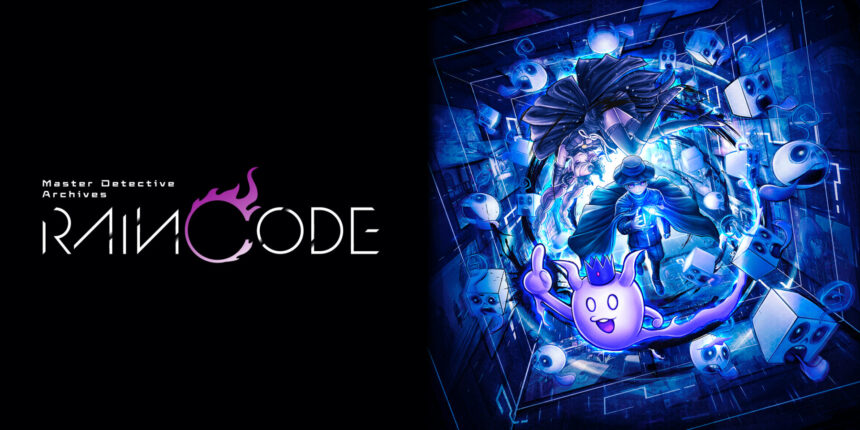
Detective stories usually trust their investigator to already know who they are, leaving the mystery entirely out in the world where it belongs. It gets more interesting the moment the person asking the questions turns out to be one of them. Master Detective Archives: RAIN CODE hands that exact complication to Yuma Kokohead, a trainee for the World Detective Organization who wakes up with no memory of his own past, alone on the cold floor of a train station’s lost-and-found room, and heads straight into Kanai Ward to find it. The city runs on rain and neon under the thumb of the Amaterasu Corporation, an oppressive megacorporation whose own private Peacekeepers stand in for a police force that barely functions anymore, burying any case that doesn’t suit the company’s interests. Yuma’s only real companion through it all is Shinigami, a chatty, cheerful death god who’s contracted herself to haunt him, carrying a sense of morality that reads as distinctly inhuman even at her friendliest.
Too Kyo Games and Spike Chunsoft built this together, with Danganronpa creator Kazutaka Kodaka co-writing alongside Takekuni Kitayama, development that Kodaka has said stretched back roughly six years before the game actually released, originally under the working title Enigma Archives: Rain Code. That pedigree shows most clearly in the Mystery Labyrinth sequences, dungeon-style deduction segments that clearly grew out of the same design instincts behind Danganronpa’s class trials without just copying them outright. The original Switch release in 2023 came bundled with a digital prequel novel, and a Mysteriful Limited Edition added a developer commentary book, a SteelBook case, a Shinigami plush, and a CD soundtrack on top of that. An enhanced Plus edition followed in July 2024 for Japan and that October worldwide on PS5, Xbox Series X/S, and Windows, folding in five detective-focused DLC side stories along with upgraded graphics and a new gallery mode holding 95 cinematics and 69 BGM tracks, 164 pieces of unlockable content total, releasing sequentially as each chapter gets cleared.
Yuma holds himself with a determination that never once tips into overconfidence, which made his blank spots about his own identity feel like real vulnerability rather than a cheap plot device to justify exposition. The death spirit haunting him plays against that uncertainty with its own strange presence. Yuma and Shinigami both end up joining the Nocturnal Detective Agency, the only detective outfit still operating in Kanai Ward, headed by Yakou Furio, an aloof, somewhat weak-kneed man who holds WDO certification without technically ranking as a Master Detective himself, and whose entire operating philosophy revolves around staying quiet enough to avoid drawing the Amaterasu Peacekeepers’ attention. The wider detective agency cast around them each bring a distinct enough personality and specialized detective ability, called a Forensic Forte, ranging from Postcognition to outright Disguise, that Kanai Ward’s oppressive security force never feels like an even match for the group Yuma ends up joining, Zange Eraser’s Forte built around a power called Thoughtography and Zilch Alexander’s centered on animal investigation among the stranger, more specific talents on display.
Investigation itself runs through collecting Solution Keys, clues gathered by exploring Kanai Ward’s districts and questioning its residents, and the city gives that exploration real texture, Kamasaki District’s high-class cafes and art gallery bathed in a calming blue light, the Sun and Moon Hotel standing nearly empty thanks to the city’s isolation, a polluted Riverbank shaped directly by Amaterasu’s own business practices, where the Nocturnal Detective Agency relocated after an eviction from its old Kamasaki offices, and Kanai Station Square itself, the only real gateway into the city and largely deserted despite its scale. Side quests scattered across those districts, tracking down a petty thief here, helping an activist disillusioned with the city gather information there, add texture to Kanai Ward even when the tasks themselves stay simple, closer to errands than actual mysteries.
Fighting Mystery Phantoms inside the Labyrinth sequences means using actual deductions rather than raw combat, dodging their gimmicks and traps with Solution Keys before striking back in fast-paced Reasoning Death Match sequences using a weapon called the Solution Blade, and I found that mechanic did a better job of keeping me invested in the puzzle underneath each case than a straightforward action encounter would have. What Yuma’s investigation into his own past actually uncovers stays out of scope here, but Kanai Ward’s corporate-controlled surface hides enough real rot underneath it that the mystery never once felt like it was stalling for time across the game’s six main chapters, most of them running several hours long on their own, adding up to a campaign closer to a few dozen hours than a quick weekend playthrough. Memory Shards hidden throughout the city unlock secret scenes between Yuma and the rest of the detective cast outside the main story, giving that extra time real purpose beyond just padding the runtime.
Rui Komatsuzaki’s character designs give Kanai Ward’s detective agency a visual identity as distinct as anything from Danganronpa. Shimadoriru’s additional art work fills out a world that runs on Unreal Engine 4, rendering rain-slicked streets and neon signage in full 3D rather than the static backgrounds a more traditional visual novel usually relies on. Exploring that city in real space, rather than just clicking between static scenes, gave Kanai Ward a sense of place I wasn’t expecting going in.
Masafumi Takada composed the score, including an ending theme called Rainy After Rain and a handful of in-universe radio songs that play as Kanai Ward’s own pop culture rather than just background music. A full English voice cast covers the dialogue, led by Lucien Dodge as Yuma, a deliberate piece of casting given his own history voicing Hifumi Yamada in the original Danganronpa and K1-B0 in Danganronpa V3, alongside Anjali Kunapaneni as Shinigami in English and Sayumi Suzushiro in the original Japanese track. Takehito Koyasu voices Yakou Furio in Japanese with Kaiji Tang taking the English side, and Amber Lee Connors, Khoi Dao, Xanthe Huynh, Aleks Le, and Lisa Reimold round out a wide supporting cast across the rest of the detective agency, giving Yuma’s confusion and the agency’s banter enough personality that I stopped noticing I was reading subtitles at all.
Piecing together who Yuma actually was before Kanai Ward erased that history made every small memory fragment recovered along the way feel like a real personal stake rather than just another clue on a checklist. Master Detective Archives: RAIN CODE builds a mystery big enough to swallow an entire city and still makes Yuma’s own forgotten identity the piece I cared about solving most.
Verdict
Master Detective Archives: RAIN CODE sends an amnesiac trainee into a corporate-run city of rain and neon, then lets deduction-driven Mystery Labyrinth sequences and Rui Komatsuzaki’s character work carry a mystery that’s just as personal as it is citywide. Full 3D exploration across Kanai Ward’s distinct districts and Masafumi Takada’s score give the city real presence, and Yuma’s forgotten identity gives the whole investigation stakes that go well beyond solving cases for other people.