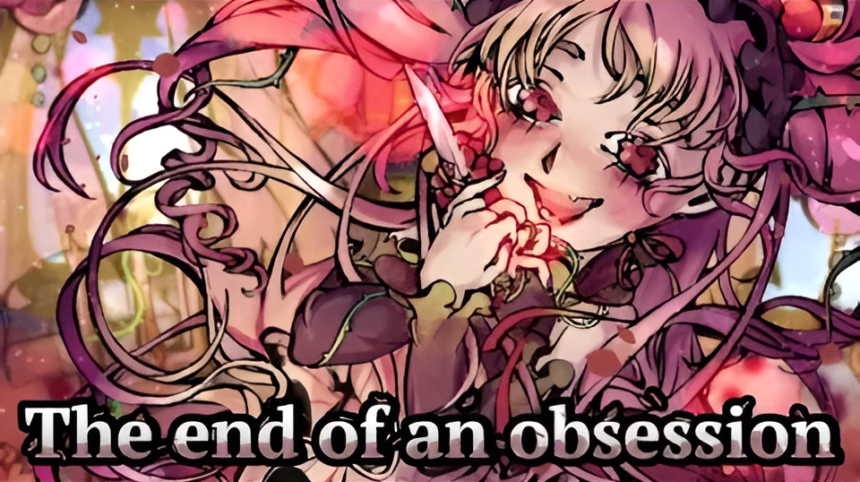
The protagonist wakes up groggy, head throbbing, with no memory of who they are or how they got here, only to find a woman who looks like a rose standing quietly by the bedside. She offers the chance to open up, to learn how to love her, and maybe even reach a happy ending if things go well. The End of an Obsession builds its entire story around what that offer actually costs, a direct sequel to ebi-hime’s earlier yandere yuri visual novel It Gets So Lonely Here. Self-published free on itch.io as one of 106 entries submitted to Yuri Game Jam 2024, hosted that year by sabrina_tvband and nadia nova, the game released October 31, 2024, built in Ren’Py and available for Windows, Mac, Android, and Linux.
The developer has said the whole idea started with a single question, what happens once a yandere finally gets tired of their victim. That question shapes everything here, leaning into loneliness and boredom eating away at a person until desperation pushes them toward anything that might change, and reading almost like a direct answer to what happens if the original game’s own victim, a young woman named Rosette who summoned her own witch companion into being, never actually recovered from what she went through.
Chains, cages, torture, and knives all factor into a story noticeably darker and more dismal than its predecessor, and the game is upfront about that going in, listing kidnapping, stabbing, murder, and toxic co-dependency, manipulation, and gaslighting directly in its own content warning rather than letting players stumble into any of it unprepared. None of that imagery gets rendered explicitly in text or art though, keeping the horror rooted in atmosphere and implication rather than anything graphic. Three proofreaders, Bishmuth, Emelia K. Fletcher, and ravnervn, worked the script over before release, a real level of polish for a free jam submission built on this small a scale.
It Gets So Lonely Here set that earlier standard with a structure built specifically to reward replaying, dreams sprinkled through each route that foreshadow how that particular path ends, and a true ending that only opens up once every other route has actually been cleared twice over. Knowing that structure going in changed how deliberately I read even small details in Obsession, half-expecting a similar kind of layered payoff even inside a story this much shorter and more linear than the game that came before it. The developer built Lonely as an experiment in second-person narration specifically, a stylistic choice made in the hopes of creating something more atmospheric than a standard first or third-person telling, and Obsession keeps that same second-person voice going, putting the reader directly in the protagonist’s position rather than watching events happen to someone else at a remove.
Running roughly eighteen thousand words, the whole thing stays short and self-contained, taking somewhere between thirty minutes and an hour to finish depending on reading speed, and the game renders at a deliberately tiny 800×600 resolution, an unusual, almost postage-stamp-sized presentation choice that fits the story’s fairytale scale rather than reading as a technical limitation.
Kalechips handled the art, cutesy and fantastical throughout, with the witch’s own outfit standing out as a particularly detailed piece of character design. Yuzuki composed an original soundtrack that released alongside the game and closely matches the story’s tense, twisted fairytale mood, the same composer who scored the original Lonely as well, with xtraspicy handling audio mastering and ell絵 contributing a video sequence that sits outside the usual static visual novel format. Select scenes carry voice acting too, adding weight to some of the story’s more pivotal moments. GUI designer elduator, another returning name from the first game, kept the interface consistent between both entries, a small continuity that made jumping from one story straight into its sequel feel less like starting over from scratch.
The game launched in English first, with Hugo Lorenzini handling the French translation that followed, Chucmek and Xannellan the Russian version, and Yuri Atelier once again bringing it into Chinese, the same translation team that had already handled the Chinese release of the prequel. That prequel’s own translation effort stretched even further, into German, Spanish, Brazilian Portuguese, Korean, and Ukrainian versions handled by a wide network of separate volunteer translators, extending Lonely’s reach well past its original English release over the years since it first came out. Both games sit inside a wider catalog of standalone yuri visual novels ebi-hime has released independently, including the gothic romance-focused Cage of Roses and a later project called Your Glass Heart in My Hands, though nothing about Obsession requires familiarity with anything beyond its own direct predecessor to follow.
What actually unsettled me most wasn’t any single scare so much as watching someone try to connect with a person clearly shaped by their own trauma into something colder than they once were. The coldness itself felt earned rather than performative, built out of the specific, accumulated weight of everything that came before it rather than dropped in for shock value.
Verdict
The End of an Obsession asks an uncomfortable question about what happens after possessive love burns out, and mostly follows through on that premise even when the answer stays deliberately bleak. A detailed witch design and a tightly matched original score give the short runtime real atmosphere, and grounding the horror in implication rather than gore keeps the darker themes from feeling gratuitous. It’s a compact, thoughtful epilogue that trades its predecessor’s hope for something colder and harder to shake.