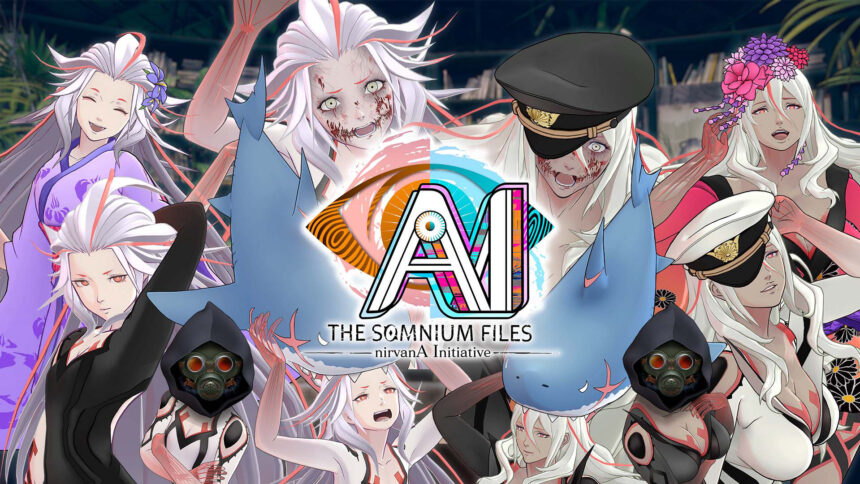
A corpse discovered split perfectly in half, with each half turning up roughly six years apart despite both dying within hours of being found, is exactly the kind of premise that only Kotaro Uchikoshi could make work. This sequel to AI: The Somnium Files splits its investigation the same way its victim was split, following two separate protagonists across two separate timelines, Kuruto Ryuki, quiet and increasingly unstable, working the case three months after the first game’s events alongside his AI companion Tama, and Mizuki Date, ABIS’s confident agent, investigating the same tangled mystery six years later with her own partner Aiba.
Spike Chunsoft both developed and published the game, with Uchikoshi returning to write it, Akira Okada, who designed and assisted on the original, stepping up to direct this time, Yasuhiro Iizuka producing, and character artist Yusuke Kozaki back for a second round with the cast. It released in June 2022 for Switch, PS4, Xbox One, Xbox Series X and S, and Steam in Japan and North America, with Europe and Oceania following that July.
That dual-timeline structure gives the game real narrative ambition beyond a simple sequel retread, and returning players get a real bonus for their prior investment, an alternate dialogue track and altered character appearances kick in automatically once the game confirms you’ve played the original. Ryuki himself carries a quieter, more painful history than his predecessor, well-educated and gentle by nature despite having already lost both his parents and his brother before the story even begins, and I found his reserved, wounded presence gave the past timeline an unsettling emotional register the confident, established Mizuki side of the story doesn’t try to replicate. Andez Komegi, ABIS’s forty-six-year-old resident quiz champion turned comedian, brings a very different energy into the mix, and the tonal swing between his lighter scenes and the actual weight of a serial murder investigation shouldn’t hold together as well as it does. Familiar faces from the first game fill out the rest of the cast too, Pewter still keeps the Psync Machine running for both Ryuki and Mizuki as ABIS’s own engineer, and internet idol Iris Sagan, known to her fans by the stage name A-set, turns up again with her fondness for the occult and urban legends intact from before.
Investigation plays out through the same core loop established in the first game, point-and-click exploration paired with Somnium sequences that let you dive into a character’s dream-state psyche under a strict time limit, uncovering Keys that reveal real dream logic while Conscious Antibodies block off information and drain that same limited time the moment you touch one by mistake. A new Wink Psync option sits alongside the full version too, a much quicker six-second peek into someone’s thoughts built specifically to sense whether they’re lying or holding something back, without committing to a full dive every time a simple gut check would do. That tension between wanting to explore every corner of a Somnium and knowing every wrong touch costs you time gave the investigative half of the game real mechanical stakes to match its writing. Each Somnium also hides five collectible eyeballs this time around, up from just one in the original game, and a few specific dream sequences swap the usual walking movement for swimming or flying instead, small variations that kept the format from settling into a single repeated rhythm across the whole campaign. A handful of optional bonus modes sit outside the main story too, including Eyeballie, a small virtual-pet-style minigame built around Aiba and Tama that added a lighter distraction between the heavier chapters.
Mizuki carries her half of the story with real confidence and wit, and Ryuki’s slow psychological deterioration across his own half builds a completely different kind of tension out of watching someone come apart quietly rather than dramatically. Both AI partners live implanted in their human partner’s left eye socket, Aiba with Mizuki and Tama with Ryuki, a small shared detail that ties the two timelines together on a level beyond just the case itself.
Keisuke Ito composed the score alongside Yasushi Asada, sixty-eight tracks total built specifically for this entry rather than recycled from the first game’s soundtrack, and the release carries two original vocal themes, Half to Whole performed by Kizuna Chieda across separate English and Japanese versions plus a distinct Grand Finale rendition of each, and The Flower That Blooms in Snow performed by Amame Doi in both languages as well. Akari Kito voices Aiba in Japanese with Erika Harlacher taking the English side, Tomoyo Kurosawa and Corina Boettger split Mizuki the same way, Atsushi Tamaru and Stephen Fu cover Ryuki, Ai Kakuma and Anairis Quinones voice Tama, and Shinobu Matsumoto and Brent Mukai bring Andez Komegi to life in either language. That full dual-language cast let me switch between Japanese and English audio without losing any of the specific character work either side put into the performances.
Where the experience shows any real friction, it’s minor, character model designs lean harder into fanservice than the writing around them always seems to want, and Ryuki’s more reserved presence means he doesn’t quite carry the same specific charisma his predecessor did in the first game, even though the writing handles his arc with real care regardless.
Verdict
AI: The Somnium Files – nirvanA Initiative builds on an already well-regarded original, using a dual-timeline murder investigation and a cast split between returning and brand-new faces to build a mystery that keeps finding new angles to work from. Improved Somnium puzzle tension between exploration and Conscious Antibodies gives the investigative half real mechanical stakes, and the tonal blend of dark mystery and lighter comedy from characters like Andez Komegi elevates even its stranger detours rather than undercutting them. Ryuki’s quieter presence won’t replicate his predecessor’s specific pull for everyone, but between its layered structure, a fully dual-voiced cast in both languages, and two very different timelines that earn real investment on their own terms, this stands as a strong continuation of a mystery worth following.