Buying or selling a house usually feels like the sort of job that rewards caution more than courage. The Letter starts with that expectation intact, then tears it apart the moment a routine inspection uncovers a desperate message that should never have been there in the first place.
Before Briar Realty Corporation can open Ermengarde Mansion to prospective buyers, agent Isabella Santos is sent to inspect the old English estate one last time. Hidden inside, she discovers a letter covered with repeated pleas for help, setting off a chain of events that reaches far beyond one abandoned mansion. Inspired by Asian horror such as Ju-On: The Grudge, The Ring, Bongcheon-Dong Ghost, Mad Father, and Corpse Party, The Letter builds its mystery around a cursed location whose influence spreads from one life to another instead of remaining trapped within its walls. That wider scope immediately separated it from many haunted-house stories I have played. It never felt like the mansion was simply waiting for victims. It actively reshaped the lives of anyone unfortunate enough to cross its path.
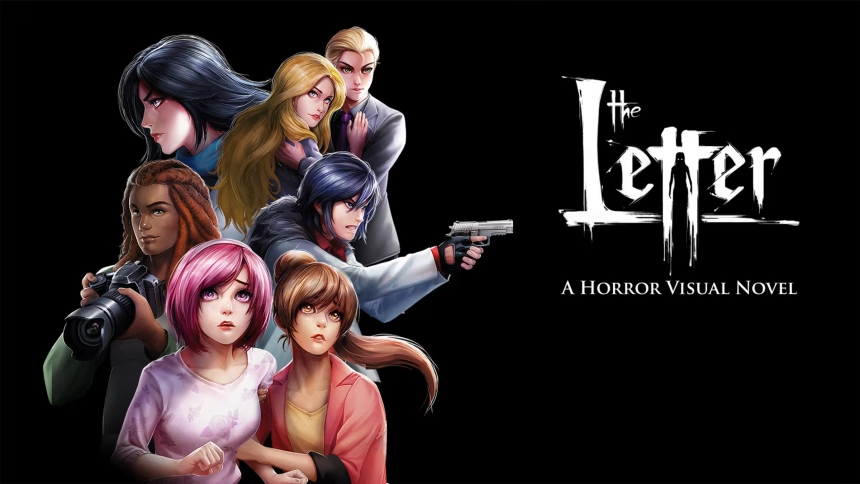
Rather than following a single protagonist, the story passes between seven playable characters whose lives intersect in unexpected ways. Their chapters overlap, revisit earlier events from different perspectives, and branch according to choices made hours beforehand. I enjoyed how often information that seemed insignificant in one route suddenly became essential after the perspective changed. The non-linear structure asks the player to think less about solving a mystery scene by scene and more about understanding how every relationship fits into a much larger chain of cause and effect.
That structure also gives the choices unusual weight. Decisions are rarely confined to the chapter in which they appear. A moment of kindness, distrust, hesitation, or recklessness can quietly alter another character’s future long before the game makes that connection obvious. I found myself slowing down before major decisions because The Letter convinced me early that there would be consequences even when I could not immediately see them. Few visual novels maintain that tension across such a large cast without making the branching feel artificial.
The writing succeeds because every playable character approaches fear differently. Some confront danger directly, others deny what is happening, while a few try to rationalize the impossible until they no longer can. Those contrasting reactions kept the supernatural elements grounded in recognizable human behavior instead of reducing everyone to horror archetypes. Even when I disagreed with a character’s decisions, I usually understood why they believed those choices made sense in the moment.
Yangyang Mobile successfully funded development through Kickstarter and Indiegogo before releasing The Letter in July 2017 for Windows through Steam. The game later expanded to additional platforms while retaining its branching structure, optional quick-time events, and extensive route-tracking tools. The in-game flowchart became one of my favorite quality-of-life features because revisiting earlier decisions would have been far more frustrating without a clear record of how each branch connected to the next. The chronological journal serves a similar purpose, organizing discoveries about Ermengarde Mansion without stripping away the mystery that surrounds it.
Presentation is one of the game’s greatest strengths. More than eighty hand-painted backgrounds, over one hundred CG illustrations, animated effects, and numerous epilogue variations give every location a distinctive identity while avoiding the static feeling many long visual novels eventually develop. Instead of relying on sudden visual shocks alone, the artwork often lets empty rooms, dim hallways, and subtle movement create unease long before anything overtly frightening appears.
That atmosphere is reinforced by a fully voiced English cast, with voice playback remaining optional for players who prefer reading at their own pace. I almost always left the performances enabled because they helped distinguish seven protagonists who spend long stretches apart before their stories converge again. An original soundtrack featuring dedicated opening, ending, and true ending themes rounds out the presentation, though I found its quieter ambient pieces far more memorable than the vocal tracks because they carried much of the mansion’s lingering sense of dread.
The Letter does not soften its horror. Graphic violence, strong language, disturbing imagery, and other mature themes are woven directly into both the supernatural mystery and the personal conflicts surrounding it. None of that felt included simply to shock me. Instead, the harsher moments reinforce the idea that every choice can permanently reshape another person’s future, making the emotional consequences land just as heavily as the supernatural ones.
Long after individual scares faded, what stayed with me was the constant uncertainty surrounding every decision. The game taught me early that no character existed in isolation, and by the later chapters I had stopped thinking about saving a favorite protagonist. I was thinking about how one seemingly harmless action hours earlier might already have sealed somebody else’s fate. That lingering sense of responsibility became far more unsettling than any ghostly encounter.
Verdict
The Letter combines an ambitious branching structure with a genuinely memorable cast, allowing every major decision to echo across multiple perspectives instead of ending with the chapter that introduced it. Ermengarde Mansion provides the supernatural foundation, but the relationships between its seven protagonists give the horror lasting emotional weight. Its length and complexity demand attention, yet the excellent presentation, route management tools, and meaningful consequences make that investment worthwhile for anyone looking for a horror visual novel that fully embraces player choice.