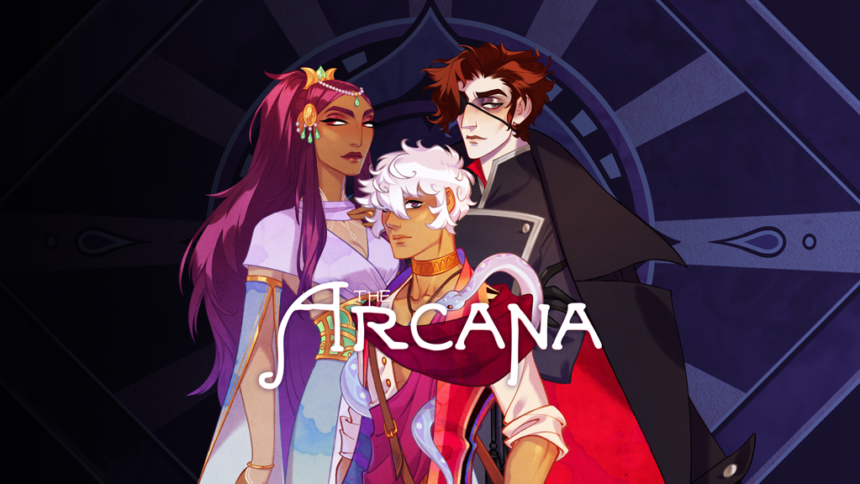
You play an amnesiac apprentice tarot reader working under your mentor, Asra, inside his magic shop in the city of Vesuvia. Asra departs suddenly, leaving you in charge of the shop and his familiar, a snake named Faust, and it isn’t long before visitors start showing up looking for him instead. The countess Nadia and the plague doctor Julian Devorak both come asking for Asra specifically, but accept a tarot reading from you instead. That small gesture ends up pulling you into a murder mystery that keeps tangling itself deeper into romance the further you go.
Nix Hydra Games started out making a virtual pet app called Egg Baby before pivoting into visual novels. The Arcana became the studio’s first attempt at the format, built with partial funding from a 2016 Kickstarter campaign that raised $42,039 from 1,721 backers before launching free on iOS and Android in 2017. Writer Lynne has described brainstorming the original three routes, Asra, Julian, and Nadia, as a team effort from the start, deliberately keeping romance woven into the plot rather than treated as a separate track running alongside it. Nix Hydra later built a second app, FictIf, in 2019, an anthology of shorter romance stories using a choose your own adventure format closer to Chapters or Episodes than The Arcana’s own branching structure. One detail worth knowing going in. A PC version promised as part of that original Kickstarter campaign never arrived, a specific point of frustration that’s stuck with longtime backers well past the game’s initial launch.
Dorian, a platform built around letting creators turn fiction into games without any coding, acquired Nix Hydra and both of its apps in July 2022. Lead artist Gabriella Rossetti made the move over with the acquisition and continues working on the game’s visuals directly, alongside community manager Alex Danino, and Dorian has kept both The Arcana and its content running in place rather than shutting anything down or starting over.
The story itself unfolds across 22 numbered Books, each one corresponding to a card in the Major Arcana, with the first five functioning as a shared prologue introducing the full cast before individual routes properly diverge. You’re free to pursue multiple character routes at once instead of being locked into just one at a time, and the protagonist has no fixed canon appearance, letting you choose your preferred pronouns, she, he, or they, right from the start.
Asra reads as the most emotionally grounded of the main trio, confident in who he is and in his feelings for you, and he’s also the only one who actually remembers what happened before the story’s amnesiac opening. Julian carries himself as the more dangerous, unpredictable presence of the group, an old associate of Asra’s now accused of a serious crime he insists he didn’t commit. Nadia rules Vesuvia with real authority and intrigue behind her, a sharp contrast to Muriel, a mysterious outsider you encounter within the city who gives away almost nothing about himself early on. Lucio is Nadia’s dead husband and the city’s former ruler, and Portia serves as her most trusted handmaiden, rounding out a supporting cast that keeps circling back into the central mystery rather than sitting outside it. Not knowing who among this cast actually deserves your trust, when everyone clearly wants something specific from you as an amnesiac stranger holding an enchanted deck, gives even the early prologue chapters real tension before any single romance takes hold.
A large part of what gives this game its identity is how deliberately inclusive its cast and structure are. Several of the named love interests are written as people of color, and the wider cast reads as openly bisexual or otherwise queer without treating that as a novelty. Letting the protagonist’s gender stay entirely undefined until you pick your own pronouns reads as a thoughtful structural choice rather than a token gesture tacked on afterward.
Where the game runs into real trouble is its monetization, and it’s worth being direct about this rather than softening it. Progress through each Book is gated behind a limited daily allotment of currency called keys, and additional premium dialogue choices and bonus scenes sit behind a separate currency called coins, both of which regenerate slowly for free or can be bought outright. Individual Books have been priced at around ten dollars each, and larger coin bundles have run past forty euros. That pricing colored how I approached spending on this game specifically, holding back on optional scenes I would have read without a second thought at a lower price point. To the developer’s credit, coin choices function as bonus material rather than gatekeeping which ending you actually reach, so no route fails purely because you declined to spend money. Any Book or coin choice you do buy also unlocks permanently rather than needing to be repurchased on replay.
Gabriella Rossetti’s art carries Vesuvia’s overall look, a Middle-Eastern, Silk-Road-adjacent visual identity that gives the setting real specificity beyond generic fantasy dressing. An ambient score plays underneath scenes throughout, though I could not turn up a specific composer credit for it despite looking. Nothing here is voiced, which keeps the whole experience resting on text and illustration alone.
Once you finish a character’s main story, additional standalone side content opens up centered on that same character, and a separate small daily minigame lets you collect postcards from the cast outside the main narrative. The app requires a constant internet connection to function, doesn’t support Chromebooks, and sits at over one million downloads on its Google Play storefront.
Verdict
The Arcana builds an engaging murder mystery around a well written, inclusive cast, letting Asra, Julian, Nadia, and the rest of Vesuvia’s residents each carry real intrigue of their own, backed by Gabriella Rossetti’s distinct visual identity for the city itself. Its monetization is a serious problem that colors the entire experience, though, gating meaningful content behind pricing steep enough to change how I engaged with the story rather than just how much I spent on it. Between its origins as a Kickstarter project, its team’s later pivot to FictIf, and its survival through a full studio acquisition, this remains a story worth reading carefully around its own price tag rather than through it.