Some games hand their heroine a sword and call it a plot. Others hand her a debt she can never repay and let the sword just be the excuse. Shall we date?: Scarlet Fate+ ~Fragments of the Past~ belongs to the second category, and it took longer than expected to realize how deliberately that choice had been made.
Shiki Ugaya carries that debt as Princess Tamayori, the shrine maiden charged with sealing a sword capable of ending the world. Players can rename her if they want, though the game defaults to Shiki Ugaya throughout. She has carried guilt since childhood too, for sins the game only reveals gradually. Set in Heian-era Japan around the year 1000, the story treats her role less as an adventure to have than a sentence to serve, and that framing shapes everything else about her. The role isn’t unique to her either. Princess Tamayori is a position passed down, one dutiful woman after another sealing the same sword before her, which makes Shiki’s private conviction that she doesn’t deserve happiness feel less like isolated self-pity and more like an inherited pattern she’s still stuck inside. This entry is the fourth numbered installment in the wider Hiiro no Kakera series, though nothing about playing it requires knowing the earlier three. She reads as calm and dutiful to everyone around her, while privately convinced she doesn’t deserve to be happy. Nearly every companion who joins her turns out to carry some version of that same weight, just in a different shape. That repetition could have flattened the cast into copies of one wound. Instead the game keeps varying who’s punishing whom and why, which keeps a fairly standard prophecy plot feeling emotionally coherent instead of borrowed.
A wounded fox stumbles into Shiki’s life on a snowy night and turns into a man named Gentoka by morning. His arrival is what actually starts the plot moving. When hunters come looking for him, she uses her own protective magic to mislead them, buying time to heal him herself. Gentoka doesn’t make it easy on her either. His first instinct is that death would be a mercy, and he tells her plainly that all he’s ever wanted is peace, not another fight. His claimed power to grant immortality makes him a target for people who want it for themselves, and Shiki ends up sheltering him rather than turning him in. Government officials are the ones hunting him specifically, not generic villains, which folds court politics into what starts as an intimate rescue. Their relationship takes real time to develop. Rather than rushing to romance, the game lets both of them recognize their own regret reflected in the other person first, and the eventual payoff carries more weight for that patience. His pledge that his life now belongs to her isn’t played as an instant, blind declaration. It grows out of her choosing to protect someone with every reason to distrust her, which gives their dynamic a foundation the prophecy plot alone couldn’t provide.
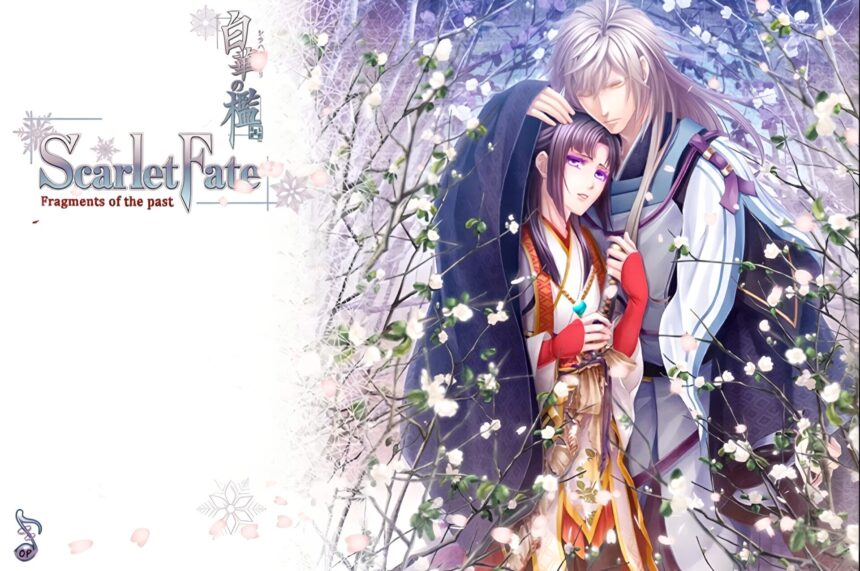
Character art carries real strength within the format’s obvious mobile constraints. Otomate built its reputation on detailed, painterly illustration work, and that quality shows here, with a Heian-period setting that gives the game a visual identity distinct from the contemporary and Western-fantasy backdrops most otome titles reach for. Idea Factory developed the original PSP release, Shirahana no Ori: Hiiro no Kakera 4, under its Otomate label. NTT Solmare brought this English localization to the long-running Shall we Date? platform in 2014, through a direct collaboration between the two companies. It launched under the Shall we Date? banner already carrying three million downloads across the platform. That release actually came in two different forms, a paid version priced per route in the four to five dollar range, and a free-to-play version I ended up spending most of my time in. I tried the free path for a stretch too, and it plays without any background music at all, cutting a real piece of atmosphere out of scenes that could use it.
Kuso-no-mikoto has been Shiki’s fiancé for years under Princess Tamayori’s old customs, though calling them close would overstate things. He’s the type to call her too sassy to deserve marrying him one moment, then prove he’d upend his own plans for her the next, and that contradiction is most of his charm. Their engagement starts as a political arrangement neither of them chose, which makes the slow thaw between them land differently than a romance that begins with attraction already in place. A journey to meet the Goddess of Creation, deep in the story’s spiritual half, pushes the two of them closer together than either expects. Later in the story, the full truth behind Kuso’s own motives comes out, and the fallout tests everything they’ve built. Watching an arranged, initially loveless match grow into something real gives their arc a specific charm none of the other companions attempt in quite the same way.
Aterui makes his entrance in the capital city, Heian-kyo, and he looks the part of trouble immediately: long black nails, a body covered in old scars, an unsettling, eerie stare. He and Gentoka share history that goes back before the current story, to when the two of them stood against the Imperial Court together. Aterui has spent the years since hunting down nobles as payback for what was done to him and his people two hundred years earlier. Learning that backstory recontextualizes his reappearance completely. His fixation on what Shiki did to change Gentoka reads less like jealousy and more like a man watching someone else escape a cycle he still can’t. Their own dynamic develops through captivity, not courtship. Partway through Gentoka’s storyline, the two of them get taken by a group of tsuchigumo, and it’s in that stretch that Aterui first sees the scars Shiki carries from her own past. There’s also a moment where Shiki refuses to leave him alone, worried he’ll slide back into the same destructive path without her. Neither one lectures the other out of their guilt. They just stop being alone in it, which does more work for the romance than any grand declaration could.
Progressing through the story here costs rations that regenerate slowly on their own or can be bought outright. A leveling system does let patient, free-to-play readers eventually earn enough strength to keep advancing without spending anything, but that patience gets tested hard across a story this long. Some readers will grind for extra levels between chapters just to keep pace without paying, turning what should be a straightforward read into extra busywork. The paid version sits right there the whole time as the faster alternative, which makes the free path feel more like an endurance test than a simple wait. Anyone hoping to see the full roster plus whatever bonus content exists is looking at a real cumulative cost if they’re not willing to wait out the game’s own pacing. That’s a trade-off worth knowing about going in, rather than discovering it three routes deep.
Tomonori Katakura and Akifusa Oki round out the group as two companions who’ve known Shiki the longest, and their friendship with each other complicates things as much as it helps her. Tomonori runs Kifu’s local government with a calculating, unreadable manner, while Akifusa handles things more directly, sword in hand. Tomonori’s own jealousy of how openly Akifusa can protect her says more about his restraint than anything he’d admit outright. Aterui and Tomonori actually joined the roster with this expanded plus edition, added on top of whatever companions the original release shipped with. Two more companions, Kodonomae and Furugutsu Akishino, round out the full roster, though I didn’t end up romancing either of them myself this time through.
Verdict
Shall we date?: Scarlet Fate+ ~Fragments of the Past~ builds its whole emotional case around guilt, duty, and the question of who gets to be forgiven. That foundation holds up even where a couple of the wider cast’s routes stay outside what I explored personally. Its ration-based structure creates real, sustained friction for anyone trying to see the full story without either patience or spending. Otome readers drawn to a Heian-period setting they don’t see often, and willing to accept free-to-play mobile pacing as the price of entry, will find a well-built romance here. Real emotional consistency runs underneath its episodic surface throughout.