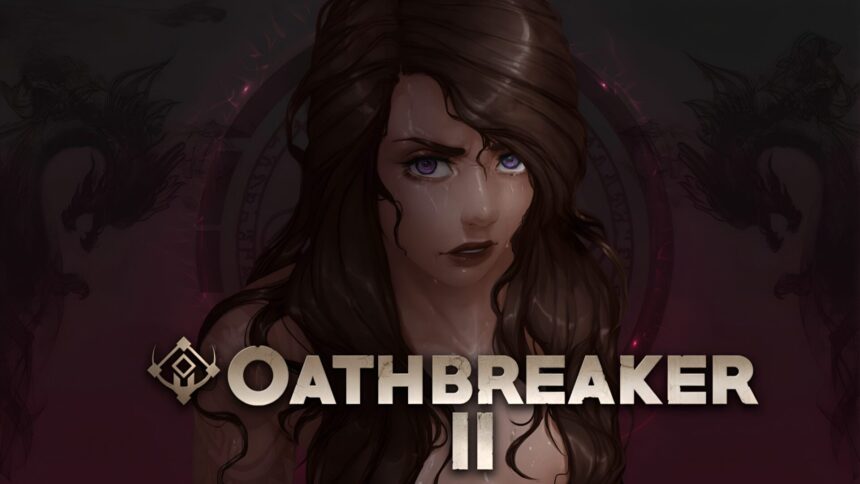
Following up a beloved, tightly focused fantasy romance with a story that widens its scope considerably is always a gamble, and Oathbreaker: Season 2 takes that gamble in an ambitious direction. Picking up three years after the events of the original free medieval fantasy visual novel, this sequel finds its protagonist, a Warlock previously caught up in a rebellion against a corrupt Divine, now navigating the political and religious fallout of that rebellion’s aftermath, all while raising a young imp child and facing a version of her world that’s grown considerably more complicated since the story last left off. That expanded scope isn’t just a marketing promise either. It shapes the entire story from its opening chapter onward, prioritizing political consequence over a simple continuation of where the romance left off.
The most immediately striking thing about this entry is just how seriously it takes its own worldbuilding. Rather than treating politics and religion as background texture to justify the romance happening in front of it, the story digs directly into questions of legitimacy, faith, and power across Northern Aradove, giving even scenes far removed from the main character real weight by spending real time with figures like Empress Maeryn’s family and a formidable religious Matriarch. Empress Maeryn’s own family dynamics get real dedicated attention too, court politics that exist independently of the main character’s own arc rather than only mattering when she happens to be present in the scene. Warlocks specifically exist here as something distinct from mages, tied directly to a Divine named Xiris and framed as a byproduct of that Divine’s own madness rather than simply another flavor of spellcaster. Watching the Matriarch specifically navigate her own political position across dozens of chapters before the story’s later turns gave her character real depth. That’s well beyond what a simple antagonist or ally role usually receives in this genre. That kind of specificity earns real credit from me, treating its fantasy politics with more depth and nuance than the genre typically bothers attempting for a free, independently developed release, and the writing consistently avoids the trap of reducing complex factional conflict into simple good versus evil shorthand.
Raelan and Theoren both factor into the wider cast as romance options, Raelan carrying over from the first game and Theoren arriving new to this entry, his heavy armor and imposing presence giving him a visually distinct silhouette next to the returning cast. Alwenn and Virion round out a supporting roster that gets real room to breathe given how much time the story spends outside the main character’s immediate circle. Virion in particular gets moments of dialogue in an in universe language the game never fully translates, small worldbuilding texture that rewards a reader paying close attention without demanding they understand every line. Poly routes exist within the game’s structure too, letting a reader pursue more than one relationship simultaneously rather than being locked into a single exclusive pairing. That poly option specifically sets this entry apart from a lot of otome adjacent visual novels. Those games tend to treat exclusive monogamous pairing as the only structurally supported outcome, regardless of how a reader actually wants to build their relationships.
A particularly welcome, less expected thread running through the story involves the protagonist’s role as a mother to the imp child introduced by the story’s premise. Rather than treating that child as a plot inconvenience or a burden weighing down the protagonist’s adventures, the writing gives their relationship real warmth and normalcy, letting a fantasy story about rebellion and political intrigue also make room for a sincere, unforced depiction of parenthood that neither infantilizes the protagonist nor sidelines the child to the background. Small, ordinary moments, feeding the child, worrying over a fever, carry as much weight in these scenes as any of the story’s larger political turns. That’s exactly the kind of balance a story this ambitious needs to actually pull off. It’s a small structural choice that pays off in real, specific emotional texture few visual novels in this genre bother reaching for.
That said, the broadened scope comes with a real, honestly acknowledged cost, and it’s the single most consistent friction point I ran into myself while playing. Spending so much additional time on new characters, factions, and political maneuvering means the core cast from the first game, the specific friendships, rivalries, and romantic dynamics that made Season 1 so beloved, gets noticeably less screen time in comparison. Certain established characters effectively vanish from the story for entire chapters at a stretch, and the snarky, tightly knit group dynamic that defined the original’s appeal thins out as a direct consequence of the story’s wider ambitions. I found myself missing specific banter and rivalries from the first game more than once, waiting through several chapters of political maneuvering before a familiar face finally reappeared with anything substantial to actually do.
Compounding that issue, the story’s final stretch moves noticeably faster than everything that came before it, several major plot threads resolving in quick succession after chapters of comparatively slower, more deliberate pacing. One character positioned for most of the game as a steady, principled background presence makes a sudden, decisive move late in the story that felt underbuilt to me given how little groundwork the preceding chapters laid for it. That pacing imbalance stands out specifically because everything preceding it moves so deliberately, giving the story’s earlier political maneuvering real room to breathe in a way the ending simply doesn’t extend to its own resolution. That compressed final stretch left several plot lines feeling more dropped than concluded, a pattern of narrative bloat that suggests the story may have taken on more plot than a single season could fully resolve.
Character writing across the returning romantic leads remains a real strength where the story does have room to focus on them, and the cast redesigns accompanying this entry reflect three years of in story time passing with thoughtful, considered changes to how each character looks and carries themselves rather than a simple superficial art refresh. Newcomer designs specifically carry real visual specificity too, distinct silhouettes and armor choices that make even a first glance enough to tell one new character apart from another across a cast this size. The interface itself picked up real polish too, distinct colors and fonts assigned to each in game language rather than forcing a reader through mirrored or backwards text the way the original handled multilingual dialogue, a small but meaningful readability improvement given how long this game actually runs.
One structural limitation carried over from the first game bothered me directly: despite the protagonist defaulting to bisexual and offering well written female romance options, pursuing an exclusively female attracted playthrough runs into a mandatory, unavoidable plot driven encounter with a male character. I found that scene immersion breaking, undercutting the sense of full player agency the rest of the character customization otherwise promises. That single mandatory scene sits at odds with how carefully the rest of the game handles player agency elsewhere, which makes its presence stand out more than it might in a game less focused on customization generally.
Presentation continues the series’ reputation for real visual polish, animated CGs and sprites giving key emotional scenes real life, and the accompanying music elevates pivotal moments effectively throughout, distinct enough that I found myself wishing for an official soundtrack release the same way earlier fans of the original Oathbreaker have asked for one without success so far. Individual CGs specifically carry real weight during the story’s bigger emotional turns, reserved for moments that actually earn that level of visual attention rather than scattered evenly across the whole runtime.
Technical stability is a more persistent, practical concern. I ran into scattered reports of corrupted save files, download issues across different browsers, and platform specific bugs, real friction for a project distributed independently outside more polished commercial storefronts. LarkyLabs, the studio behind this, previously operated under the name Rinmaru Games before rebranding, and development on Season 2 stretched across roughly three years, from an early Patreon prologue in 2020 through to a full public release years later. That rebrand from Rinmaru Games to LarkyLabs happened sometime before this sequel’s own development began, based on how consistently the newer name appears across all of Season 2’s own promotional materials and storefront listings. Both the original Oathbreaker and this sequel remain free to download, distributed through itch.io alongside early access content offered through the studio’s Patreon.
Verdict
Oathbreaker: Season 2 takes real, admirable risks expanding its predecessor’s world into considerably more ambitious political and religious territory, and where that ambition succeeds, particularly in its unusually sincere depiction of parenthood folded into a fantasy adventure, it delivers some of the most thoughtful writing available in a free visual novel. That expanded scope comes at a real cost to the tight character dynamics that made the original beloved, and a meaningful number of newly introduced plot threads go underexplored by a rushed final stretch. Scattered technical issues and a structural limitation around one specific romantic path add further friction. For fans of the original willing to accept a broader, occasionally less focused sequel in exchange for real worldbuilding ambition, though, this remains a worthwhile continuation of one of itch.io’s more distinctive free fantasy visual novels. Few free fantasy visual novels attempt political worldbuilding this ambitious while still finding real room for something as small and sincere as a parent worrying over her child.