
Waking up on someone else’s floor is one kind of disorientation. Being handed someone else’s whole life to inhabit at the same time is another thing entirely, and it’s worth sitting with the difference for a second before diving into the review.
True impersonation isn’t about wearing another face and hoping it fits. It’s about learning, moment by moment, how a stranger’s shoulders sit differently than your own, how their silences land, how the people around them expect an answer before they’ve even opened their mouth. I’ve never lost a sibling to a fight I didn’t witness. I’ve never woken up on a stranger’s floor and been asked to become someone I’d never met. The closest I’ve come to living someone else’s life is forgetting my own name for half a second after waking from a long, disorienting nap. None of that matters here, though, because pretending to be someone else turns out to demand far more honesty than most disguises ever ask for.
Palmier, the protagonist of Bewitching Sinners, wakes up on the floor of a world that shouldn’t exist, next to an unconscious body wearing every feature of their own face. The person Palmier is asked to become is a witch tangled up in a fight gone wrong, and the months leading up to that morning have been rough ones: a sister’s death, a slide into grief and self-destructive habits, the kind of numb haze that makes waking up in a stranger’s world feel almost beside the point. Impersonating that double buys time to search for a way home, but it also means stepping into a life mid-crisis, surrounded by witch hunters who don’t trust her and men who already love someone she’s only pretending to be.
The witches and witch hunters circling that double’s life could have stayed background noise, the kind of vague political tension dating sims often gesture at without ever building out. Bewitching Sinners doesn’t take that shortcut. Wander its campus map long enough and library shelves turn up real lore, side conversations flesh out how the magic actually functions, and environmental details reward curiosity instead of punishing players for skipping past them. Digging through a stack of old books between dates ended up pulling me further into the setting’s politics than most main-route dialogue managed on its own, and that kind of incidental worldbuilding is rare enough in this genre to be worth calling out directly.
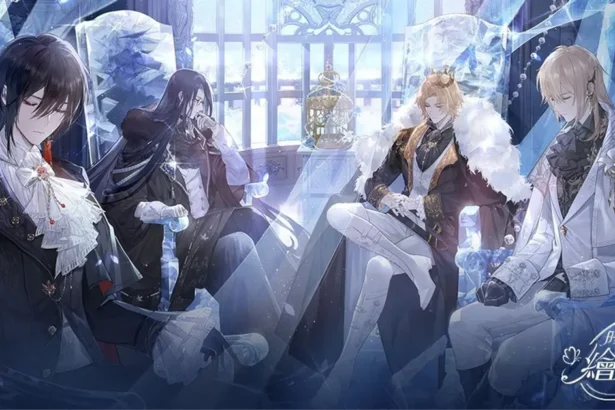
Quill, Arshem, Thane, and Lyall make up the four love interests, and all four hold up well enough that picking a favorite took longer than it usually does in this genre. Quill’s awkward, easily flustered charm gives the early routes some much-needed levity. Arshem carries a heavier, broodier weight, clearly working through trauma he’s not eager to discuss. Thane reads as the sweet, golden-retriever type of love interest at first glance, until his own hardships start surfacing under the surface warmth. Lyall, despite an intimidating build, comes across as timid and socially unsure in a way that makes his softer moments land with real weight. Four love interests written this evenly is not something every otome release manages, and Bewitching Sinners clears that bar without an obvious weak link among them.
Dialogue throughout stays naturalistic rather than stiff, sidestepping the trap a lot of reverse-harem stories fall into where every love interest ends up sounding interchangeable once you strip away the character tags. Palmier’s own internal voice carries a distinct, grief-soaked cynicism early on rather than generic sadness, and that voice holds up consistently as the story moves past its opening setup.
Dating anyone in this cast ties into a crafting system that turns gift-giving into more than a menu clicked through blindly. Quests double as ways to earn currency and materials for those gifts, which pushes exploration of the campus and surrounding world into something with actual purpose rather than padding between story beats. That loop, explore, gather, craft, gift, repeat, gives the romance a mechanical backbone that a lot of otome titles skip entirely in favor of pure dialogue trees.
Choosing to play as the male version of Palmier comes with noticeably more content than the female option gets, extra CGs and richer scene writing included. A game built this heavily around gender and pronoun customization sets up an expectation of equal treatment that doesn’t quite hold, and the female protagonist path reads as the less finished of the two because of it. None of that erases what works elsewhere, but it’s the sort of imbalance better known going in than stumbled into three routes deep.
Character sprites and CGs throughout carry a level of polish that stands out even next to bigger-budget otome releases, all the more impressive once you factor in that Miss Xero built essentially the entire game solo. At least one major fight scene abandons the usual static illustration approach entirely in favor of full comic-panel layouts, panel borders, motion lines, and all, and that choice alone sets Bewitching Sinners apart visually from most of what this genre typically offers. With reportedly over three hundred pieces of original art packed into the full release, the sheer volume on display is hard to overstate for a one-person project.
Sound design stays mostly out of the spotlight. There’s no voice work carrying any of the four routes, which places the full weight of characterization on the writing and art alone, and to its credit, the game mostly earns that trust. The background music sets a quiet mood without asking to be noticed, which works fine for scenes that need to breathe but leaves little to point to as a standout element on its own.
Arshem’s route hits its emotional peak in a way that earns the buildup, without giving away exactly how his trauma resolves or doesn’t. Thane’s arc lands its heavier beats by contrast, since the golden-retriever warmth up front makes his quieter, sadder moments cut deeper than they would on a character written as somber from the start. The dynamic between Palmier and the doppelganger being impersonated carries its own quiet weight too, less about romance and more about identity, and that thread stays present long after any single route wraps.
Priced higher than most indie visual novels ask for, Bewitching Sinners does raise a fair question about value before committing. Eight to sixteen hours of content depending on how much side exploration gets done, four distinct romance routes, and a few hundred unique illustrations from a single creator make a reasonably strong case for that price tag, even if it’s still worth going in with clear eyes about the cost relative to genre norms.
Verdict
Bewitching Sinners earns its place among stronger solo-developed otome and BL releases through worldbuilding that rewards curiosity, four well-written love interests without an obvious weak link, and presentation, especially its comic-panel fight sequences, that outperforms its indie scale. The uneven treatment between its male and female protagonist options is a real shortfall for a game that sells itself on customization, and its price tag asks players to weigh that cost against what’s actually delivered.