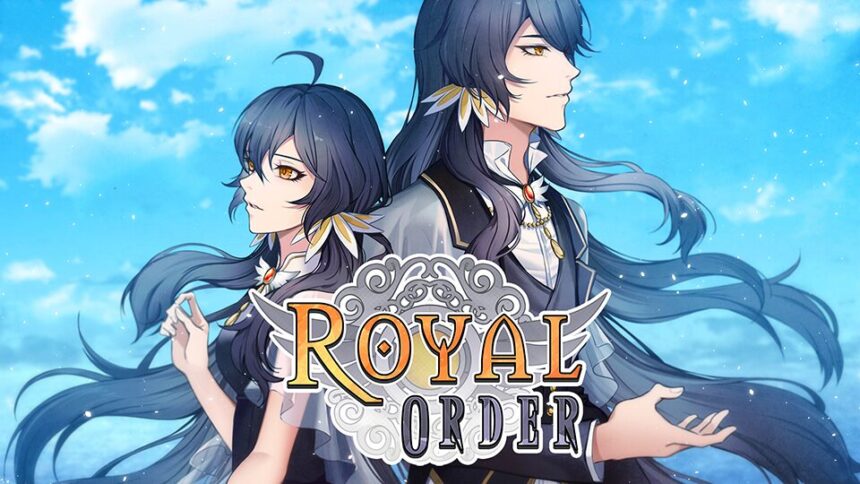
The Sval, raiders from the far north, have spent years plundering the coastline of the continent of Igrith. Three kingdoms finally send their royal heirs to the High Council, a powerful faction of magicians, to plead for help ending it. The Council agrees, forming a new body called the Royal Order and keeping the three heirs close at hand, but old grudges between their kingdoms resurface almost immediately. Aarya de Chabenet, whose appearance, pronouns, and name are all customizable, joins as the newest member of the High Council and gets pulled directly into managing that fragile peace. I expected a customizable lead to feel like a blank slate dropped into someone else’s drama. Aarya read as a real participant in it instead, opinions and all.
Two separate stats-raising systems run underneath everything, one tracking Skills and one tracking Personality, layered under a time management and quest structure spanning sixty in-game weeks. Ten different endings exist, along with a long list of ways for characters, including Aarya, to die if their stats fall short. Difficulty modes let you dial that death frequency up or down depending on whether you’d rather focus on survival or on the relationships and politics around it. I played cautiously at first and still watched a stat check fail on me once. That single failure sold the stakes of this world better than any amount of dialogue about the Sval’s raids managed.
Emrys and Darryl are the two male love interests, and Iris is the sole woman available. Emrys gets set up early, and the chemistry between him and Aarya builds fast enough that I understood the appeal before I’d even chosen to pursue it. Darryl works at a slower burn by comparison. Iris tends to get less immediate spotlight than either man, but she rewards patience with an ending built around a quieter, more settled happiness than the drama surrounding the other two routes. Watching these three heirs try to build something like trust, forced together by circumstance and old family history, gave even the quieter administrative scenes real tension underneath the surface. Everyone around them still carries decades of resentment.
Neri, a character carried over from Royal Alchemist, also appears here, giving anyone who played that earlier game a thread of continuity even though Royal Order tells its own separate story. Nifty Visuals, the small Swiss-German studio behind both games, funded this one through a Kickstarter campaign before its full release. That background context reframed the worldbuilding’s density for me. It read less like padding and more like a team returning to a world they had already built once and wanted room to do justice a second time.
The writing leans hard into that worldbuilding, and for the most part the density pays off. Political detail about the three kingdoms and the mechanics of the Royal Order itself accumulates steadily rather than arriving in dumps. The stretches of daily court life between major plot beats establish why the alliance feels as fragile as it does. That same density slows the pacing noticeably in the middle of the story, though, where the emphasis on everyday routine occasionally outweighs forward momentum. I felt that dip most in the stretch right before the first major stat check, where I caught myself skimming dialogue just to get back to a choice that mattered.
Character and CG art comes from a specialized team for an indie project this size. DarkAvey leads as the main artist, with Adirosa assisting, elRion handling chibi illustrations, and DustyVixen and Huixci contributing additional artwork, while Son Huynh takes the background art specifically and Kathaeris built the interface. That division of labor shows in the finished product. Character portraits, chibi expressions, and the wider world each carry a distinct visual treatment rather than one artist stretched across every asset type. The background work specifically held up for me during slower administrative scenes that could have felt flat otherwise.
Composer Irene Chan scores the whole thing, and the music sits comfortably behind the political intrigue without ever needing to announce itself. There’s no voiced dialogue anywhere in this release, keeping it firmly text based. The absence registered less than expected for a story this dialogue heavy, since the writing itself does most of the character work on its own.
Writing credit goes to lead writer Petter Skult alongside additional writing from Rhy, Paige N. Staudt, and Josh Kaplan, with Tianna Ebnett and Mae Windchimes handling outlining and S. Marek and Melissa Whisper covering editing and proofreading. Sitraxis and Kailoto handled scripting, and Feniks built the Android port separately. Outside the main release, Nifty Visuals sells a spoiler-free Strategic Guide covering relationship building and stat management, along with an Artbook and Lore book for anyone chasing more of the setting. Royal Order runs on Windows, macOS, Linux, Android, and Steam, though the current build isn’t compatible with macOS 10.15 Catalina or later versions on that platform, worth knowing before buying on a Mac.
Verdict
Royal Order builds a dense political world around three heirs forced together by crisis and old history, and the romance options carry real weight because the surrounding conflict never fully lets up. The middle stretch’s focus on daily routine slowed momentum more than I wanted at points. Even so, the scope of what this small team pulled off, from Skills and Personality stats to ten separate endings, is hard to overstate. Between DarkAvey’s character work, Irene Chan’s score, and a writing team large enough to be credited role by role, this is a project that understood exactly how much world it was trying to hold together.