I like road trips because they promise that movement alone might solve something. A few hours behind the wheel can make any problem feel smaller, even when you know you’ll still be carrying it after the engine stops. Road Trip to the End of the World understands that illusion better than most stories about long drives, and it spends its entire runtime asking whether closure is really a destination or simply another story we tell ourselves to keep moving.
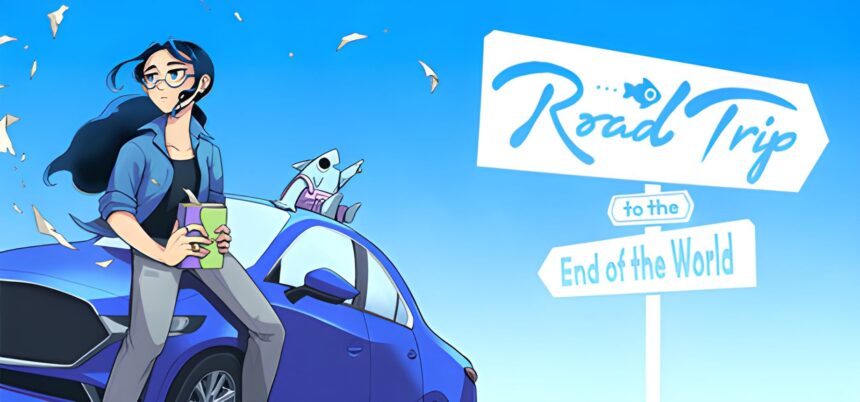
The journey begins after Andy Min drops out of medical school and receives an uninvitation to the wedding of her former best friend, Bora. Instead of accepting the silence that has grown between them, she climbs into her car with her imaginary childhood companion, Fishy, and heads across the country hoping to confront a relationship she never truly let go of. Developed by Alex M. Lee under Shark and Pelican Games, the visual novel was originally created as part of the School of Visual Arts’ MFA Visual Narrative program before launching as a free release for Windows and macOS.
What surprised me most was how little the game cared about assigning blame. It would have been easy to paint Andy as completely justified or Bora as entirely responsible for their falling out, but the writing refuses that shortcut. Instead, every new stop along the highway peels back another layer of Andy’s own decisions, revealing someone who can be funny, stubborn, defensive, and painfully self-aware within the same conversation. Watching her wrestle with memories that refuse to stay comfortably nostalgic gave the story a weight that lingered well beyond its relatively short runtime.
Fishy prevents that emotional weight from becoming exhausting. His relentless optimism often clashes with Andy’s frustration, creating conversations that made me laugh one minute before quietly exposing another uncomfortable truth the next. Their chemistry carries much of the game, not because either character constantly delivers memorable one-liners, but because they challenge each other’s view of the journey in ways that feel honest instead of manufactured for dramatic effect.
The structure remains refreshingly simple throughout. Road Trip to the End of the World is a linear visual novel with light point-and-click interactions, and I never wished it had more complicated systems or branching routes. Every mechanic exists to support the conversations rather than distract from them, allowing the road trip itself to become the connective tissue between memories, self-reflection, and the occasional absurd roadside encounter.
Its presentation reinforces that focus. Alex M. Lee handled the writing, artwork, and programming, giving every scene a consistent visual identity through expressive hand-drawn character art and colorful environments that gradually shift as the trip progresses. The changing scenery quietly sells the feeling of covering real distance, making each destination feel like another step in Andy’s emotional journey rather than just another background.
The music left just as strong an impression. Rather than fading into the background, the original soundtrack frequently becomes part of the storytelling itself. Music director Jennie Han worked alongside Moodin Jang, Hyunseo Park, and Hyundo Yoo to create the score, while the original song “Three Days Gone,” written by Ethan Ness, arranged by Jacob Gehlbach, and performed by Victoria Princi, arrives at exactly the right moment without overwhelming the scene surrounding it. I never missed voice performances because the writing and soundtrack already carried the emotional beats with confidence.
Its biggest limitation comes from its modest scope. Lasting roughly one to two hours, the story rarely has time to linger with the people Andy encounters outside its central relationship. I occasionally wished a few conversations had been allowed another scene before the journey continued. Even so, that restraint also keeps the pacing focused, and I reached the ending feeling that the game had told the story it wanted to tell without stretching it beyond its natural length.
Verdict
Road Trip to the End of the World tells a deeply personal story about the end of a friendship without searching for an easy villain or an effortless solution. Andy’s flaws make her growth believable, Fishy provides warmth without undercutting the heavier moments, and the focused structure allows every conversation to matter. Its short runtime leaves me wanting a little more time with its world, but it also proves that a memorable emotional journey doesn’t need dozens of hours to reach its destination.