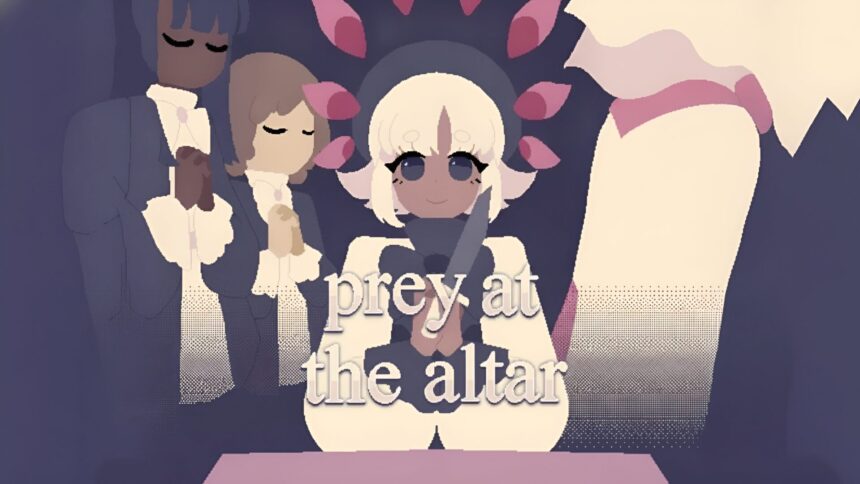
The player assumes the role of the chosen lamb of the Church of the Hound, selected as the sacrifice that will summon an ancient deity destined to cleanse the world of its sins. Everyone surrounding the protagonist insists this is a blessing rather than a tragedy. The ceremony is spoken about with admiration, encouragement, and unwavering certainty, leaving almost no room for doubt. That atmosphere immediately unsettled me because the game never needs anyone to openly threaten the protagonist. The confidence with which every character accepts the ritual becomes frightening enough on its own.
Developed by mokadevs in collaboration with versegm, Prey at the Altar is a short narrative horror game created in RPG Maker and released on itch.io in May 2024 as a free, pay-what-you-want experience. Despite its modest scope, it wastes very little time establishing its central conflict, choosing to focus almost entirely on the emotional weight of the protagonist’s role rather than expanding into a larger mythology. I thought that restraint worked in the game’s favor because every scene reinforces the same unsettling question: what happens when someone has been taught that their own destruction is the highest form of devotion?
Player choice gives that question real significance. Throughout the story, the Shepherd repeatedly issues instructions that gradually determine which ending becomes available. Obedience leads toward the White Sheep route, while repeated defiance opens the Black Sheep path. Fully committing to either philosophy unlocks its corresponding True Ending, while wavering between the two results in an entirely different conclusion. I appreciated that structure because it asks for consistency rather than encouraging players to simply pick whichever option seems immediately beneficial. Every decision quietly communicates what the protagonist has ultimately chosen to believe.
Replaying the game reveals another thoughtful detail. Small pieces of descriptive text change depending on previous actions, rewarding careful observation without announcing every variation to the player. Those subtle adjustments made repeated playthroughs feel more meaningful because they reinforced the idea that even seemingly minor moments reflected the protagonist’s gradual acceptance or rejection of the Church’s teachings.
The writing is strongest whenever it allows ordinary conversation to become quietly unsettling. Characters rarely behave like overt villains. Instead, they speak with genuine warmth, encouragement, and reassurance, making the religious devotion surrounding the sacrifice feel deeply ingrained rather than artificially imposed. That normality is what I found most disturbing. Horror built around unquestioned belief often becomes far more effective than horror relying entirely on violence or sudden shocks, and Prey at the Altar understands that balance remarkably well.
Visually, the game adopts a deliberately simple pixel-art presentation that resembles an illustrated storybook more than a conventional horror game. Rather than undermining the atmosphere, that softer aesthetic makes later moments even more uncomfortable because the world initially appears welcoming and harmless. The environments remain compact, but they communicate the isolation and ritualistic nature of the Church effectively without requiring elaborate visual effects.
The soundtrack follows a similarly restrained philosophy. Quiet ambient pieces and understated melodies accompany much of the experience, allowing long stretches of silence to carry as much emotional weight as the music itself. Instead of attempting to frighten through loud audio cues, the sound design reinforces the feeling that something deeply unnatural has become accepted as completely ordinary.
Because the game is relatively brief, it never overstays its welcome or dilutes its central idea with unnecessary subplots. Every scene contributes to the same overarching theme of institutional belief, personal agency, and the frightening ease with which language can reshape morality. By limiting its scope, the story allows its central metaphor to remain focused from beginning to end. What lingered with me after the credits was not the ritual itself, but the way everyone surrounding the protagonist sincerely believed they were expressing kindness. The game repeatedly demonstrates how words like honor, duty, and devotion can become frightening when nobody is willing to question what those words are actually asking someone to sacrifice. That quiet realization proved far more unsettling than any single ending.
Verdict
Prey at the Altar accomplishes an impressive amount with a remarkably small runtime. Its branching endings, subtle choice-dependent variations, understated presentation, and tightly focused writing combine to create a horror experience built far more on psychological unease than graphic spectacle. By examining how belief and social expectation can disguise cruelty as virtue, it delivers a memorable story that lingers well beyond its brief length.