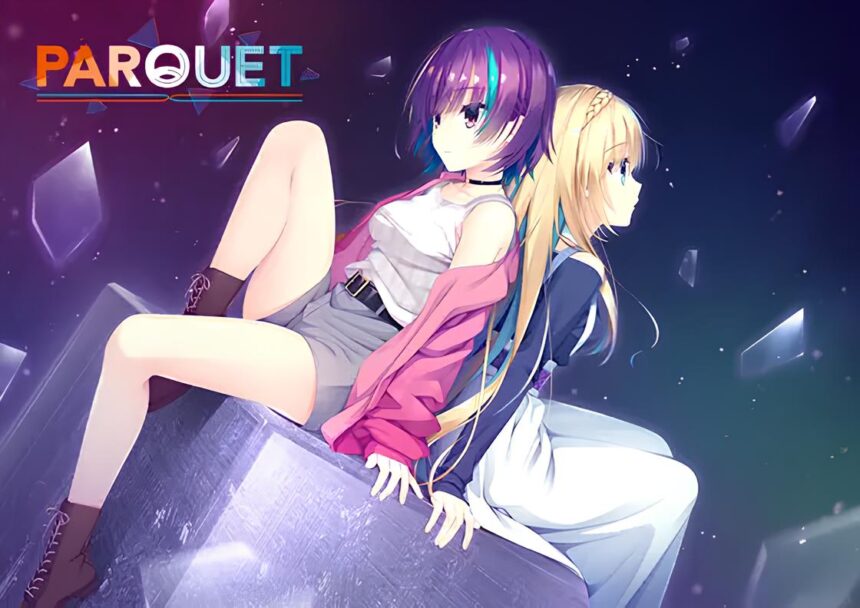
A person built entirely out of other people’s memories has more in common with an amnesiac than a machine. Kanato is that person, brought into existence when an illegal experiment meant to digitize human memory instead poured thousands of lives into a single new body.
PARQUET spends its opening stretch on Kanato working up the nerve to leave the only world he has known and look for a memory that belongs to him alone, and that search is what eventually puts him in the same near-future city as Kido Tsubasa and Ibaraki Rino, two women whose own lives turn out to have been shaped by the same reckless Brain-Machine Interface technology that created him.
Tsubasa’s outgoing streak and Rino’s quieter, more guarded nature play off each other constantly once the three end up living under one roof, and Nika, Tsubasa’s friend with a mischievous streak a mile wide, keeps stirring up trouble alongside her own father, a gruff cafe owner who dotes on his daughter more than he’d ever admit out loud. Rino’s boss at the flower shop where she works, an older woman named Aya, brings a warmer, more playful energy into scenes that could otherwise sit too quietly.
PARQUET runs as a kinetic novel, meaning the main story offers no branching choices at all, and it wasn’t until the credits rolled that I got a single menu decision, splitting off into a short After section between Rino and Tsubasa. That structure means every reader experiences the same core story the same way, which took some adjusting to after visual novels that dangle branching paths the whole way through.
The first half leans hard into slice of life material, and Kanato’s own lack of direction during those early chapters made some of it drag more than it needed to. That changes once Tsubasa and Rino start opening up about their pasts, and the back half moves with a purpose the opening stretch never quite finds. Both women turn out to share something with Kanato that neither of them fully understands going in, and I won’t say what that connection actually is, only that the story takes its time earning the reveal rather than rushing toward it.
What stuck with me more than the mystery itself was how little the story leans on cheap gags to fill space between plot beats, choosing instead to sit with real questions about friendship and what makes an identity belong to someone. I won’t describe how Kanato’s story or either woman’s arc resolves, only that the payoff landed harder than the slower opening chapters led me to expect.
Yuzusoft Sour put this out as its debut title, a new all-ages branch of Yuzusoft, the studio behind Riddle Joker, Senren Banka, and Sabbat of the Witch, and PARQUET marks their first release without any adult content attached. Scenario writer Amamiya Ritsu handles the story, with Yumeri Rin, Komai Ichi, and Hasumi Rio credited on character design and artwork and Komomen Haruka on the SD illustrations sprinkled through lighter scenes. Japan got the game first on July 30, 2021, with NekoNyan and Hikari Field bringing English and Chinese localizations to Steam and Android on August 27 and an iOS release following about a week later.
Famishin and Angel Note handled the music, and the ending theme, a track called Fureru Furueru, is sung entirely by Nao Touyama as a duet with her own voice. That detail matters more once you know Touyama also voices both Tsubasa and Rino, since the two heroines came from the same performer working to make each one sound distinct rather than like two shades of the same character. Yukina Shuto voices Nika, Daisuke Kageura voices her father, and Natsue Sasamoto voices Aya, and each performance gave the side cast more personality than their screen time alone would suggest. Kanato himself has no voiced lines at all, which stood out to me every time he was the one carrying a scene.
Verdict
PARQUET takes a familiar sci-fi identity premise and gives it real weight once Tsubasa and Rino start letting Kanato past the surface of who they are, turning a slow opening into a back half that actually earns its stakes. Choosing warmth and real questions about identity over the genre’s usual filler humor gives the whole thing a sincerity that the side cast, Nika and her father especially, never undercuts. A kinetic novel with no voice for its own lead is an odd choice, but by the time the After section opened up, that was a minor complaint next to everything the main story got right.