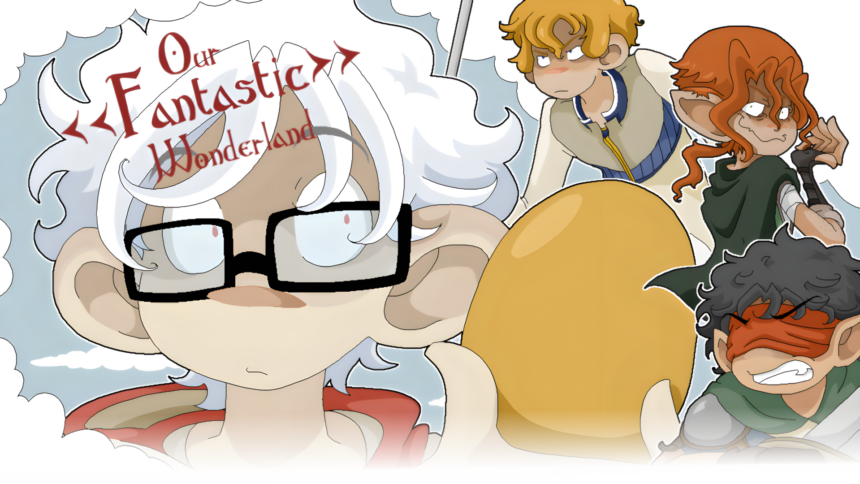
Somewhere between a Dungeons & Dragons one-shot and a proper campaign sits this side story, built with more chaos and tongue-in-cheek energy than the wider series it spins out of usually allows itself. Ignatius, a mild-mannered cleric better known to his friends as Iggy, sets out to return the Jewel of Happiness to the Sacred Altar. What should be a straightforward fetch quest turns into a gauntlet of increasingly absurd threats, tomato monsters, an overgrown hellspawn octopus, and a giant eyeball creature among them, that the game clearly relishes throwing at its own protagonist.
Iggy recruits a small party along the way. A foul-mouthed knight named Genzou, a scheming imp assassin named Orlam, and a stubborn prince named Ghent round out the core group, with all three doubling as romance options depending on which choices I made across the adventure. That dating-sim layer sits comfortably alongside the combat and comedy rather than competing with it, giving quieter character beats room to breathe between the more chaotic set pieces. A rabbit soldier named Jerry turns up as an ally here too, appearing in this side story before he ever shows up in the main series’ own later chapters.
Our Fantastic Wonderland is a side story built off Our Wonderland, a dark fantasy psychological horror visual novel told across five arcs, the first of which released back in 2021. Anyone coming to this cold, without background in that wider series, will still find a complete, self-contained story here. The connective tissue to the main timeline rewards anyone already invested in that cast with a few extra layers of context a newcomer simply won’t catch. That main series follows Iggy and a group of childhood friends who once found their way into a fantastical Wonderland together, only to return to it as unhappy adults years later. Each of them carries their own private grief into a place that remembers them very differently than they remember themselves.
Tonally, this is a real palate cleanser next to the horror and heavier psychological drama the main Our Wonderland games are known for, and that shift works in the game’s favor. Humor carries most of the writing, quick-witted banter between the party members, self-aware jokes about genre conventions, a rhythm to the comedy that suggests real confidence in a sillier register than the series usually allows itself. That said, the game doesn’t stay purely lighthearted throughout, and the late turn the story takes lands with real weight precisely because the earlier chapters worked so hard to earn my guard being down.
Carrot Patch Games, run solo by a developer who goes simply by Carrot, built this specifically for a Spooktober-themed visual novel jam in its fourth year running, releasing the finished game that September. Carrot handled the writing, scripting, art, and interface work alone, while sourcing supporting material from elsewhere rather than building every asset from scratch, backgrounds purchased from artist Minikle through DLsite, sound effects pulled from Freesound.org, and code templates contributed by Gouvernathor and tofurocks. A short list of beta testers, credited in-game as key, Jam, and Aural4444, helped shape the final release before it went out the door.
Presentation exceeds what a jam’s tight timeframe usually allows. The character art, backgrounds, and CGs carry real polish, though there’s no CG gallery to revisit those illustrations after the credits roll this time around, a missing feature a returning fan of the series is more likely to notice than someone coming in fresh. It’s the animation work that stands out most, fluid, expressive sequences that push well past what Ren’Py projects usually attempt, giving combat encounters a sense of motion and impact that a lot of higher-budget visual novels don’t bother chasing.
The score itself isn’t an original composition. It’s pulled from Audiostock’s licensed music library, with the specific tracks and their composers credited directly in-game rather than folded into a single anonymous soundtrack, and sound effects are sourced the same way from Freesound.org. That doesn’t stop the music from doing real work, propulsive during action beats and quieter where the character moments need room. Even a small touch like a rhythmic timing cue built into the end credits shows a level of care that outpaces the game’s jam origins. Nothing here is voiced, standard for a project this size, so all of that tonal work rests on the writing and the animation, and between the two, neither one drops the ball.
Ghent in particular carries more going on beneath the surface than a first playthrough necessarily reveals. I’m staying vague on details here, but anyone already familiar with the wider Our Wonderland cast will likely recognize more in his characterization than the surface-level stubborn-prince archetype lets on at first glance. Orlam’s own dynamic with the party plays notably gentler here than his reputation elsewhere in the series might suggest, banter with Genzou in particular landing as warm rather than the more unsettling register that character can carry in other contexts. Genzou himself gets to be the group’s loudest, most foul-mouthed presence without the story ever using that volume as a substitute for actual characterization. His sharper exchanges with Ghent specifically carry a rivalry that reads as more affectionate than the two of them would ever admit outright.
Verdict
Our Fantastic Wonderland delivers on exactly what it promises up front. It gives the Our Wonderland cast a lighter, funnier adventure without losing the emotional gut-punch that’s become the series’ signature, saving its heaviest beat for a late twist that earns its weight through the comedy built up around it. Iggy’s small party of allies, and the option to romance several of them, gives the D&D-pastiche structure real character stakes beyond the monster-of-the-week formula, and the animation work in particular punches well above what a solo-developed game jam entry usually delivers. It’s a shorter, more contained experience than the main series it spins out of. Newcomers will get a complete story out of it even without that context, but anyone coming in already invested in this cast will get the most out of what’s ultimately a confident, well-crafted side adventure.