The first piece of information I uploaded to Orwell seemed harmless. It was already sitting on a public webpage, available to anyone willing to look for it. Yet the moment I selected it, removed it from its original context, and placed it inside a government file, it stopped feeling harmless.
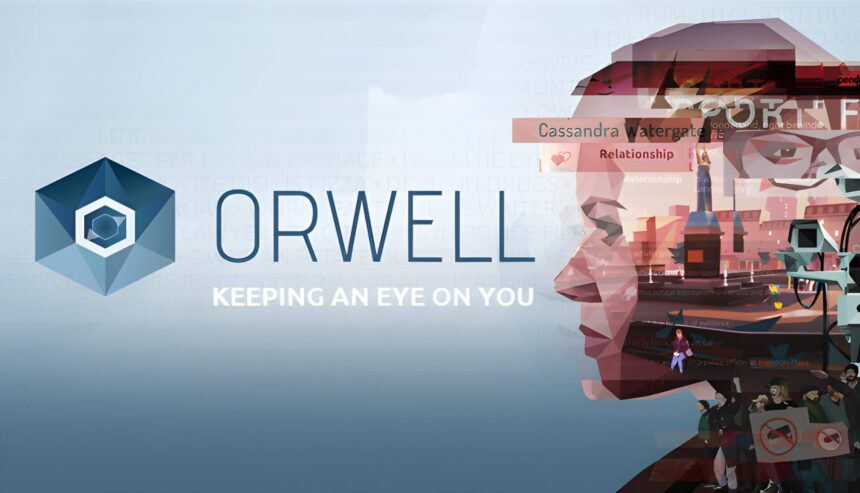
That transformation is the central mechanism of Orwell: Keeping an Eye on You. Developed by Hamburg-based Osmotic Studios, the game places the player behind a fictional government surveillance system capable of examining citizens’ public activity, private communications, personal computers, and confidential records. The player is selected from thousands of candidates to become Orwell’s first human researcher, just as an attack in Freedom Plaza rocks Bonton, the capital of a country known only as The Nation.
Orwell can gather enormous quantities of information, but it does not independently decide what the government should act upon. Human researchers are supposed to protect citizens’ privacy by reviewing what the system uncovers and forwarding only material they consider relevant. That arrangement makes the player both a safeguard and the system’s greatest vulnerability.
The investigation unfolds almost entirely through a computer interface. I searched news reports, blogs, social-media pages, dating profiles, and other public websites before gaining access to private chats, emails, computer files, and medical information. Relevant excerpts appear as selectable “datachunks,” and only the information I deliberately upload becomes available to the security forces.
That restriction is what gives the game its moral tension. Orwell may uncover two statements that contradict each other, but the system does not necessarily understand whether one was a joke, a lie, an outdated belief, or a sentence stripped of essential context. The player decides which version enters the official record. Once uploaded, information can influence how a person is perceived and what actions are taken against them.
An adviser named Symes guides the investigation from a panel beside the main interface. Osmotic’s own account of the interface-development process describes Symes as the game’s commenting and guidance feature, designed to remain visible without constantly interrupting the player’s work. In practice, his presence reinforces the distance between investigation and consequence: the player supplies information, while Symes and the authorities respond to what reaches them.
The people being investigated do not initially appear as complete characters. They emerge through fragments: a profile description, an old photograph, a private message, a professional record, or a conversation written for someone else’s eyes. Each source can alter the apparent meaning of another. A hostile statement may look different after reading the argument surrounding it, while an ordinary personal connection can appear suspicious once inserted into a terrorism investigation.
I found that process more uncomfortable than simply choosing between clearly marked moral options. The interface rarely asked me whether I wanted to be compassionate or cruel. It asked whether a particular sentence was relevant. That seemingly administrative decision could still shape a person’s file, and the consequences did not always match what I had intended.
The investigation gradually expands from its first person of interest into a network connected to Stelligan University and an activist group called Thought. Members of that network have their own friendships, disputes, political beliefs, and private histories, leaving the player to decide whether those connections constitute evidence or merely proximity to someone already under suspicion.
Because the story is presented through records and communications, investigation and characterization become the same activity. Reading someone’s correspondence advances the case, but it also reveals details that may have no legitimate connection to the attacks. The game repeatedly leaves the player holding information that is personally revealing yet only questionably useful.
Osmotic released the story as five weekly episodes beginning on October 20, 2016. The episodes were titled “The Clocks Were Striking Thirteen,” “A Place Where There Is No Darkness,” “Unperson,” “Memory Hole,” and “Under the Spreading Chestnut Tree.” The project’s original credited studio team consisted of game designer and producer Daniel Marx, artist and business lead Melanie Taylor, and programmer Michael Kluge. It was published through Surprise Attack Games, the company now trading as Fellow Traveller Games.
The studio described itself during development as a three-person game company based in Hamburg. Its use of the name Orwell and terms associated with Nineteen Eighty-Four is unmistakable, although the game tells an original story about digital surveillance, online identities, and modern information gathering rather than adapting George Orwell’s novel.
The complete first season is available on PC, Mac, iOS, and Android. Its reception also extended beyond conventional reviews: Orwell won Best Serious Game at the 2017 German Computer Game Awards, the Long Feature Award at A MAZE. 2017, Best Story and the Innovation Award at the 2017 German Developer Awards, and Best Social Impact Game at BIG Festival 2017. It was also nominated for Games for Impact at The Game Awards 2016 and was a finalist for Excellence in Narrative at the 2017 Independent Games Festival.
A second season, Orwell: Ignorance is Strength, began on February 22, 2018 and concluded with its third episode on March 22. Its story takes place parallel to the first season and adds tools that allow the player to influence public opinion as well as collect information. What stayed with me from the original game was not the quantity of information Orwell could retrieve. It was how little effort it took to convert that information into an official judgment. Selecting a datachunk required only a click, but the ease of the action made its possible consequences feel more unsettling rather than less.
Verdict
Orwell: Keeping an Eye on You builds its investigation around a precise and effective distinction: the surveillance system finds information, but the player decides what becomes evidence. Searching websites, intercepting communications, and examining private files are mechanically simple actions, yet deciding which excerpts to upload made me repeatedly question whether I was documenting a person accurately or constructing a misleading version of them. Its interface-driven storytelling turns surveillance into an exercise in selection, context, and responsibility, giving the player enough authority to understand why that authority should feel dangerous.