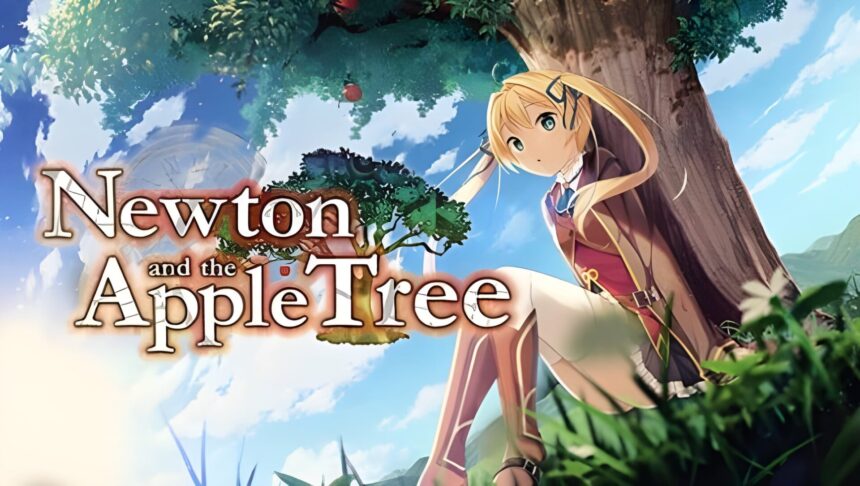
I picked this up planning to read for maybe an hour before bed. Four hours later, I was still going, laughing every few minutes at jokes that had no business still landing by then. Newton and the Apple Tree bets everything on one joke holding up for dozens of hours, and somehow it does. At the center of it all is Syuji Asanaga, who gave up on following his grandfather into physics years ago and settled instead into a street musician career he isn’t particularly good at. His grandfather, Asanaga Syuichiro, vanished on a trip to England without explanation. Everything changes when Syuji’s childhood friend, Yotsuko Utakane, receives a mysterious package from him, containing a key that happens to fit a Newtonian telescope. Touching it throws the two of them back to 1687, the exact year Newton’s Principia was published.
What they find waiting beneath the apple tree isn’t the historical Isaac Newton at all, but a young woman named Alice Bedford, who’s been using Newton as a cover identity. Syuji’s spectacularly clumsy arrival, quite literally crashing into the tree in front of her, interrupts the precise moment she was about to work out universal gravitation. That single mistake sets off a time paradox unraveling key points of history around them, and fixing what he broke while finding a way home becomes the mission driving everything that follows. I expected the paradox to fade into the background once the jokes took over. Instead, it kept resurfacing at exactly the moments I’d started to forget about it.
That mission plays out at a fictional English school called Tenbridge University, a fairly transparent Cambridge riff justified in-universe by the fact that it spans ten separate bridges. Rather than forcing a full restart each time, one heroine’s route flows directly into the next through a single choice made partway through, and pursuing every heroine’s story runs past twenty hours total, with more content unlocking once you’ve cleared them all. Five different women make up that cast, and each of them pulls Syuji’s reckoning in a different direction once her route begins.
Yotsuko carries a blunt, sharp-tongued energy as Syuji’s childhood friend, drawn into science herself after learning from his grandfather and obsessed with precise measurement above almost anything else, which makes her an entertaining contrast to Alice’s more theoretical, fact-first mindset. Where Alice works out every equation with patience, Lavi Gier, another genius inventor on campus, is perfectly happy to invent first and worry about the resulting fires later, treating Syuji more like a convenient test subject than someone she’s supposed to be falling for. I spent longer than I expected rooting for her to notice the difference. Haru Tsukumo, a fellow Japanese expatriate, brings a calmer, more caring presence to a cast otherwise defined by chaos, standing as the closest friend Alice actually has. Emmy Felton, meanwhile, works as a maid at Tenbridge to support her younger brothers, which makes her the one person in the cast who actually knows the campus and its people.
That friendship between Alice and Haru gives the story some of its most sincere moments, a bond that clearly matters to both of them well before either becomes central to a romance. Syuji’s own arc runs alongside it, forcing him to actually reckon with why he walked away from physics rather than letting the joke of the premise carry him past that question forever. My assumption going in was that the comedy would carry the whole experience. Instead, it’s the scenes built around Syuji’s history with his grandfather that actually earned my attention.
Balancing that kind of dramatic weight against jokes about a teenage-looking scientist accidentally undoing the discovery of gravity is a tightrope walk, and the game rarely looks like it’s about to fall. That balance is what keeps the joke from wearing thin over twenty-plus hours: Syuji’s reckoning with science and music gives the comedy something real to push against instead of floating free of consequence.
That same push and pull shows up visually too, in backgrounds that lean into a detailed, varied depiction of Old World England and in the personal touches that carry real character work of their own. Alice’s room, papers strewn everywhere from a mind that clearly outpaces her ability to stay organized, tells you who she is before she says a word, while Emmy’s potato-stocked room does the same for her more practical, working-class background. Character designer Bekotaro is credited with Alice’s design specifically, and it shows: that cluttered room adds a whole layer of personality to a character I’d already formed an opinion of from her dialogue alone.
Underneath all of it sit around fourteen music tracks, split between upbeat daily-life themes and a handful of more somber pieces for the heavier moments, and I noticed the same track loop back more than once across a long session without it ever grating on me. Every character except Syuji is voiced in Japanese, his own lines running instead as silent scrolling text, a choice that shifts real weight onto the other actors’ performances. Hearing Alice’s pride crack in her voice during one mid-route scene did more for that character than the script alone could have managed.
None of this happened by accident. Laplacian developed Newton and the Apple Tree in Japan, releasing it there in May 2017 before Sol Press crowdfunded a western release that pulled in over 88,000 dollars against a 31,200 dollar goal. The Steam release that followed in August 2018 offers both an all-ages version and an 18+ patch for those who prefer it, and I stuck with the all-ages read for this one. Robert Hooke, Newton’s real historical rival, turns up as a supporting character, grounding the time travel premise in actual history rather than leaving the central joke to carry that weight alone. The game has even picked up an academic footprint rare for its genre: a 2024 character affectivity case study in the Journal of Games Criticism took it seriously enough to study.
Verdict
Newton and the Apple Tree commits fully to its own absurd premise, and it backs that commitment with a script funny enough to carry twenty-plus hours without wearing out its welcome. Syuji’s reckoning with the science he walked away from gives the comedy a floor to stand on, and a cast this distinct, Lavi’s fire-prone impulsiveness next to Emmy’s quiet practicality, keeps every route feeling like its own story. Bekotaro’s character work and a voice cast that carries real weight despite a silent lead round out a package built by people who clearly loved the joke enough to see it all the way through.