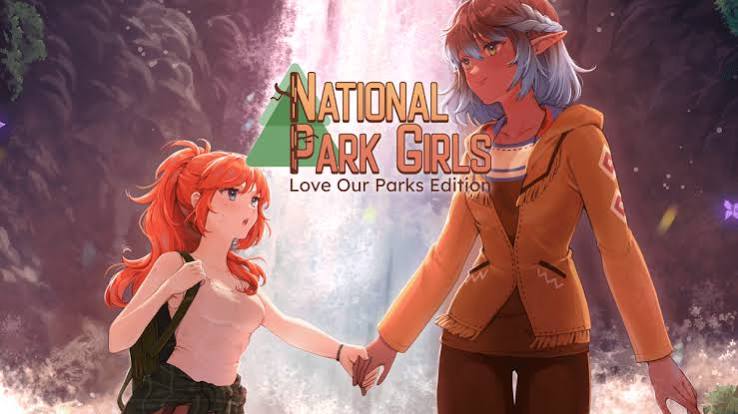
National Park Girls: Love Our Parks Edition stars Eve Aadams. She has spent five years as a ranger in Yosemite National Park, but careless visitors, irritating coworkers, and a tightening budget have worn down the enthusiasm that brought her there. After a stressful incident gets her transferred to a remote cabin post, she meets three girls claiming to be the living manifestations of Yosemite, Yellowstone, and Zion National Parks. The premise is ridiculous enough that I expected the joke to carry the opening. Instead, Eve’s burnout gives it something much sturdier to push against.
That contrast became one of my favorite parts of the writing. Eve is not an eager guide welcoming three magical visitors into her world. She is tired, irritable, and already questioning whether her work matters when these impossible girls force themselves into her routine. Yosemite can be cutting and difficult, Yellowstone brings a more playful energy, and Zion’s younger presence changes the rhythm again. Their differences keep the cabin from feeling like a collection of interchangeable cute characters, and Eve’s reluctance gives their growing familiarity somewhere to go.
The five-episode structure lets those relationships change without rushing them. Cabin Fever establishes the strange living arrangement, while Happy Trails gets Eve out on a reluctant hike with Yellowstone and begins digging further into where the girls came from. Daughter of Zion shifts attention again as Yosemite starts behaving unusually, and the two Eternal Evergreen episodes carry the larger story toward its conclusion. Reading all five inside one release made the progression feel much more natural than the original episodic format suggests. I could move straight from one stage of Eve’s life into the next without waiting years for the final pieces.
I also appreciated that the parks are more than names attached to character designs. Yellowstone literally carries a caldera on her head, and the supernatural details give the personification idea a visual language before the story has to explain everything. The bonus Fireside Chat material with Yellowstone and Zion pushes the connection further. Those segments step outside the main drama to spend time on national park information, and I liked the change of pace because it reminded me that the affection behind the premise extends to the actual places rather than stopping at anthropomorphized versions of them.
Satchely’s character and CG art carries that idea with an expressive, colorful cast, while Moorina is credited with character design and Umujacha with chibis and additional art across the earlier episodes. Background work involved Badriel alongside additional artists as the series expanded, and the complete release specifically highlights famous American landmarks among its rendered locations. I responded most to the moments where those landscapes were allowed to occupy real space on screen. A story about recovering affection for national parks needs the environment to feel worth caring about, and the backgrounds gave Eve’s frustration something beautiful to exist beside instead of leaving nature as an abstract cause she talks about.
Love Our Parks Edition also adds a new key visual by Konett while revising the older material with improvements to art, direction, and the interface. The Extras have been expanded as well, with CG and guest-art galleries joined by trivia. I spent more time with the trivia than I expected because it suits this particular story better than a generic bonus menu would. The complete edition feels less like five folders bundled together and more like an attempt to give the finished series a proper home. Sarah Mancuso’s music helps enormously with that cohesion. She composed the score across the series, and the soundtrack moves comfortably between the quieter cabin material and the more emotionally loaded stretches without making the natural setting feel overly grand. Episode 1 also includes “Broken Wings,” composed by Mancuso with lyrics by Syon Abernathie and vocals by Lisa Reimold, while Episode 3’s “50 States of Impermanence” pairs Mancuso’s composition with lyrics and vocals by Wyatt Abernathie. Those vocal pieces gave me memorable breaks from the instrumental score because they arrive as part of individual episodes rather than being treated as interchangeable theme music.
The English voice cast gave the park girls just as much separation as the artwork. Natalie Van Sistine voices Eve, Rachael Messer plays Yosemite, Jill Harris voices Yellowstone, and Lisa Reimold handles Zion, with Daisy Guevara as Jessie Hayvers and Freddie Heinz among the supporting performers. Eve benefited most from being fully voiced for me. Her frustration could have become exhausting if every complaint landed at the same intensity, but Van Sistine gives her enough variation that irritation, fatigue, embarrassment, and softer moments do not blur together. Messer, Harris, and Reimold then make the three manifestations sound distinct enough that even scenes built around everyone sharing the same space remain easy to follow.
Syon Abernathie directed and wrote the series, with Josh Kaplan joining as a writer on Episode 2, while Kari Tuberville handled programming and Lisa Reimold worked as sound engineer. The project originally came from Studio Coattails, with Sekai Project publishing the earlier episodes. Studio Coattails officially merged with Studio Élan in October 2022, and the final episode, Eternal Evergreen Part 2, arrived under Studio Élan on September 8, 2023. That long production history is unusually visible in the episode credits, where additional artists and production roles shift as the series grows.
The definitive version arrived on January 31, 2025. Rather than keeping the five episodes separated, Studio Élan turned the existing release into National Park Girls: Love Our Parks Edition, giving owners of Episode 1 the complete game and making this the version available going forward. It runs on Windows, macOS, and Linux, includes 27 Steam achievements, and retains full English audio. Simplified Chinese text was added in July 2025, alongside an accessibility option that displays audio cues describing music and other sounds. The same update improved self-voicing support for journal entries, while an earlier March patch added a clearer warning for animal violence.
Those later accessibility changes fit a release that has received meaningful work after the story itself was already complete. I particularly liked the audio-cue idea because it does more than indicate that sound is occurring. The notifications identify audio and its channel, turning part of the soundtrack and sound design into readable information. It is the kind of addition I would have been happy to see at launch, but I was glad the definitive edition kept changing instead of being treated as finished the moment all five episodes were placed together.
Across those episodes, Eve’s exhaustion remained the part I cared about most. The supernatural premise keeps finding stranger ways to complicate her life, yet her starting problem is painfully ordinary. She wanted to protect something, discovered that caring did not make the work easier, and reached the point where disappointment began replacing purpose. I did not need the story to make her love her job again immediately. Letting her relationships with Yosemite, Yellowstone, and Zion slowly challenge the way she sees the parks gave that emotional movement enough time to feel earned without reducing burnout to a problem a few cheerful conversations can fix.
Not every comic beat worked equally well for me, especially when the sillier exchanges arrived close to material where Eve’s frustration had finally become more interesting. The series can move abruptly between absurd supernatural comedy and more reflective character writing. Over five episodes, though, I became more comfortable with that unevenness because the characters themselves provided continuity. The immediate problem could change and the focus could shift from one park girl to another, but Eve’s relationship with the work she once cared about kept pulling everything back toward the same emotional center.
Verdict
National Park Girls: Love Our Parks Edition worked for me because Eve’s burnout gives its strange personification premise a reason to matter beyond the joke. Yosemite, Yellowstone, and Zion gradually turn a remote posting into something Eve can no longer treat as just another miserable assignment, while Satchely’s art, Sarah Mancuso’s music, the full English cast, and the landmark backgrounds give that change plenty of personality. The tonal jumps occasionally caught me at the wrong moment, but five episodes give the story enough room to make Eve’s changing relationship with her work feel patient rather than convenient. I came away remembering the tired ranger at the center of it more than the novelty of national parks becoming people.