Some stories get told so often that the reveal stops functioning as a reveal at all, and adapting one of those stories well means finding tension somewhere other than the secret everybody already knows. You might know the ending of this story but trust me when i say you’re still going to enjoy the ride to that destination. In this story, Gabriel John Utterson spends most of his waking hours worrying about his old friend Henry Jekyll, and that worry pulls him into the fog-choked streets of 19th century London, chasing down a man named Hyde who seems to hold some strange leverage over the doctor’s life. MazM: Jekyll and Hyde puts you in Utterson’s shoes for that investigation, and then, in a choice the original novella never gives a reader, lets you step directly into Hyde’s own perspective as well, watching the same events sour from the other side.
Growing Seeds, the Korean studio behind it, built this as the second entry in their MazM series, a run of classic literature adaptations that started with The Wonderful Wizard of Oz and later grew to include The Phantom of the Opera. Jekyll and Hyde first reached mobile devices through publisher CFK in the summer of 2018, and Steam and Nintendo Switch picked it up on April 2, 2020, carrying an ESRB rating of E for Everyone with a Mild Blood descriptor on that release. I went in braced for a straightforward Victorian ghost story. What I got instead spent nearly as much time in Hyde’s head as it did in Utterson’s, and that decision alone kept me more off balance than I expected.
Progress runs through letters, case notes, and personal testimonies that Utterson pieces together into a timeline, and the game lets you carry a piece of new information back to an earlier location to unlock a scene that wasn’t accessible before. Minigames built around puzzle solving and code entry break up the reading, and the whole thing plays out at a fixed diagonal camera angle that gives every location the same stage-like framing. None of the puzzles gave me much trouble. A couple of frame-rate stutters did show up whenever a scene cut from dialogue into one of those minigames, small reminders that this started life as a mobile game before it reached a bigger screen.
Stevenson’s original text stays mostly intact here, with new scenes added that the novella only ever implies, giving Hyde’s cruelty an unsettling shape well beyond a passing description on the page. Enfield, a distant relative of Utterson who stumbles into one of Hyde’s worst moments firsthand, and Poole, the butler who has served Jekyll loyally for twenty years and starts sensing something wrong long before his employer will admit it, both ground the mystery in people who feel like they have their own stakes in it rather than furniture for Utterson to interview. Watching Hyde’s temper flare over something as small as a bump on a crowded street unsettled me more than any single dramatic set piece did, mostly because the game never lets you look away from how casually he escalates.
Dr. Lanyon gets one of the story’s most unnerving stretches, an old friend of Jekyll’s whose steady, rational worldview starts cracking the moment he witnesses something in Jekyll’s laboratory that he cannot explain away. I won’t describe what he sees or what it costs him afterward, only that the game lingers on his reaction long enough that his horror became more upsetting to me than anything Hyde does directly.
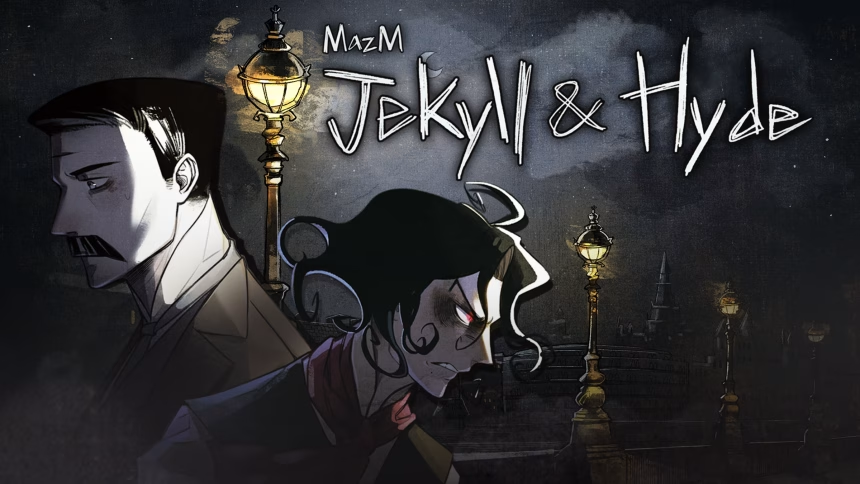
A sketchy, ink heavy style carries most of the visual load, reading like a gothic picture book brought to life, and it suits Victorian London better than a cleaner, more polished style would have. Character portraits and full screen stills carry most of the emotional weight, sliding between stoic and outright unnerving depending on the scene, though the character models themselves stay mostly static and rarely interact with the environment around them, which occasionally undercuts a tense moment more than the art style deserves.
Slow, quiet cues carry most of the investigation, letting the mystery breathe instead of rushing toward answers, then tightening up whenever a scene pushes toward its most dangerous moments. It does not always land. A couple of cues felt mismatched to what was happening on screen, undercutting tension in scenes that needed it most, though the quieter, more deliberate stretches of the score are exactly the mood this story needed.
None of it is voice acted. Every supported language, ten in total including English, Japanese, Korean, and both Chinese scripts, gets interface text and subtitles only, so the mood rests entirely on the writing, the art, and that slow-building score doing their job together. That absence actually worked in the game’s favor for me. Nothing was performing Lanyon’s horror on my behalf, so I had to sit with it and fill it in myself, and it stuck with me longer because of that.
One location hides a poster that resembles promotional art for The Phantom of the Opera, a quiet nod to another MazM adaptation of Gaston Leroux’s novel, and finding it felt like catching a stranger’s inside joke rather than a marketing plug. I won’t say how Utterson’s investigation resolves or what it costs the people caught up in it, only that the story earns its dread honestly, building it scene by scene rather than leaning on the fact that most players already know where a story called Jekyll and Hyde has to end up.
Verdict
MazM: Jekyll and Hyde takes a story most players already know the shape of and still finds real dread in getting there, with Enfield, Poole, and Lanyon each grounding Utterson’s side of the investigation in stakes of their own. The expanded scenes around Hyde’s cruelty and the letters-and-testimony structure give that investigation real weight, even with a mobile pedigree showing through in the puzzles and the frame rate. For a story most of us already know the ending to, finding new dread in it is no small feat.